


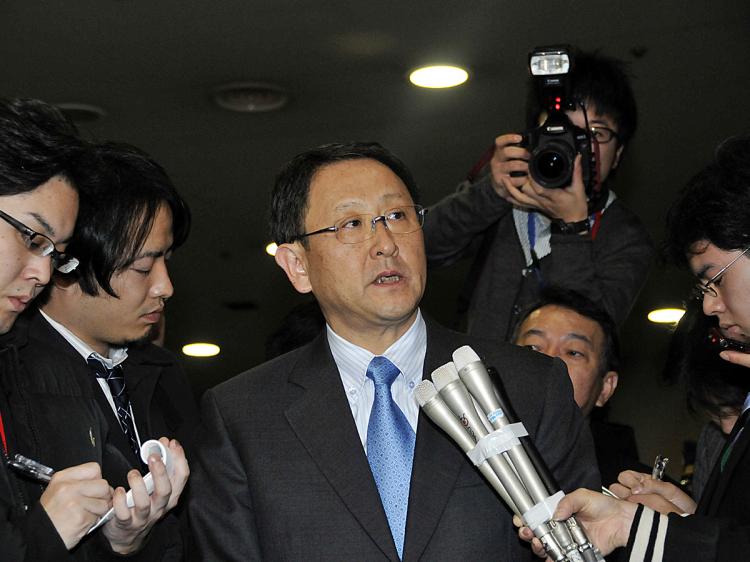
NEW YORK—Toyota Motor Corp. this week attempted to refute a study presented to Congress last month that suggested the sudden acceleration issues in its vehicles are due to electronic failures.
Professor David Gilbert, an auto engineering professor at the Southern Illinois University, said in an ABC report and testified in Congress last month that he had found a problem within the electronic throttle system in Toyota vehicles that could be the cause of its sudden acceleration problem—one of the issues that forced the world’s largest automaker to issue a massive safety recall during the last three months.
In a news conference this week, the Toyota City, Japan-based Toyota tried to ease consumer and investor concerns by stating that the driving conditions under which Gilbert conducted his tests were unrealistic, and that the company’s electronic controls were working as intended.
In a separate announcement, Toyota is reportedly planning a recall of 2004-2009 model year Prius hybrid vehicles to fix floor mats that could pin down gas pedals, forcing the cars to accelerate uncontrollably. The Wall Street Journal first reported the plan.
The plan was unveiled after an incident on Monday in San Diego, California where a Prius accelerated uncontrollably. A state highway patrol officer helped the driver bring the car to a stop. According to Toyota, the recall was already planned but unannounced, and had nothing to do with the California incident.
“The analysis of professor Gilbert’s demonstration establishes that he has reengineered and rewired the signals from the accelerator pedal,” Toyota said in a statement. “This rewired circuit is highly unlikely to occur naturally and can only be contrived in a laboratory. There is no evidence to suggest that this highly unlikely scenario has ever occurred in the real world.”
Toyota cited an outside review by an engineering professor from Stanford University and a third-party consulting firm named Exponent to discredit its critic.
Mike Michels, a Toyota company spokesperson, said ABS and Gilbert “made a rush to judgment.”
Toyota is facing criticism over its handling—and the efficacy of its fix—for the unintended acceleration issue. The U.S. National Highway Traffic Safety Administration is currently investigating several claims by Toyota owners stating that their vehicles continued to accelerate uncontrollably even after the vehicles have been fixed by Toyota dealerships.
Toyota faces dozens of lawsuits from current owners and those who claimed to have been injured by defective Toyota vehicles. Late last month, Toyota President Akio Toyoda appeared before the House Oversight Committee and testified that the company is doing everything in its power to restore customer confidence and fix the problems it identified.
The company, known for its reliability and quality, has seen its reputation take a nosedive in recent months, according to vehicle sales data and prospective buyer sentiment.
Reports indicate that Exponent was hired directly by Toyota, and that the company provided financial assistance to the Stanford professor to conduct his research. In addition, Safety Research and Strategies, an auto safety organization that has been critical of Toyota’s handling of its recalls, helped fund Gilbert’s research, according to records obtained by Reuters.
So far, Toyota has recalled more than 8 million vehicles worldwide due to issues related to sudden acceleration, floor mats, brakes, and steering, in one of the largest automotive recalls in history.
Professor David Gilbert, an auto engineering professor at the Southern Illinois University, said in an ABC report and testified in Congress last month that he had found a problem within the electronic throttle system in Toyota vehicles that could be the cause of its sudden acceleration problem—one of the issues that forced the world’s largest automaker to issue a massive safety recall during the last three months.
In a news conference this week, the Toyota City, Japan-based Toyota tried to ease consumer and investor concerns by stating that the driving conditions under which Gilbert conducted his tests were unrealistic, and that the company’s electronic controls were working as intended.
In a separate announcement, Toyota is reportedly planning a recall of 2004-2009 model year Prius hybrid vehicles to fix floor mats that could pin down gas pedals, forcing the cars to accelerate uncontrollably. The Wall Street Journal first reported the plan.
The plan was unveiled after an incident on Monday in San Diego, California where a Prius accelerated uncontrollably. A state highway patrol officer helped the driver bring the car to a stop. According to Toyota, the recall was already planned but unannounced, and had nothing to do with the California incident.
A ‘Rush to Judgment’
“The analysis of professor Gilbert’s demonstration establishes that he has reengineered and rewired the signals from the accelerator pedal,” Toyota said in a statement. “This rewired circuit is highly unlikely to occur naturally and can only be contrived in a laboratory. There is no evidence to suggest that this highly unlikely scenario has ever occurred in the real world.”
Toyota cited an outside review by an engineering professor from Stanford University and a third-party consulting firm named Exponent to discredit its critic.
Mike Michels, a Toyota company spokesperson, said ABS and Gilbert “made a rush to judgment.”
Toyota is facing criticism over its handling—and the efficacy of its fix—for the unintended acceleration issue. The U.S. National Highway Traffic Safety Administration is currently investigating several claims by Toyota owners stating that their vehicles continued to accelerate uncontrollably even after the vehicles have been fixed by Toyota dealerships.
Toyota faces dozens of lawsuits from current owners and those who claimed to have been injured by defective Toyota vehicles. Late last month, Toyota President Akio Toyoda appeared before the House Oversight Committee and testified that the company is doing everything in its power to restore customer confidence and fix the problems it identified.
The company, known for its reliability and quality, has seen its reputation take a nosedive in recent months, according to vehicle sales data and prospective buyer sentiment.
Reports indicate that Exponent was hired directly by Toyota, and that the company provided financial assistance to the Stanford professor to conduct his research. In addition, Safety Research and Strategies, an auto safety organization that has been critical of Toyota’s handling of its recalls, helped fund Gilbert’s research, according to records obtained by Reuters.
So far, Toyota has recalled more than 8 million vehicles worldwide due to issues related to sudden acceleration, floor mats, brakes, and steering, in one of the largest automotive recalls in history.


