

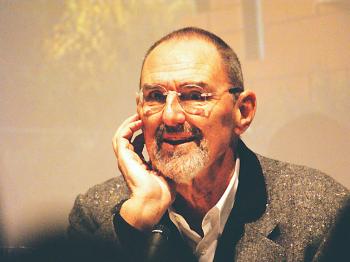
Architect Thom Mayne decided early on not to worry about aesthetics. Instead, his work is steeped in solving problems, putting together an incredible group of solutions to create buildings that are like organisms.
“Whether we like it or don’t like it, who cares? Does it operate in an interesting way? Does it take you some place in your brain? We should be focused on issues that are of some substance that represent a connective tissue,” Mayne said. He was speaking at the “Landmarks in 21st Century American Architecture” function in the New York Center for Architecture, March 5, 2009.
The Fed. Building
The 2005 winner of the Pritzker Prize has begun a collection of edifices in different cities that personify a movement that is more about function than form. The Federal State building in San Francisco, completed in 2007, was designed to consume less than half the power of a standard office tower. The building has no air conditioning, rather relying on an intricate system of a steel screen, opening windows, undulating concrete ceilings, and glass fins to create natural ventilation.
“This was a gutsy building. I wanted some sort of invention, and that non-repeatability,” Mayne said.
Despite its inherently energy-saving nature, the building failed the Leadership in Energy and Environmental Design (LEED) certification that is designed to rate buildings on their sustainability.
“We did this building and it was super-green. And we became greener than green because we out-greened the green guys,” Mayne said. He is supportive of the LEED program, he said, but a set of rules means architects often then restrict themselves. “The architects just then follow a checklist.”
Not one to follow a checklist, Mayne tends break norms rather than follow them.
“If it’s actually disgusting to you, it’s actually very important—everybody needs buildings they absolutely despise in the city–that’s what cities are about, right?”