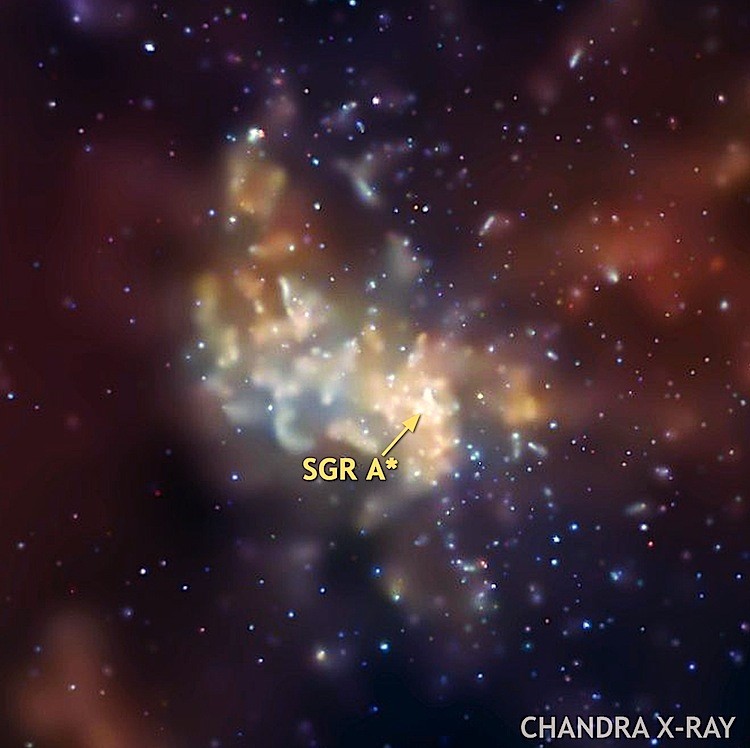
Final proof for the black hole at the heart of our galaxy arrived exactly 10 years ago on Sept. 5, 2001, when NASA’s Chandra X-ray Observatory detected a powerful burst of energy around 26,000 light-years from Earth.
The findings, published in Nature, allowed scientists to estimate the size of the Milky Way’s black hole, called Sagittarius A* (pronounced "A-star") or Sgr A* for short. It is believed to be about 4 million times the mass of our sun.
2011 has been an important year for advances in black hole research. Intense radiation spotted by NASA’s Swift satellite on March 28 revealed that a black hole was awakening from its slumber at a galactic center in the constellation of Draco around 3.9 billion light-years away.
Now known as Swift J1644+57, studies of the powerful energy it emitted have revealed the monster was devouring a star, the first time this process has actually been observed. The results suggest it could have twice the mass of Sgr A*.
Just over one week after the radiation burst, the controversial Templeton Prize went to Lord Martin Rees, Professor of Cosmology and Astrophysics at the University of Cambridge in England.
The theoretical astrophysicist won the prize on April 6 for his exceptional contribution to affirming life’s spiritual dimension.
His research into the nature of black holes, the implications of the big bang, and other concepts such as the multiverse have pushed the boundaries of our understanding of the physical processes that define the cosmos.
Dr. John M. Templeton, Jr., president and chairman of the John Templeton Foundation, said Rees qualified for the award due to the questions he inspires.
“The questions Rees raises have an impact far beyond the simple assertion of facts, opening wider vistas than any telescope ever could,” Templeton said at the news conference for the award.
“By peering into the farthest reaches of the galaxies, Martin Rees has opened a window on our very humanity, inviting everyone to wrestle with the most fundamental questions of our nature and existence.”
Also in April, the development of a device that shows how the fabric of space-time warps around black holes was reported in the New Scientist.
Namely, relatively simple patterns of "tendex" (stretching and compressing forces) and "vortex" (twisting forces) lines show how gravity deforms space, and provide insights into phenomena such as black hole mergers and superkicks when black holes may be ejected from their host galaxies.
Last month, Chandra was back in the news again with elucidation of a pair of supermassive black holes at the heart of a spiral galaxy only 160 million light-years away, making them the nearest known binary black holes to our planet.
For an amusing explanation of the tidal forces of a black hole, watch this video of American astrophysicist, director of the Hayden Planetarium, describing the process of "spaghettification" or death by black hole gravity!