This copy is for your personal, non-commercial use only. Distribution and use of this material are governed by our Subscriber Agreement and by copyright law. For non-personal use or to order multiple copies, please contact The Epoch Times Reprints.

The Epoch Times
The Epoch Times
AD
The Epoch Times
Social Media

Personal Data Surveillance of Smartphone Users Through Apps Is Overlooked: Cybersecurity Adviser

Google LogoMark Us Preferred on Google
Personal Data Surveillance of Smartphone Users Through Apps Is Overlooked: Cybersecurity Adviser
This illustration picture shows social media applications logos from Linkedin, YouTube, Pinterest, Facebook, Instagram, and Twitter displayed on a smartphone in Arlington, Va., on May 28, 2020. Olivier Douliery/AFP via Getty Images
Ella Kietlinska
Ella Kietlinska
Reporter
11/6/2020|Updated: 11/6/2020

Collecting personal information from internet users through social media apps in order to promote certain products to those users or influence their voting for a presidential candidate gets overlooked, said Rex Lee cybersecurity and privacy adviser.

Mobile apps such as Facebook or Twitter apps can be used to collect personal data including “emails, email attachments, photos, and instant messages,” Lee said in a recent interview on Epoch Times’ Crossroads program.

However, a lot of people are unaware of the fact that even if the user is not on the social media platform these apps can still explore and gather their personal data, Lee added.

“Most of the information collected on the end-user has nothing to do with the end users use of the app or platform,” Lee said, moreover “the apps are programmed to take control over” the camera and microphone of the phone, as well as all phone’s sensors such as GPS or near field communications chip which allows the user to make payments with a smartphone.

Therefore tech companies “can conduct audio, video, and physical surveillance on the end-user 24 by seven 365 days here, while collecting the end-users sensitive user data through the app itself,” Lee said, adding that even if a user deletes their Facebook or Twitter account but do not deactivate the app on the phone, that app is still running and can surveil and collect sensitive data.

Government agencies such Federal Trade Commission (FTC) need to enforce existing consumer protection and privacy laws as well as child protection and privacy laws, Lee said.
On October 28, Rep. Greg Steube (R-Fla.) unveiled legislation that would require big tech companies to adhere to the “First Amendment standard for their content moderation practices.” The bill would limit the immunity the companies have when they restrict speech or censor certain content, allowing for more accountability.
Lawmakers should focus not only on the social media platforms operating as publishers and censoring information but also on how much personal information has been collected by these platforms in order to suggest the user buying a certain product or voting for a certain presidential candidate, Lee said.

Consumer Privacy Rights Are Not Protected

Tech companies can collect person’s data utilizing their subscriber account data with Facebook, Google, Amazon, Twitter, or TickTock when the person is on their platform, Lee said, however, personal data is collected mostly when the user is off the platform.

It is possible to mine data off the platform because the terms of use of Facebook or Twitter platforms are separated from the terms of use of their apps, Lee said.

“These apps and platforms are supported by two sets of terms of use, one is published, and then one is unpublished, and hidden in the device.”

Legal statements associated with permissions to grant apps access to the camera, microphone, and other phone features are “hidden in the device and not published online within your online privacy policies, terms and conditions, and end-user licensing agreements,” Lee said. He provided examples of such permission statements for Android devices. These permissions apply to all apps on an Android device, Lee said.
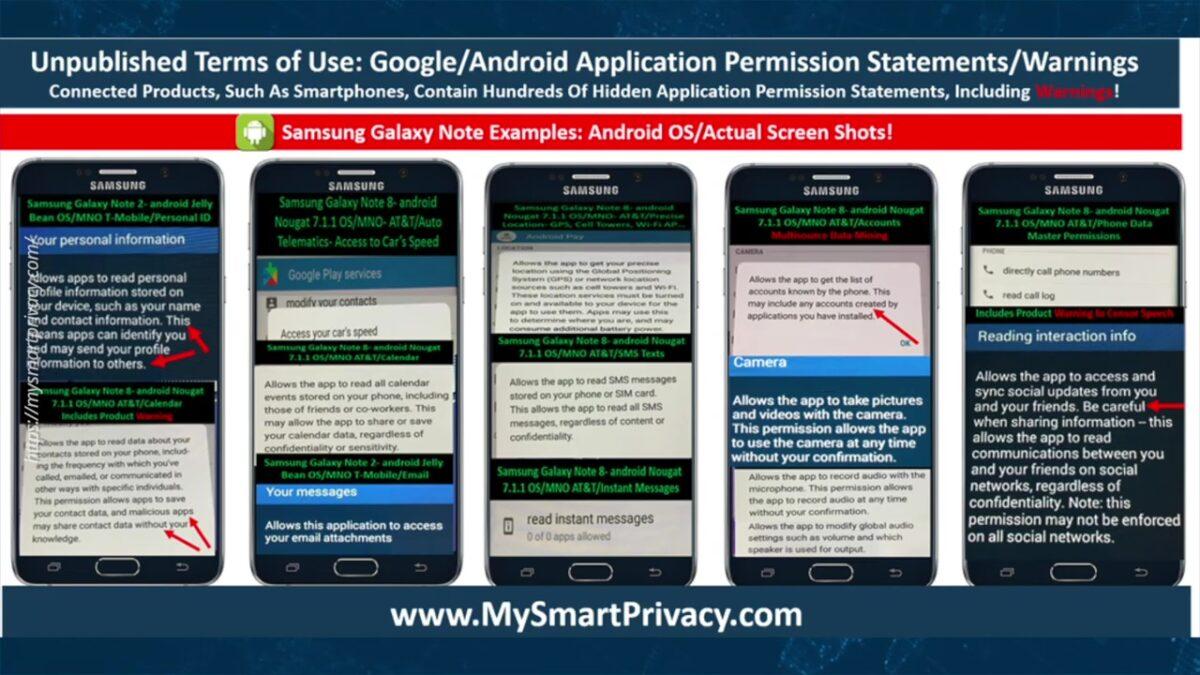
Sample permission statements on Android phones (Crossroads screenshot)
Sample permission statements on Android phones Crossroads screenshot

Lee also pointed out that “the apps are intentionally developed to be addictive, even at the expense of the end-user safety” and this was publically admitted by Sean Parker, co-founder of Facebook, and Tristan Harris, a former lead product designer for Google.

Parker told Axios in an interview in November 2017, “the thought process that went into building these applications, Facebook being the first of them ... was all about: How do we consume as much of your time and conscious attention as possible?”

“I don’t know if I really understood the consequences of what I was saying, because [of] the unintended consequences of a network when it grows to a billion or 2 billion people ... it literally changes your relationship with society, with each other ... it probably interferes with productivity in weird ways. God only knows what it’s doing to our children’s brains,” Parker said.

Harris wrote in 2016 in his article for Observer, “The average person checks their phone 150 times a day. ... One major reason why is the #1 psychological ingredient in slot machines: intermittent variable rewards ... [a]ddictiveness is maximized when the rate of reward is most variable.”
Joshua Philipp contributed to this report.
Google LogoMark Us Preferred on Google
Ella Kietlinska
Ella Kietlinska
Reporter
Ella Kietlinska is an Epoch Times reporter covering U.S. and world politics.
Author’s Selected Articles
EU Sets Deadline for Member Countries to Apply New Migration, Asylum Law
Jun 19, 2024
EU Sets Deadline for Member Countries to Apply New Migration, Asylum Law
US and Poland Launch Center to Counter Russian Disinformation
Jun 12, 2024
US and Poland Launch Center to Counter Russian Disinformation
EU Elections: The Winners and the Losers
Jun 09, 2024
EU Elections: The Winners and the Losers
EU Elections Will Not Drastically Change Status Quo in Brussels: Expert
Jun 09, 2024
EU Elections Will Not Drastically Change Status Quo in Brussels: Expert
Related Topics
privacy rights
app
personal information
personal data
AD
Add to My List
Save
The Epoch Times
Copyright © 2000 - 2026 The Epoch Times Association Inc. All Rights Reserved.