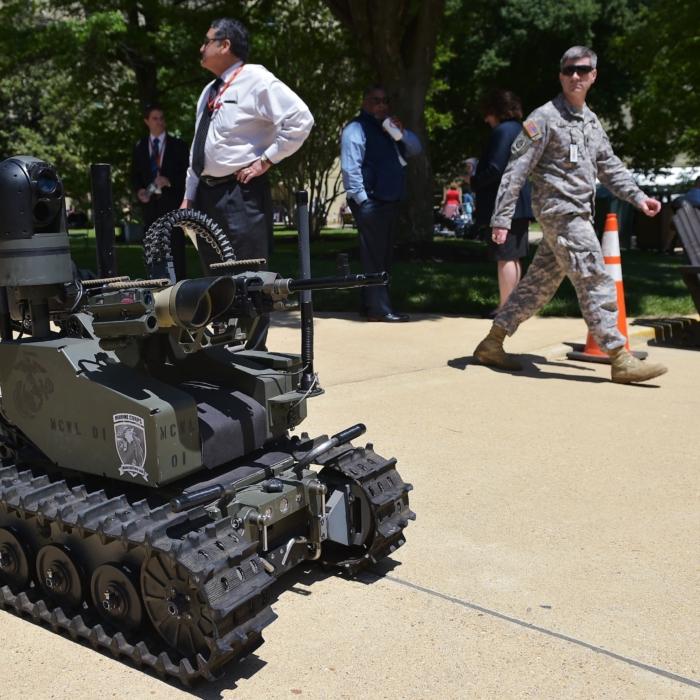
San Antonio International Airport’s security team is about to get a new member, an autonomous security robot known as the K5 model, which will respond to alarms at improperly opened doors in secure areas, as required by regulation.
During the discussion session, San Antonio Director of Airports Jesus Saenz Jr. told the council the K5 will start work sometime in the next two months and will be used only in secure, non-public indoor areas and not for surveillance purposes. According to Mr. Saenz Jr., the airport frequently experiences staff tripping alarms connected to the doors.
“Daily, we have door alarms that are opened inappropriately, inaccurately, or by accident, and it requires a response, based on the federal regulations that we have to adhere to, to maintain an overall security posture of the airport,” he said.
The plan is to have the K5 near doors where alarms are frequently triggered so it can respond and record what’s happened with its cameras. Then, an airport employee in the command center can make the call on what the appropriate response will be.
Mr. Saenz Jr. thinks using the K5 will make the airport “more efficient and effective” because employees will no longer have to be on guard in spots where alarmed doors are frequently triggered. He also said the robot’s presence might deter unauthorized people from trying to access restricted areas in the first place.
Initially, the robot will reportedly have another employee as a handler.
Council member Cabello Havrda expressed support for the pilot program.
Some Council Members Worried About Privacy, Replacing Employees
Not everyone was on board with employing the K5, though. Three of the ten council members voted against getting the robot. Jalen McKee-Rodriguez, a council member representing San Antonio’s second district, voted against the contract and said he had concerns about future use for surveillance, and the collecting and storing of data that may pose a privacy threat.“It’s not your intention to create a space where surveillance is happening, but if the robot has the ability to collect data and information and transmit that, that possibility remains. That door is open,” he said.
“Because we know that conditions change in five years, ten years, and I don’t want to be responsible via my vote for whatever happens then,” Mr. McKee-Rodriguez added.
New York City also adopted a pilot program for the K5 last year but had to cut it short earlier this month because the robot needed babysitting by a human employee. At this stage, New York City Mayor Eric Adams’s office has said it is exploring the “next deployment” for the robot.
At the same time, Teri Castillo, another San Antonio council member against the K5, was also concerned about robot development potentially replacing the jobs of other airport employees.
Mr. Saenz Jr. said that in this case, it would not impact employees and would only act as a way to supplement security already in place.
“This is a supplement to our staff to ensure that we are moving in the right direction, to improve our efficiency and our effectiveness and response time to what we’re doing,” he said of the plans for the airport.
Mr. McKee-Rodriguez said he remained concerned about the wider social trend toward engaging autonomous robots.
“The robots’ presence raise concern about privacy and racial profiling throughout the country,” he said. “That’s a foundational concern I have with these robots and devices. I believe we’re opening a door that should remain closed.”
“Many other cities across the country have purchased these devices from Knightscope with a goal to be innovative but they have proven ineffective and in many cases dangerous, leading them to end their contracts.”
An incident in July of 2016 saw the robot’s competency questioned.
Knightscope called this a “freakish accident” and apologized to the family.