Supernova Factory Spotted in Distant Galaxy

September 30, 2011 Updated: October 1, 2015

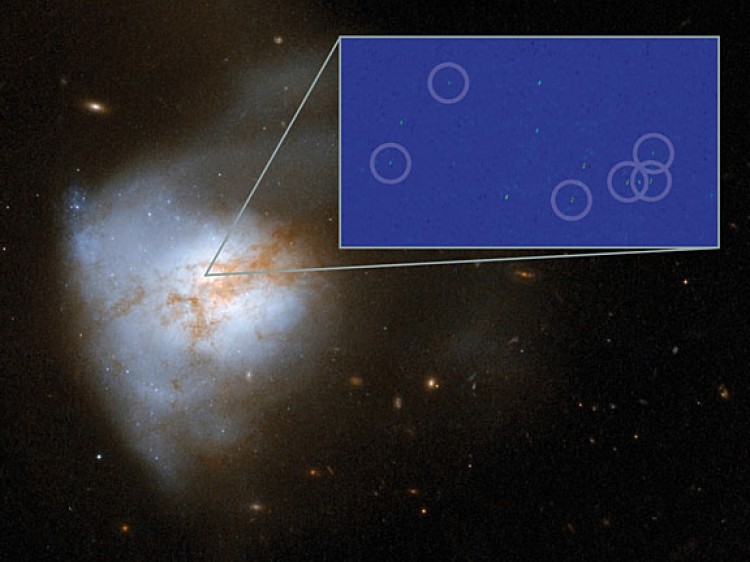
Galaxy Arp 220 (main image, taken with the Hubble Space Telescope) with some of its newly discovered supernovae (inset, taken with Global VLBI). The inset image is 250 light years across. (NASA, ESA, Hubble Heritage Team, Chalmers )
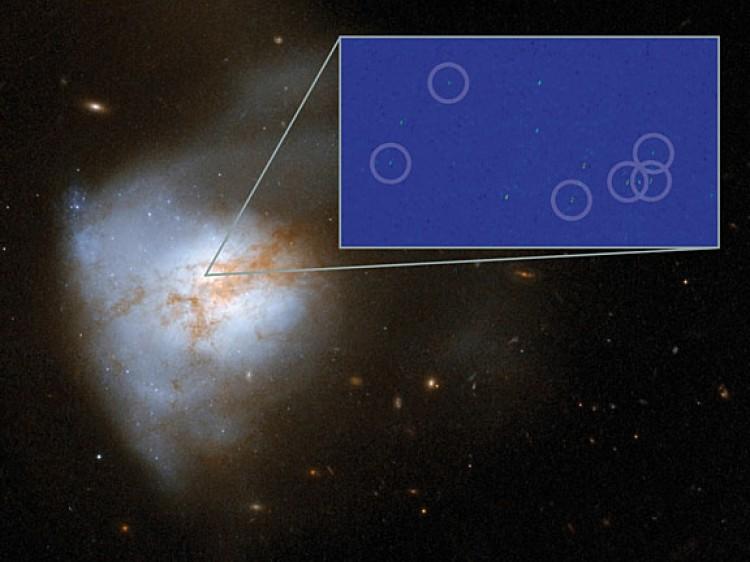
Seven new supernovae have been discovered in the ultra-luminous infrared galaxy Arp 220, 250 million light-years away from Earth. This is the highest number of stellar explosions found simultaneously in the same galaxy.

An international team of astronomers detected about 40 sources of radio wave emission using various telescopes around the world, and observed variations in the radiation over several years.

"With all the data in place, we can now be certain that all seven of these sources are supernovae: stars that exploded in the last 60 years," said lead author Fabien Batejat, of Denmark’s Onsala Space Observatory (OSO), in a press release.

With one star exploding every 25 years on average, Arp 220 demonstrates far more supernova activity than the Milky Way, where there is approximately one explosion seen per century.

"Arp 220 is well-known as a place where star formation is very efficient," said co-author John Conway, also of OSO, in the release.

"Now we have been able to show that star factories like this are also supernova factories," he says.

The rate of explosions is consistent with the rate of star formation in Arp 220, confirming a long-held astronomical belief that galaxies with a high rate of star formation are also supernova factories.

The data also revealed to the team how radio waves are generated by supernovae.

"Our measurements show that a supernova’s own magnetic field is what gives rise to its radio emission, not the magnetic fields in the galaxy around it," said Batejat.

The findings will be published in the Astrophysical Journal.