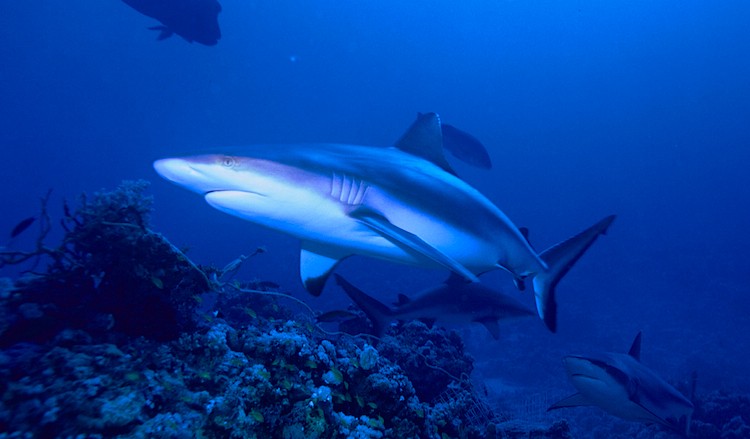
"There is mounting evidence of widespread, substantial, and ongoing declines in the abundance of shark populations worldwide, coincident with marked rises in global shark catches in the last half-century," the researchers write in their article, published in PLoS ONE on Sept. 23.
"Consequently, overfishing of sharks is now recognized as a major global conservation concern, with increasing numbers of shark species added to the International Union for the Conservation of Nature’s list of threatened species," they continue.
Measuring changes in shark populations is complicated. The basic approach of studying trends in fisheries catches does not yield useful results for sharks.
"First, many countries with coral reefs don’t keep reliable records of catches or fishing effort," said co-author Sean Connolly at James Cook University (JCU) in a press release.
"Second, around 75 per cent of the world shark catch consists of illegal and unreported finning," he added. "Third, sharks may be caught, discarded, and not reported when fishers are targeting other species."
Alternatively, estimates of shark growth, birth, and death rates can be used to calculate population growth rates. However, it is difficult to accurately estimate shark mortality rates.
The researchers created several models based on shark birth and growth rates, and introduced different methods to estimate mortality, which were adjusted using statistics. They thus developed a more robust long-term population prediction method for two shark species on the GBR—whitetip and grey reef sharks.
The team applied the approach to several fished and unfished reefs to explain variation in shark abundance, according to the length of time the unfished reefs had been protected for. The results from all methods were close, and showed a rapid decline in shark numbers due to fishing.
"Our different approaches all painted a surprisingly consistent picture of the current state of population decline, but also of the potential recovery of these species if they are adequately protected," said lead author Mizue Hisano at JCU in the release.
"Shark declines are quite rapid,” Connolly said, according to AFP. “Our consensus estimates are around 6% per year decline for whitetip reef sharks and 9% for grey reef sharks."
"Shark populations in other countries with significant coral reefs in our region are going to be in much worse shape even than ours are – and ours are not in good shape."
The close similarity in results between the different techniques suggests that management strategies are required to lessen reef shark mortality due to fishing.
"More broadly, we believe that our study demonstrates that this approach may be applied to a broad range of exploited species for which direct estimates of mortality are ambiguous or lacking, leading to improved estimates of population growth," Hisano concluded.
Read the research paper at http://bit.ly/oOD0EU