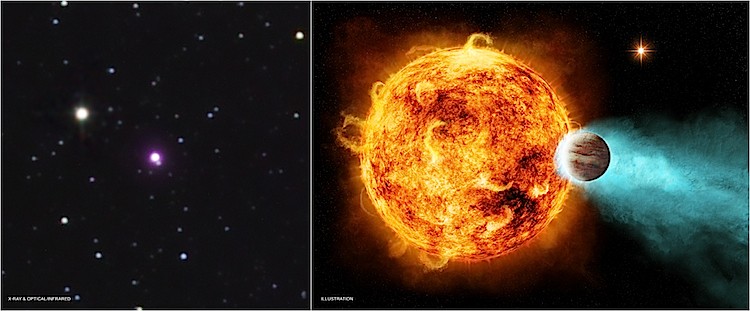
Known as CoRoT-2b, the planet’s mass is about 1,000 times that of Earth, and is closely orbiting the highly active star, CoRoT-2a, at a distance about 10 times that between Earth and the moon.
The X-ray radiation is 100,000 times more powerful than the energy that our sun sends towards the Earth, and is vaporizing around 5 million tons of matter from CoRoT-2b per second.
"This planet is being absolutely fried by its star," said Sebastian Schroeter of the University of Hamburg in Germany. "What may be even stranger is that this planet may be affecting the behavior of the star that is blasting it."
It appears that the planet may be activating its sun’s magnetic fields and increasing its rotation rate due to their close proximity. This could explain why the 100- to 300-million-year-old star is exhibiting such youthful behavior.
"If it wasn’t for the planet, this star might have left behind the volatility of its youth millions of years ago," said co-author Stefan Czesla, also at the University of Hamburg, in the release.
CoRoT-2b also has an unusually inflated appearance, which could be related to its sun’s X-ray barrage.
"We’re not exactly sure of all the effects this type of heavy X-ray storm would have on a planet, but it could be responsible for the bloating we see in CoRoT-2b," said Schroeter.
"We are just beginning to learn about what happens to exoplanets in these extreme environments."