We’ve reached college football’s version of the Final Four. On Thursday, the Miami Hurricanes will face the Ole Miss Rebels in the Fiesta Bowl, and then on Friday, the Indiana Hoosiers will take on the Oregon Ducks in the Peach Bowl.
Before the College Football Playoff began in December, we looked at each of the 12 teams and gave reasons why they could become national champs. For the semifinalists, there are also legitimate concerns.Here’s why each of the quartet could fail to hoist the national title trophy come Monday, Jan. 19.
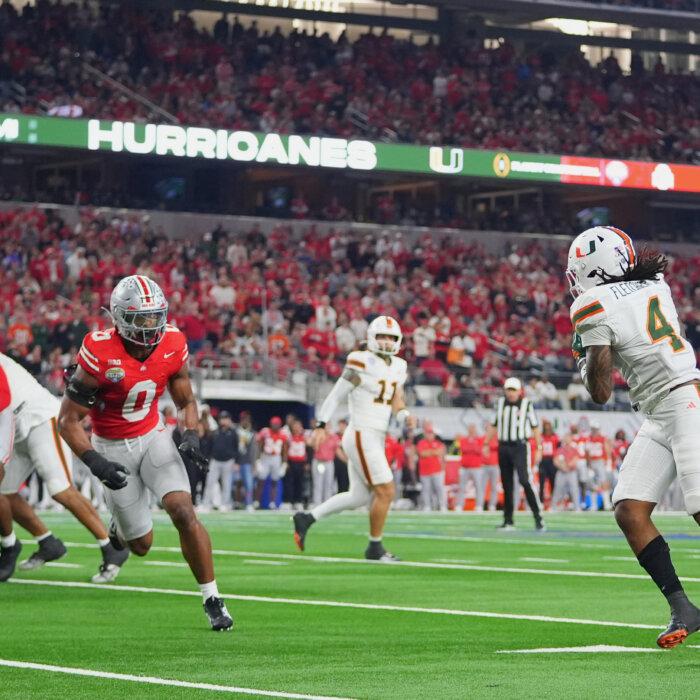
No. 10 Miami: Lagging Offense
Third, ninth, 10th, 30th… one of these is not like the other, and that’s Miami’s offense compared with the other semifinalists. Indiana, Oregon, and Ole Miss all rank in the top 10 nationally in scoring this season, while Miami sits 30th, between the likes of Old Dominion and Navy. The passing game holds its water, as Miami is second in the nation in completion percentage (73.5 percent), but the run game lags behind. The Hurricanes are outside the top 70 teams in the country in both rushing yards per game (152) and yards per carry (4.3).Miami also has a tendency to shoot itself in the foot. Among the four semifinalists, the Canes average the most penalties per game, the most penalty yards, and they’ve thrown the most interceptions.
There’s also the fact that history isn’t on the side of the Canes. Miami is 0-4 all-time in the Fiesta Bowl, with its last appearance being the controversial BCS Championship Game defeat to Ohio State in 2003.
No. 6 Ole Miss: Run Defense
While one could argue that the Rebels’ biggest weakness is not having the architect who constructed this Ole Miss season, former coach Lane Kiffin, their kryptonite is something that was present when Kiffin was on the sideline. Teams have run through the Ole Miss defense all season, to the tune of 146.1 rushing yards per game. That’s about twice as much as Indiana (73.7) has allowed, and even far inferior teams have gashed Ole Miss on the ground.The team allowed 220-plus rushing yards to both Mississippi State and Arkansas, who combined to have a 7-18 record this season. Even Group of Five opponents such as Georgia State (191 yards) and Tulane (178 yards) had success on the ground. The Rebels’ inability to control the ground game is a big reason why Ole Miss sits 29th in the country in points allowed per game, while Indiana, Miami, and Oregon all rank among the top six.
No. 5 Oregon: Red Zone Woes
There may be no better team in the country between the 20-yard lines than Oregon, but the Ducks have major concerns in the red zone, on both sides of the ball. Oregon is one of three FBS teams to rank in the top 10 in both completion percentage and yards per carry, but that efficiency deserts it where it matters most. Dan Lanning’s crew sits 68th in the nation in converting red zone opportunities into scores with an 84.7 percent rate. When you look at solely touchdowns, Oregon’s red zone percentage drops to 64.4 percent.The other side of the ball is even worse, with OU ranking 100th (out of 134 FBS teams) in preventing red zone scores. None of the other 11 teams that made the CFP have a worse ranking than the Ducks, who have allowed opponents to score on 87.1 percent of their red zone trips.

The Ducks also have to contend with the mental challenge of facing Indiana, as Oregon’s only home loss since November 2022 came to the Hoosiers earlier this season.
No. 1 Indiana: Pass Protection
You really have to squint to find flaws in Curt Cignetti’s crew, and apart from the program’s horrendous history prior to the coach’s arrival, Indiana’s biggest weakness is protecting its Heisman-winning quarterback. Unfortunately for IU, it’s a weakness that has become even more glaring as the season has progressed—Fernando Mendoza has been under fire lately.Mendoza was sacked three times by Alabama in the CFP quarterfinals, which followed his being taken down three times by Ohio State in the Big Ten Championship Game. Over his last five games, he’s been sacked 14 times, an average of 2.8 per game. For comparison, over his first nine games, Mendoza was sacked just seven total times, an average of 0.8 per game. That could be an issue versus Oregon, which is averaging 2.7 sacks over its last six games, and it will definitely be a concern if Indiana matches up with Miami in the CFP Title Game. The Canes’ 46 sacks lead all of college football, and they already have the second-most sacks in a single CFP (12) in the history of the playoff, with potentially two games still to go.