Albert Goodwill Spalding is baseball’s top salesman of all time.
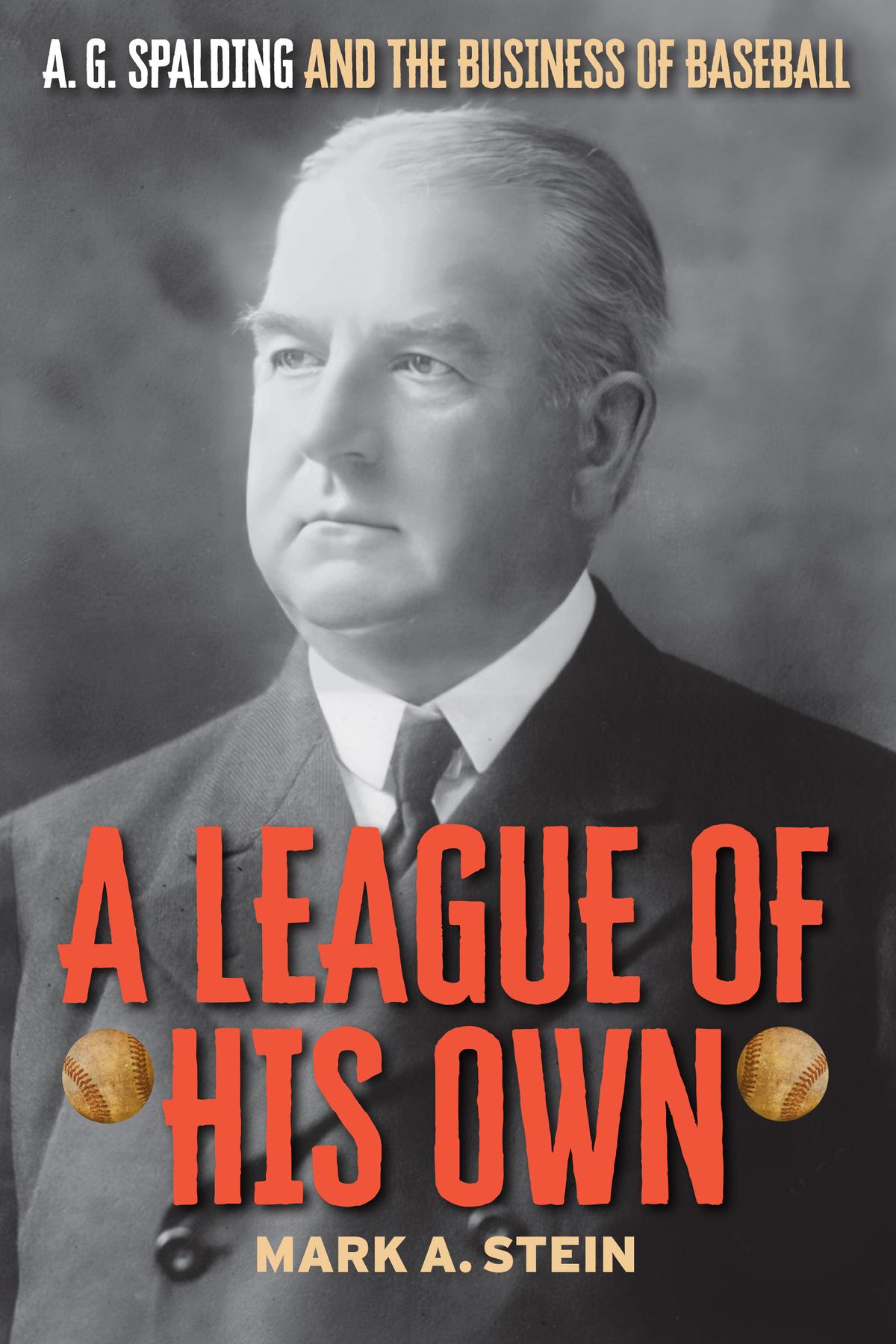
Thanks to Pulitzer Prize winning journalist and author Mark Andrew Stein, baseball fans now have the definitive guide on just how valuable Spalding is to the game. Stein’s soon-to-be-released biography of the Baseball Hall of Famer (Class of 1939)—“A League of His Own: A.G. Spalding and the Business of Baseball”—unleashes a treasure trove of acquisitions, innovations, and partnerships sparked by one of America’s most successful entrepreneurs in the 1800s. Yet, despite all the prior accomplishments and discoveries made by Spalding that are detailed in the book, to most in the sporting world, the name was simply associated with equipment stamped with his name on it.
Spalding was a man who was perpetually energized. He was a publisher of sports guides and rule books, had an important role in the 1900 Olympic Games held in Paris, where he served as U.S. Commissioner, and was a co-founder in 1876 of what is today’s MLB’s National League. As a ballplayer, Stein presents Spalding as among the very best in the early history of the game.
During his seven professional seasons as a pitcher (1871–1877), Spalding dominated the competition, winning 251 games, with only 65 losses. It was in his last season as a player with the Chicago White Stockings (today’s Chicago Cubs) that Spalding began using a glove while on the field. He is considered the first to do so on a regular basis. In 1886, Spalding’s team experienced the first modern-day spring training site, at Hot Springs, Arkansas, to prepare for the upcoming regular season. There are many “firsts” created by Spalding in his 65 years of life.
“I hadn’t appreciated what he had done,” Stein told The Epoch Times. “I knew that he was a very good player, and later ran the team that became the Cubs. But, why hadn’t I heard about him? The most recent book I could find about him was from the mid-1980s. I knew there had to be much more information about him today. Learning about Spalding was almost a hobby for me.”
Perhaps the most exciting news of the rise of Spalding in manufacturing sporting goods comes in Chapter 7: “The Big Mogul.” This is where we learned that at age 27, Spalding retires as a player, remains as the White Stockings’ secretary, and decides to dip his toe into a sporting goods supply business.

Along with his brother Walter Spalding and his trusted brother-in-law William Thayer Brown, the trio bought into the Wilkins Bros. factory in Hastings, Michigan. Nearly 200 miles from Chicago, the Spaldings and Brown soon would take over the factory that was a supplier of baseball bats, fishing tackle, croquet mallets, and archery equipment. This would be the beginning of the Spalding empire. By the late 1800s, Spalding was turning out 500,000 bats annually.
“He was a competitor,” says Stein of Spalding. “When Spalding saw the success in Chicago that Montgomery Ward & Company and Sears were having, he saw an opportunity.”
The catalog business was in its infancy, and Spalding wanted in on the new way of making sales through the mail. The various league guides Spalding published turned into virtual catalogs for his myriad of manufactured goods—bats, balls, and bicycles. The Spalding name even ventured into the track and field arena, stamping its company name on discuses being hurled. The Spalding influence was also felt throughout the AAU (Amateur Athletic Union). In some cases participants needed to use Spalding equipment, or face reprisal if they didn’t.
As the Spalding brand grew, “A League of His Own” brings to light just how far-reaching it became. By 1889 there were 35 domestic depots or retail stores, plus in Australia, Canada, Hawaii, and New Zealand. One year earlier, in 1888, Spalding organized baseball’s first round-the-globe tour. Inviting newspaper reporters as well as ballplayers, Spalding secured stops in several countries including France, Italy, and Egypt. The goodwill tour of one year only increased the exposure of the Spalding brand. The company was now manufacturing, supplying, and selling its own line of equipment in its retail stores.
There wasn’t a sports rule book that Spalding wasn’t publishing.
“What he didn’t invent, Spalding saw as an opportunity and seized it,” Stein says.
Throughout the book’s 246 pages, there are no “long innings” to get through. Each chapter walks you through a growing business that by today’s standards was well before its time of networking. You learn quickly that Spalding cannot rest on his laurels. Always looking for a mountain to climb, after relocating to San Diego, Spalding was a Republican candidate for the United States Senate in 1911. Spalding died in 1915.
On Spalding’s desk was a sign that read: “Everything is possible to him who dares.” From reading “A League Of His Own” (release date Jan. 6, 2026), no truer words have been said about a “titan of industry” as Albert Spalding.