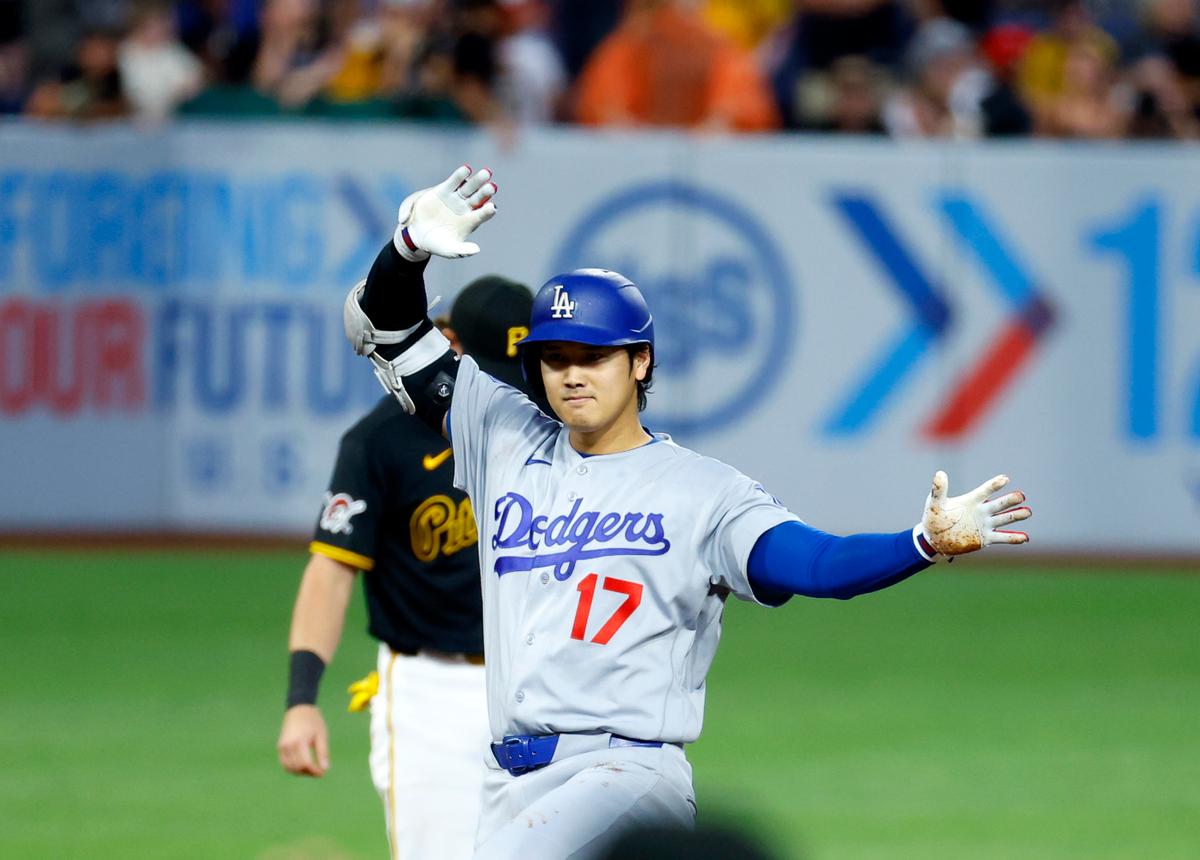
If baseball legend Babe Ruth is turning over in his grave, it might be because even he wants to get a better view of what Shohei Ohtani is doing in Major League Baseball.
Ohtani, the two-way superstar for the Los Angeles Dodgers, set out this season to prove he is not just a talented offensive player who can pitch, nor is he simply a good-hitting pitcher.
Ruth was the last two-way player whose numbers could be brought up when discussing Ohtani’s unmatched accomplishments. And many of the records—many of which Ruth held—Ohtani erased were established about a century ago, when the game wasn’t specialized or scrutinized.
The ninth-year man out of Japan entered the season by stating he wants to take aim at the Cy Young Award—the top honor among big league pitchers and the ultimate statement for him to likely end all debate about the greatest player ever on the baseball diamond. Ohtani has a 0.74 ERA with 67 strikeouts and 18 walks over 61 innings, and has arguably been the team’s steadiest arm on the mound this season.
And while he has an incredible hill to climb as far as outpitching the likes of Jacob Misiorowski, the flamethrowing strikeout whiz of the Milwaukee Brewers, and the shutdown pitching of Cristopher Sanchez of the Philadelphia Phillies, he still has an ERA of less than 1.00 through 10 starts. But Ohtani’s 0.79 WHIP would be tops in baseball just ahead of Misiorowski’s 0.81, if he had logged enough innings to qualify for the honors. But Ohtani is behind the pace, much in part because of L.A.’s six-man rotation. But the accolades are pouring in for what Ohtani is doing on the mound.
“He might be the best pitcher in the league,” Tokyo-based Jason Coskrey of The Japan Times told The Epoch Times in an email. Coskrey and others have seen a drop-off for the four-time MVP winner, who is 31 and didn’t put together the typical Ohtani start at the plate.

The man nicknamed Sho-Time has the baseball world murmuring about fatigue and the notion that this Samurai pitch-and-hit show might need an extended intermission. Japan’s diamond master, who was the first player in major league history to have 50 home runs and 50 stolen bases in the same season in 2024, sputtered out of the gate this season at the plate, slashing .273/.406/.491 in April and March. But he has bumped that up to .480/.552/.760 (through Monday’s games) amid criticism that he might be slipping. That noise has faded over the past month.
“He hasn’t done this full bore for a couple of years, and that’s two full seasons and playoff runs of mileage on him now. Plus, he’s that much older,” Coskrey said of being both fulltime hitter and pitcher.
“I can’t say if one is taking away from the other, he’s doing what he has done before, but it’s certainly possible, especially as he’s back to pitching full time. It’s still early in the season.”
Ohtani has had to field a persistent line of questions about his physical status and rest, having been taken out of the lineup a couple of times when he started on the mound.
The slugger certainly hit back hard at those inquiries.
“And even if you find something good, you don’t know how long you can continue it. In fact, it’s not just making a good change, it’s keeping it going for a long time that’s more often the most difficult thing. So, like I just said, it’s about using the [day off] tomorrow and turning it into a day that gets results over time.”
When asked about the workload and the fact that he might be slowing down, Ohtani snapped back: “Right now, I feel like I’m at the top of my game and that I’m still young, so I just want to do my best.”
In fact, Ohtani has set the bar pretty high for himself. Even after successful outings, in which he pitches well, and he and the team come away with the victory, he still keeps his focus on process over results.
“Well, there was some good defense behind me that helped me out, and that was huge,” Ohtani said after firing six innings of inconsistent no-hit ball and hitting a solo home run as the Dodgers completed a sweep of the visiting Colorado Rockies with a 4–1 victory on May 27.
“But as I just said, it was my control—the frustration from the fact that I couldn’t get my pitches where I wanted to. That was what I was battling with.”