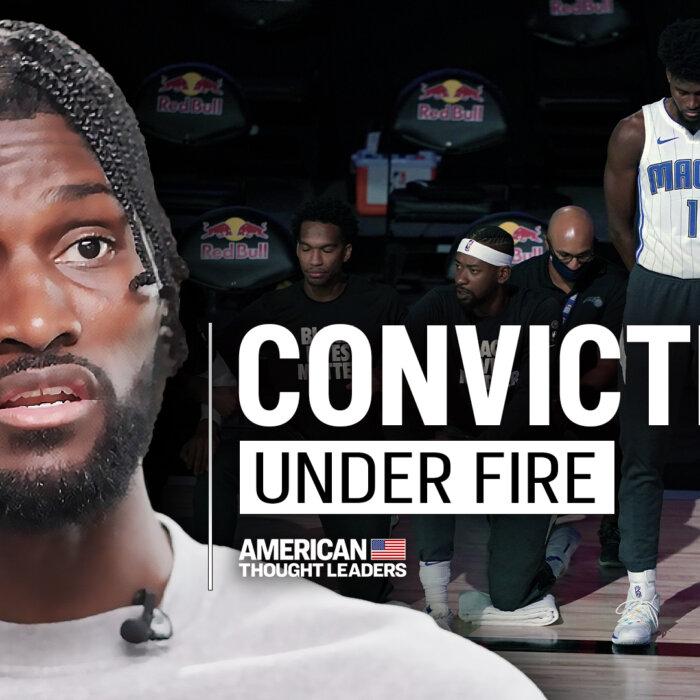
Orlando Magic forward Jonathan Isaac was in the spotlight in 2020 for neither taking the COVID-19 vaccine nor kneeling during the national anthem.
But he was not always a man of faith.
“I didn’t really, really become a Christian until I got to the NBA,” he said. “But I grew up in the church, and so I had somewhat of a foundation.”
When times were good, he distanced himself from Christianity and tried to fit in with those around him. And when they were bad, he would go back to church.
Shortly after the Magic drafted Isaac with the sixth overall pick in the 2017 NBA draft, Isaac got inspiration from an unlikely place.
“I’m getting into my new place, and I meet a guy on an elevator. And he says to me, ‘I can tell you how to be great,’” he said. “And I said, ‘How?’ And he said, ‘You have to know Jesus.’ And I was like: ‘Man, I know Jesus. Me and him are close.’ But I wasn’t living that way.”
Refusing to Kneel During the National Anthem
During the 2020 season, the case of the police custody death of Minneapolis man George Floyd led to protests and riots in a number of cities across the country. Athletes sympathetic to the Black Lives Matter (BLM) movement were also still kneeling during the playing of the “Star-Spangled Banner” after the gesture was popularized by San Francisco 49ers quarterback Colin Kaepernick in 2016.Isaac declined to kneel during the national anthem. But it was not because of opposition to BLM.
“I understood where the humanity and where it all was coming from,” he said. “But me, being a Christian, at the time, I was trying to figure out: ‘What does this mean? What is an appropriate response that honors the truth and that honors giving an answer toward progress?’”
Isaac talked with friends and said that it is Jesus who can bring people together. But they rebuffed him.
Isaac took issue with BLM’s tone and rhetoric and came to realize that it was not for him.
“I was like, ‘I don’t know if I can give my allegiance—not that black lives don’t matter—but give my allegiance to this movement, because of the way that they were operating and speaking and everything like that,’” he said.
Isaac recalled that his pastor said that Floyd’s death was an opportunity to resist the “natural” human responses of anger, resentment, retaliation, and hate.
“Jesus said, ‘If you live by the sword, you’re going to die by the sword,’” he said. “And he said if we could step into this moment with love, grace, mercy, and truth, there can really be progress.”
There was a team meeting the day before a game, which was played in the “NBA Bubble,” as it was known during the COVID-19 pandemic, and players decided they had no choice but to wear BLM T-shirts and kneel during the national anthem. One of Isaac’s teammates asked him whether he was going to kneel, and Isaac said no.
“I just believe that there’s a better and greater solution to not only racism, but all the problems that we see in our world,” he said. “Because ultimately, I believe that there are heart issues, and Jesus can change hearts because he’s changed mine.
Not Taking the Shot
Isaac also came under fire for not taking the COVID-19 vaccine.The player said he trusted God and the science that said that healthy people may get COVID-19 but that it was highly unlikely the infection would lead to death.
Isaac noted that he got support for not taking the vaccine despite that some disagreed or did not understand his point of view.
“I had letters coming to my house,” he said. “I think my jersey sold second highest in the NBA at that point [because of the number of] people who agreed with me and understood where I was coming from with it.”
Isaac got COVID-19 but said it passed after a few days. He said that not taking the vaccine was something he talked about only when he was asked.
On the issue of faith, Isaac said he changed his attitude about God as he got older.
He said he initially thought that God did not want people to have fun in life.
“My experience [now] is that’s just not true, that God isn’t trying to take anything away from us, that he’s inviting us into his plan and that he’s actually trying to give something to us,” Isaac said. “That’s what I’m experiencing.”