Rudi Johnson, a former Pro Bowl running back who starred for the Auburn Tigers and then the Cincinnati Bengals in the 2000s, died on Tuesday at 45 years old. The Bengals made the announcement in a statement in which team owner Mike Brown commended Johnson for not only his ability as a player but his character as a person.
Johnson spent eight seasons in the NFL (2001–2008) after being a fourth-round pick by Cincinnati after playing one season at Auburn. His first seven seasons were spent with the Bengals, with his final year coming with the Detroit Lions. The running back was one of the most productive players at his position in the mid-2000s, after which he supplanted longtime starter, Corey Dillon, in the backfield.
From 2004 to 2006, Johnson rushed for at least 1,300 yards every season, with a dozen rushing scores each year. His 4,221 rushing yards during this stretch were the fourth-most in the NFL, trailing only Tiki Barber (5,040), LaDainian Tomlinson (4,612) and Shaun Alexander (4,472). Additionally, Johnson’s 36 scores on the ground were the fifth-most over this span.
Johnson made his lone Pro Bowl in the 2004 season as he was part of a talented offensive attack that included quarterback Carson Palmer and wide receivers Chad Johnson and T.J. Houshmandzadeh. Rudi Johnson’s banner game came in a Week 12 contest that season where he rushed for a career high of 202 yards, to go along with a pair of rushing touchdowns, as the Bengals outlasted the Cleveland Browns, 58–48. The 106 total points scored in the game are the second-most in NFL history, trailing only 113 scored in a 72–41 victory by the Washington Redskins over the New York Giants in 1966.
On Tuesday, Palmer remembered his former backfield mate, who he spent four seasons as a teammate with.
“He loved his business, and he was all about his business. An incredible player. He had to wait his turn and when he got his opportunity, he took off.”
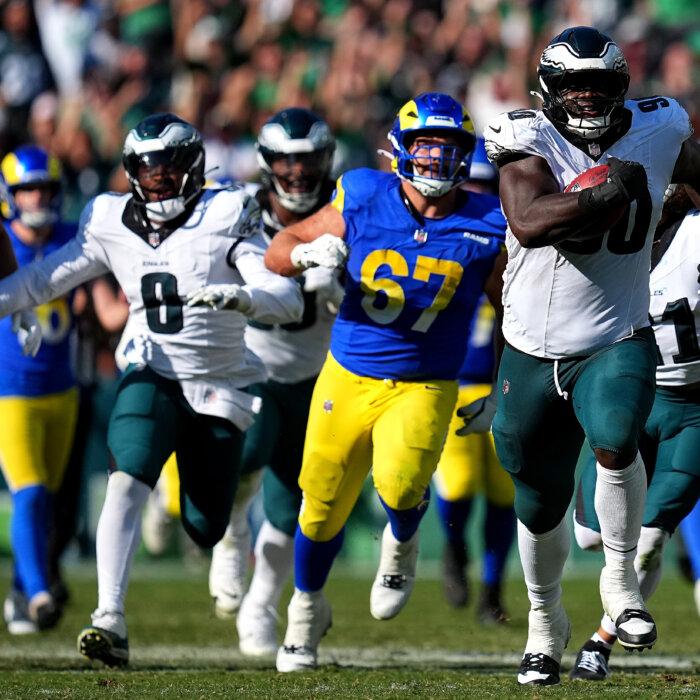
For his seven years with the Bengals, the Cincinnati crowd would always chant, “Ru-u-di” whenever Johnson had a big play, and he gave the fans lots of opportunities to serenade him. Johnson ranked third in franchise history with 5,742 rushing yards when he departed the team in 2008 and was second with 48 rushing touchdowns.
Throughout his tenure in Cincinnati, the franchise frequently tried to upgrade the running back position with high draft picks, but none could ever beat out Johnson. In 2004, the team took RB Chris Perry in the first round, but he couldn’t supplant the productive Johnson, just as Johnson once did to Pro Bowler Dillon.
Then in 2007, Cincy took Kenny Irons in the second round, after Irons’ stellar career at the same Auburn University that produced Johnson. While Irons topped many of Johnson’s rushing marks at Auburn, he couldn’t top Johnson on the Bengals depth chart.
It was at Auburn that Johnson made a name for himself, even though he spent just one season with the program. In 2000, Johnson led the SEC with 1,567 rushing yards and ranked second in the nation with 324 rushing attempts. He was the definition of a bell cow back as he had over 30 carries in four games, and when Johnson touched the ball, the Tigers always won. Across Johnson’s seven games with at least 27 carries, Auburn won all seven as the running back was named the SEC Player of the Year.
His 1,567 rushing yards were the second-most in a single-season in Auburn history, trailing only the legendary Bo Jackson (1,786) during his Heisman-winning 1985 season. Johnson was also First-Team All-SEC in 2000 and was a Second-Team All-American.
Prior to Auburn, he spent two years at Butler Community College, where he led the team to JUCO National Championships in both 1998 and 1999. Johnson was named the JUCO Player of the Year in 1999 and would subsequently be inducted into the NJCAA Hall of Fame.