Ford Frick was a busy baseball commissioner.
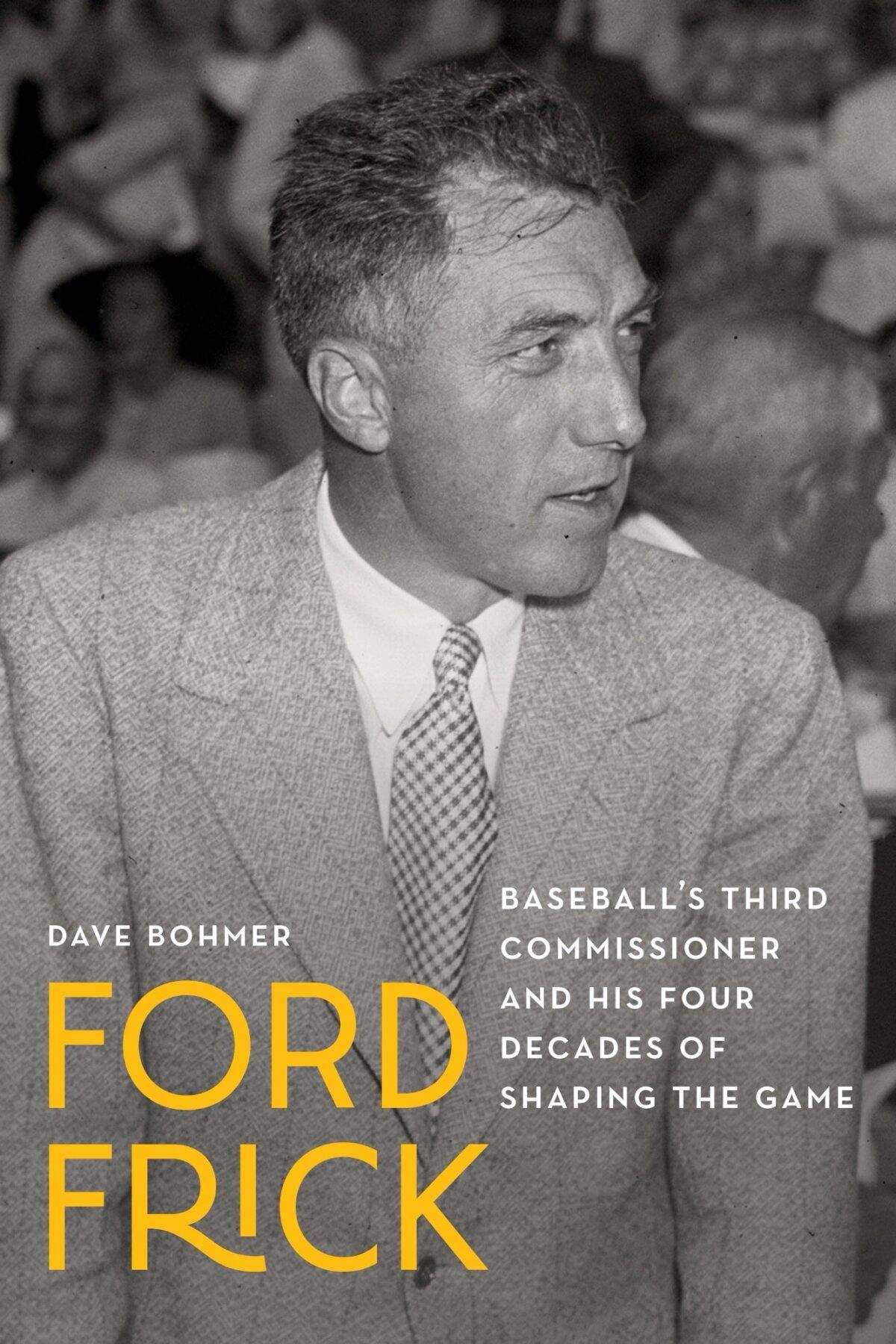
Author Dave Bohmer brilliantly reminds us just how important one man could be as a caretaker of Major League Baseball, nearly 100 years ago, in the newly published biography—“Ford Frick: Baseball’s Third Commissioner and His Four Decades of Shaping the Game.”
Once completing all 279 pages of Frick’s contributions to baseball in Bohmer’s literary journey, many salutes of gratitude are in order for the late executive extraordinaire. It’s not a stretch to say, as Bohmer clearly and factually lays out, without Frick’s support and vision, there would be no National Baseball Hall of Fame and Museum in Cooperstown today. When serving as National League president during his 17-year tenure, it was Frick who championed Hall of Fame founder Stephen C. Clark and his assistant Alexander Cleland’s vision to have a permanent depository of “America’s Pastime.”
“In May 1935, Clark and Cleland met with Frick in his office, and pitched the idea of a Hall of Fame, of which he was supportive,” Bohmer told The Epoch Times. “Frick may have seen the Hall of Fame as a gateway to honoring his friend Babe Ruth. At the first induction ceremonies in 1939, both Frick and [MLB] Commissioner Judge Kenesaw Mountain Landis were in attendance. Most of the inductees and others coming to Cooperstown did so by train. Train service had stopped during the Depression [to Cooperstown], but was restored for the inductions.”
The close relationship between Frick, first as a sportswriter, then as a leader of the game, with Ruth is interesting, if not heart-warming. Bohmer dishes on their closeness, from being golfing buddies, to Frick being the Babe’s ghostwriter in the 1920s, to their wives playing bridge regularly.
“[Frick] was one of the last to see Ruth on his deathbed,” Bohmer said.

Bohmer unequivocally debunks a myth perpetrated as far back as MLB’s second commissioner, Albert “Happy” Chandler, that Frick was an ineffective commissioner. With little official National League minutes recorded as proof, there is, however, a paper trail of Frick’s tireless efforts of making trips to Washington, D.C., to keep baseball going during World War II. With his hand on the pulse of top politicos of the time, all the way up to President Franklin Roosevelt, Frick became fast friends with military leaders as well on if the game should be shut down, who would be eligible to play for a big league club, and how travel restrictions would shape where teams may train.
“World War II, the Depression, clubs facing bankruptcy, Frick dealt with all this. Why didn’t he get the credit he deserved in being successful? The short answer—Bill Veeck and Chandler. Veeck was never far from wanting to buy the Philadelphia Phillies, and wanting to achieve integration with Black players in 1943. Veeck blamed Frick that he got turned down,” Bohmer said. “Chandler on a constant basis referred to Frick as ‘Rip Van Winkle,’ the fictional, do-nothing, easygoing soul who fell asleep for 20 years. He was highly critical of Frick.”
Facts are rapidly offered throughout the nine chapters in Ford Frick: Baseball’s Third Commissioner and His Four Decades of Shaping the Game, making a case that the commissioner was the most magnanimous executive among American leaders of his time. As the 1960s rolled in, Frick not only thwarted an outside attempt of the established National and American Leagues to create a third and opposing league, but he also oversaw baseball’s expansion of four clubs.
Night baseball is another of baseball’s firsts that Frick was entrenched in.
“Frick was supportive with the installation of lights in Cincinnati,” Bohmer says about the first night game in 1935 at Crosley Field. “When he came into office, night baseball was already moving down the road. He was at the ballpark in Cincinnati when President Roosevelt hit the switch in Washington that turned the lights on.”
Beyond coming up with solutions to defeating the declining attendance baseball faced in wartime, and adequately staffed club rosters (at one time, it was feared that clubs would collectively be 60 players short in filling out rosters), Frick was a major player in the Brooklyn Dodgers integrating the game in 1947 with Jackie Robinson being signed to play for them. Bohmer’s research reveals Frick’s support of the historic decision made by Brooklyn’s president and general manager, Branch Rickey.
“He knew it was the right thing to do. Frick and Rickey had worked together (Brooklyn was a National League club) for 10 years, and they lived in the same metropolitan area. There’s no question in my mind that the two were talking about his plan, going back to 1945. If Frick was against Robinson and integrating baseball, he could have blocked it. He signed off on all players that were in the National League.”
Along with his work as a sportswriter in Colorado and New York City, Frick became one of radio’s first nationally recognized sportscasters. He hosted America’s first radio show dedicated to sports: 15 minutes weekdays on WOR AM, beginning in 1930. Other assignments to follow were calling the Army-Navy football game, the World Series, and New York City-area college games. Frick’s affinity for broadcasting led to the establishment in 1978 of the Ford Frick Award presented annually by the National Baseball Hall of Fame and Museum to honor broadcasters for major contributions to baseball.
Bohmer, with factual precision and an uncompromising appreciation of baseball history, pulls back the veil on Frick, as a prolific writer, broadcaster, pioneering executive, and good steward of sports with his dedicated biographical project.