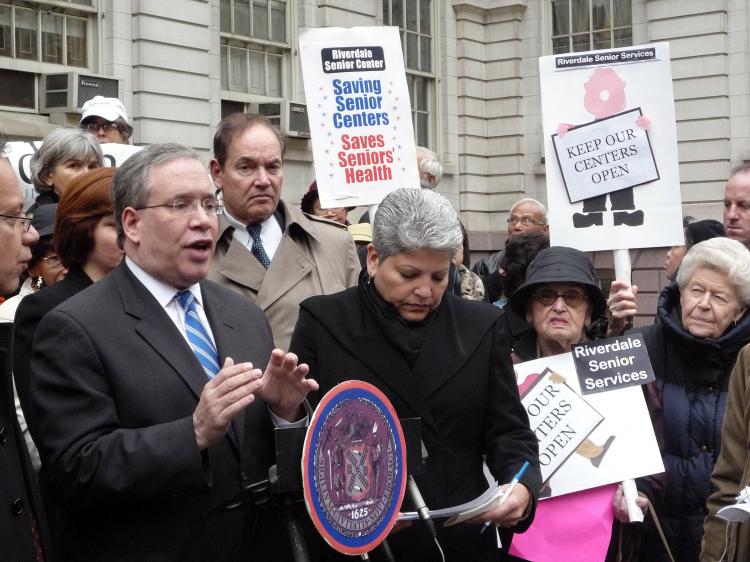
Speaker Quinn Says Bad Time to Shut Senior Centers

November 14, 2008 Updated: October 1, 2015

NOT NOW: Manhattan Borough President Scott Stringer speaks out against a plan to revamp senior centers, which he and other elected officials say is poorly timed.  (Christine Lin/Epoch Times)
NOT NOW: Manhattan Borough President Scott Stringer speaks out against a plan to revamp senior centers, which he and other elected officials say is poorly timed. (Christine Lin/Epoch Times)
NEW YORK—Seniors and several council members on Thursday called for a halt to a senior center modernization plan that they say could leave many seniors out in the cold.

The City's Department for the Aging (DFTA) operates 329 senior centers in the five boroughs. The modernization plan will change the way centers handle cases, home meal delivery, and facilities. But some, though not necessarily opposed to the plan itself, are concerned with the timing, given the economy.

“This is not the right time to significantly change how senior services are delivered in New York City,” council speaker Christine Quinn said at a press conference Thursday at City Hall. The administration is asking senior centers to submit requests for funding just as budget cuts dock DFTA programs a total of $11 million this fiscal year.

Quinn questioned the City's ability to afford the plan. The majority of the $117 million allotted to the modernization was taken from existing City funding as opposed to new funding, according to the Speaker's office.

The plan includes building 15 to 30 more comprehensive wellness centers in the five boroughs. Quinn and others worry that while those sites are in the making, services may be disrupted at 85 existing centers, which according to the mayor's Request For Proposals (RFP) would be closed down.

Manhattan Borough President Scott Stringer is concerned that seniors affected by this shift will not travel the extra distance to the new centers. “As a result, they're going to become shut-ins,” he said.

Longstanding Concerns

Similar sentiments had been echoed by various government officials since the introduction of the plan in Mayor Bloomberg's State of the City speech in January.

In March, Public Advocate Betsy Gotbaum issued written comments on the DFTA's concept paper for the plan. One of her issues with the plan as stated was the de-emphasis of core services: meals, transportation, social and educational services. “Because DFTA is stressing cost containment and making core services optional, providers will likely feel pressure to forgo the provision of core services their clients need in order to succeed in the competitive bidding process,” Gotbaum's statement read.

State Senator Thomas K. Duane wrote to DFTA Commissioner Edwin Mendez-Santiago, urging the Department to “prevent a homogenization of services as a consequence of streamlining them,” referring in part to the reduction of menu items that fit individual seniors' tastes. His letter of assessment was one of several from elected officials that were submitted to the DFTA.