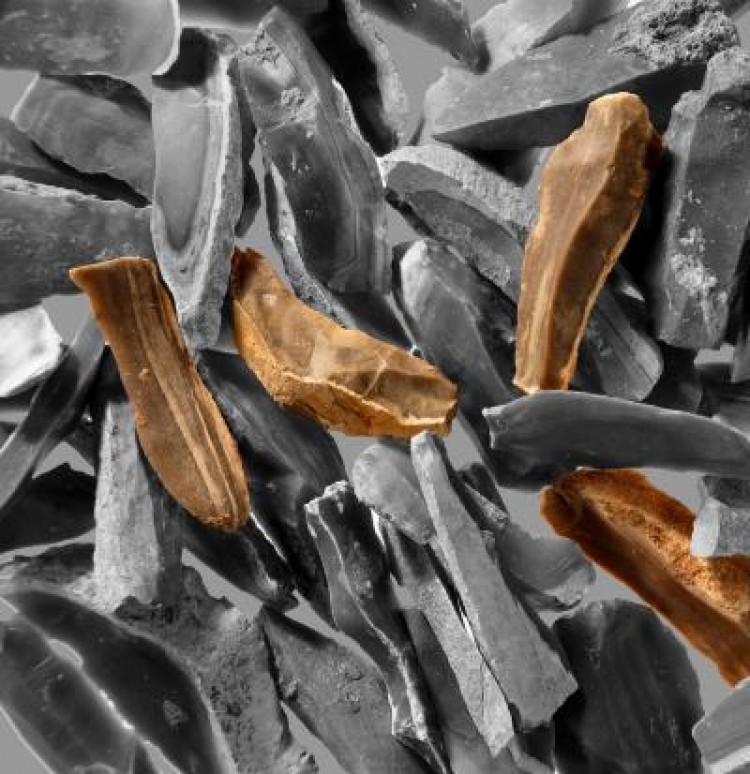
Were modern humans the first to mass-manufacture items in an organized manner? Recent findings from Qesem Cave near Tel Aviv in Israel suggest otherwise.
Advanced blade production was believed to be associated with the period between 30,000 and 40,000 years ago, along with cave art.
However, researchers from Tel Aviv University have found thousands of stone blades at the cave, with the stratigraphic sequence dated between 200,000 and 400,000 years ago. Their findings were published this month.
Blades from a more remote age have been discovered elsewhere, but these blades were made from a well-planned “production line,” said study co-author Dr. Ran Barkai, according to a press release.
The tools are believed to be from Amudian industry in the late Lower Paleolithic period from the Acheulo-Yabrudian Cultural Complex (AYCC), a group of people who inhabited parts of the Middle East.
After analyzing the raw materials of the blades and the production method, Barkai and colleagues concluded that a sophisticated mass-production system was used.
The researchers found evidence suggesting the makers of the blades selected flints that would best fit their technology, and used a systematic method that takes into account the mechanics of stone fracture to produce the blades, which each have a sharp edge for cutting, and a dull edge that would allow an easy grip.
Not only was the technology standardized, but also only a small amount of waste material was produced during the process.
“Because they could be produced so efficiently, they were almost used as expendable items,” said co-author Avi Gopher in the release.
The team also found that the cave inhabitants performed different tasks of processing hunted prey in different parts of the cave. For example, carcasses were butchered and cooked in a specific area, whereas the skin was processed elsewhere.
“We argue that the reduction sequences of blades at Qesem Cave represent an innovative and straightforward technology aimed at the systemic and serial production of predetermined blanks,” the scientists wrote in their research paper.
The researchers’ discoveries make one wonder how people from so long ago developed such advanced technology, and why it didn’t get passed down to our civilization.
The Epoch Times publishes in 35 countries and in 19 languages. Subscribe to our e-newsletter.