


The sun’s corona is dancing again with two new flares unleashed in the last two days—an M-class event on Monday night and an X-class one on Tuesday night.
Both flares were produced by active region 1283 and accompanied by coronal mass ejections (CMEs) or giant clouds of solar particles that could cause geomagnetic storms here on Earth over the coming days.
The M5.3 class flare was emitted at 9:35 p.m. ET on Sept. 5, followed by the X2.1 class flare, some four times stronger, that peaked at 6:20 p.m. ET on Sept. 6.
X-class flares have the capacity to cause strong radio blackouts. According to NASA, early models suggest these CMEs will not travel directly towards Earth, but may graze our Northern atmosphere with the potential to cause Northern lights or Aurora Borealis.
The X2.1 event was this year’s third most powerful flare. The sun’s current cycle, Solar Cycle 24, is expected to peak around 2013.
This increased activity arrives as scientists announce that the Solar Dynamics Observatory (SDO) has spotted a new pattern in solar flares in the last 15 months.
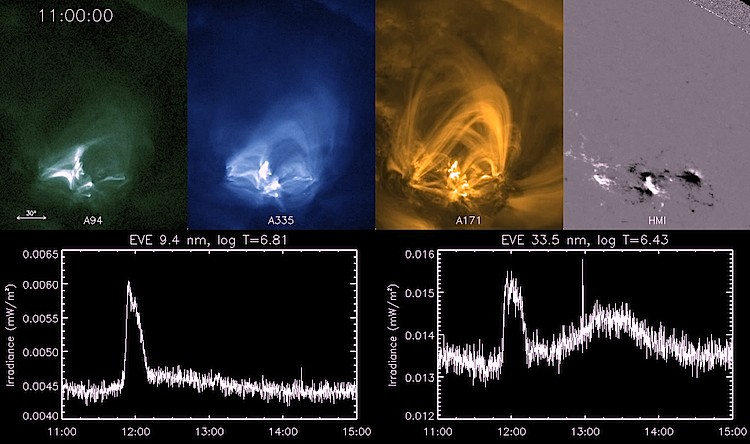
The SDO has analyzed 191 flares since May 2010 and found that around 15 percent of the events demonstrated a “late phase flare” after the eruption, sending a lot more energy into space than previously thought.
“We’re starting to see all sorts of new things,” said SDO scientist Phil Chamberlin at NASA’s Goddard Space Flight Center in a press release. “We see a large increase in emissions a half-hour to several hours later, that is sometimes even larger than the original, traditional phases of the flare.
“In one case on November 3, 2010, measuring only the effects of the main flare would mean underestimating the amount of energy shooting into Earth’s atmosphere by 70 percent.”
SDO’s data showed electromagnetic wavelengths peaking at different times from the X-rays, which are used as the standard to measure flare activity.
The scientists used an SDO instrument called EVE (Extreme ultraviolet Variability Experiment) to record four phases in a typical flare’s lifetime.
The first three phases are already understood—the hard X-ray impulsive phase, the second gradual phase when heated plasma explodes upwards and follows magnetic loops, and the coronal dimming phase, which is often associated with a CME.
But EVE also saw the hitherto unknown fourth phase or late phase flare when a second peak of warm coronal material without an X-ray burst happens one to five hours after some flares.
“The intensity we’re recording in those late phase flares is usually dimmer than the X-ray intensity,” said first author Tom Woods at the University of Colorado, Boulder, in the release.
“But the late phase goes on much longer, sometimes for multiple hours, so it’s putting out just as much total energy as the main flare that typically only lasts for a few minutes.”
Woods and colleagues are now researching how these late phase flares impact space weather because the effects of this extra energy on Earth’s atmosphere are significant.
The study will be published in the Astrophysical Journal on Oct. 1.


