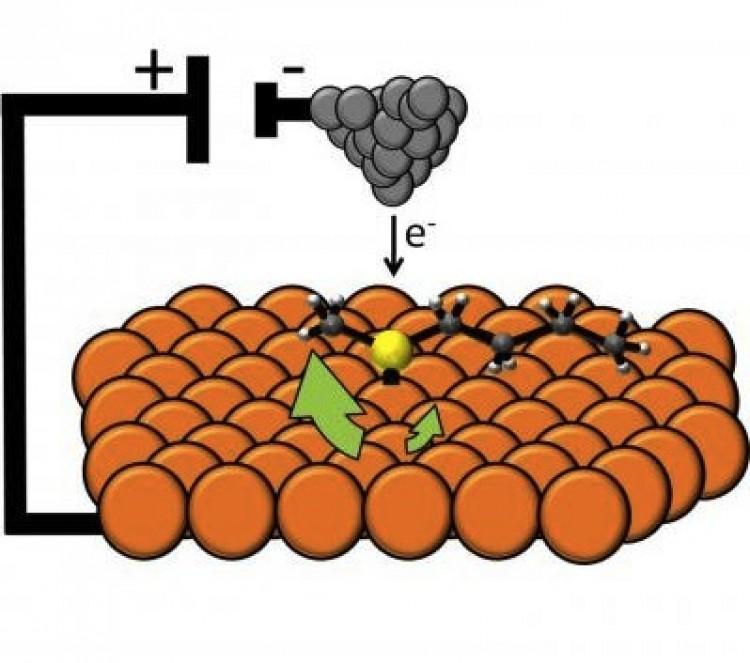
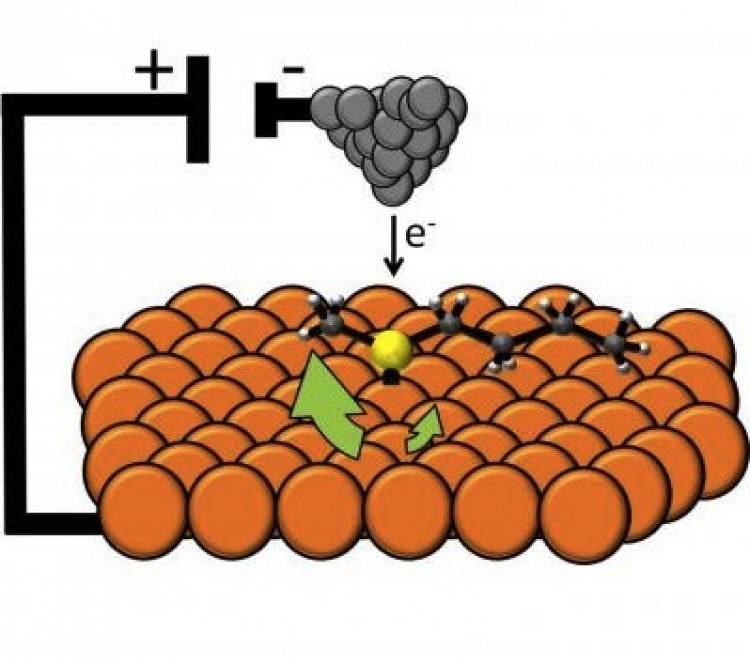
The world record for the smallest electric motor has been broken with the development of a single molecular motor—a butyl methyl sulfide molecule—that is only one nanometer wide.
To put it in perspective, about 60,000 of the single-molecule motors would fit across the width of a human hair.
The previous record was set in 2005, when US researchers created a motor by moving atoms between two molten droplets of metal inside a carbon nanotube which measured less than 200 nanometers across.
Led by E. Charles H. Sykes of Tufts University, a team of scientists and students used a low-temperature scanning tunneling microscope (LT-STM) to control a molecular motor with electricity.
The microscope observes electrons instead of light, and its metal tip delivered electricity to a butyl methyl sulfide molecule adsorbed on a conductive copper surface. Chains of carbon and hydrogen atoms on the molecule can rotate around the sulfur-copper bond.
The researchers tracked the molecule’s rotations under different temperatures, and found the ideal temperature for observation is about 5 Kelvin (-450 degrees Fahrenheit).
"There has been significant progress in the construction of molecular motors powered by light and by chemical reactions, but this is the first time that electrically-driven molecular motors have been demonstrated, despite a few theoretical proposals," said Sykes in a press release.
"We have been able to show that you can provide electricity to a single molecule and get it to do something that is not just random."
More research is needed to determine optimal operating temperatures prior to real-world application of this technology, for example in sensing and medical devices inside tiny pipes.
"Friction of the fluid against the pipe walls increases at these small scales, and covering the wall with motors could help drive fluids along," said Sykes.
"Coupling molecular motion with electrical signals could also create miniature gears in nanoscale electrical circuits; these gears could be used in miniature delay lines, which are used in devices like cell phones."
Some high school students were involved in the data collection and analysis of the research. Sykes believes that this promotes interest in science as a career. One of the students has since enrolled at Tufts and is majoring in chemical engineering.
"Involvement in this type of research can be an enlightening, and in some cases life changing, experience for students," said Sykes.
The findings were published online on Sept. 4 in Nature Nanotechnology, and the motor is being submitted to Guinness World Records.