A three-way fracture in the GOP, sharply defined in the Iowa caucus, is likely to play out again in New Hampshire, adding to Mitt Romney’s difficulty in uniting the Republican Party behind him, says independent political analyst John Zogby.
Zogby is founder of the nonpartisan polling firm, Zogby International, and first senior fellow at The Catholic University of America’s Life Cycle Institute. He says the Iowa results show three intensely distinctive groups among Republican voters, each represented by one of the three frontrunners.
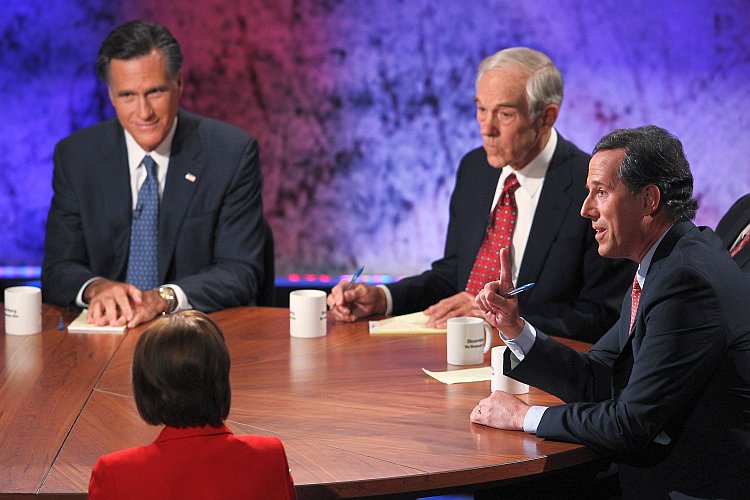
Former Massachusetts Gov. Mitt Romney, winner by 8 votes in Iowa with 25 percent support, represents what Zogby describes as the “establishment, moderate conservative.”
Former Pennsylvania Sen. Rick Santorum, also with 25 percent, represents social conservatives and traditional Christians; third-placed Texas Congressman Ron Paul, with 21 percent in Iowa, represents the “anti-statist/libertarians,” a third wing of the party.
Speaking at a forum at the National Press Club in Washington, D.C., Jan 5, Zogby said Santorum’s surge would see him in the “toughest position of the 2012 GOP” race.
“People haven’t generally stayed as frontrunner for very long,” he noted, posing the questions: “‘Does he have staying power?’ and ‘Is he a Romney alternative?’”
But Zogby said it was Ron Paul’s wing that highlighted the extent of the fracture, the Libertarian gaining support from over 40 percent of new voters, young voters, and independents in the Iowa caucuses.
“There were a substantial number of never-before caucus votes who turned out in Iowa, a significant number, higher than normal number of younger voters, and for that matter independent voters,' he said, ”and those three groups substantially supported Ron Paul.”
The Jan. 10 primary next Tuesday in New Hampshire is likely to see the fracture again come into play, Zogby said.
“It is significant that in Iowa we had 25, 25, 21, but as we move into New Hampshire the party is aligned differently ... a lot of independents vote in New Hampshire,” he said, adding, “It begs the question ‘Should Romney win the nomination, can he put those three wings together?’”
The New Hampshire primary is the first primary in the nation and, in using the same process as the general election, is recognized as a good indicator of a likely candidate—although history indicates, this is not always the case. Barack Obama was leading Hillary Clinton in the New Hampshire polls during their memorable presidential contest, but after a tearful outburst, she won the primary.
The most recent poll, the Suffolk University/7 News tracking poll, puts the three Iowan frontrunners ahead of the pack in New Hampshire, with Mitt Romney well in the lead at 48 percent. Ron Paul was second at 18 percent, and Rick Santorum at 8 percent. Former House Speaker Newt Gingrich and former Utah Gov. Jon Huntsman are close at 7 percent, while 17 percent remain undecided.
Zogby’s poll, based on surveys done by JZ Analytics on Jan. 1 and again all day Wednesday, had the candidates in a similar configuration, but Zogby says predicting outcomes is becoming increasingly difficult, describing his method as a “snapshot” rather than “predictive.”
“You never know what you are going to get anymore because things are so volatile early and apparently pretty volatile earlier than ever before,” he said.
Fractures Run Deep
Fractures within the Republican Party were among the most notable features of the GOP campaign so far, Zogby said.
Anger at President Obama among conservatives was expected to drive more participation in the Iowa caucuses and unite conservatives behind one candidate, he explained, but to date that has not happened.
Turnout in Iowa remained similar to 2008 at around 120,000, and among those surveyed, a high 38 percent said they would support the candidate that shared the same views rather than the candidate they thought would most likely beat Obama.
Zogby also noted that while there have, in the past, been divisions within the Republican Party—the initial rift between Sen. John McCain and former president George Bush an example—the three-way divide this year, he believed, was more intense.
Today it stems from the bottom up, he explained, with influence from well-organized but “uncompromising, ‘it’s my way or the highway’” grassroots movements like the Tea Party and Grover Norquist’s No Tax Pledge.
“The only thing that unites those three wings is the desire to defeat Barack Obama,” Zogby said adding: “Right now ... I am not seeing that happening yet, particularly in that Ron Paul group.”
Zogby says the chronic lack of enthusiasm for Mitt Romney among Republican voters, the untested ability of Rick Santorum to take the heat after his success in Iowa, and the intensity of fracturing within the GOP, are all contributing factors in the coming New Hampshire primary.
One thing he is clear about, however, is that Barack Obama is presently the “Big Winner.”
Obama has improved in his polling up to 46 percent from the low 40s last year, Zogby said, and will gain the advantage of a fractured GOP party.