Religious Freedom Still Languishes Worldwide: US State Dept

September 15, 2011 Updated: October 1, 2015
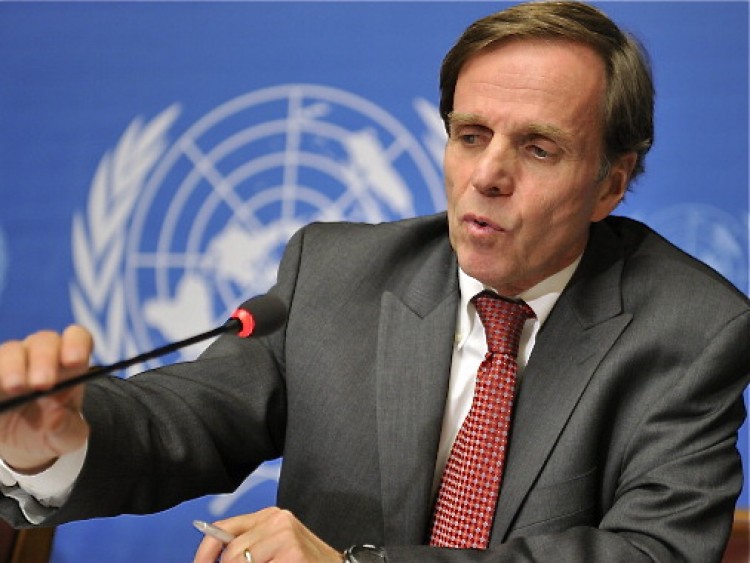
US Assistant Secretary of State Michael Posner speaks during a press conference, in 2010, at the UN Offices in Geneva.  (Fabrice Coffrini/AFP/Getty Images)
US Assistant Secretary of State Michael Posner speaks during a press conference, in 2010, at the UN Offices in Geneva. (Fabrice Coffrini/AFP/Getty Images)

A Christian is beaten and tortured in Eritrea for refusing to renounce his faith; a Buddhist monk is jailed in Burma for denouncing restrictions on religious assembly; a Bahai in Iran is denied employment or education; a Falun Gong practitioner in China is sent to a re-education through labor camp for his beliefs.

These everyday occurrences are examples of—and a drop in the bucket of—the incessant infringements on religious freedoms in nearly 200 nations around the globe, violations of religious rights documented by the U.S. State Department’s 13th “Annual Report on International Religious Freedom” released Tuesday.

Among the countries named in the report are the eight most heinous offenders of religious liberty, dubbed the "Countries of Particular Concern," which include the four states mentioned above along with Saudi Arabia, North Korea, Sudan, and Uzbekistan.

These countries are and have been "long-term, chronic, and egregious violators of religious freedom," Michael Posner, the assistant secretary of state for Democracy, Human Rights, and Labor, said Tuesday at a press conference, according to a transcript of his remarks.

The degree of religious intolerance in the Countries of Particular Concern ranges from bans on proselytizing in Uzbekistan to the prohibition of all faiths except Islam in Saudi Arabia to a totalitarian grip on all religious activities in North Korea.

In China, the overall level of tolerance of religious activities has worsened as the repression of Tibetan Buddhists, Muslim Uyghurs, Falun Gong adherents, and Christians by the authoritarian and officially atheist state persists.

The Chinese communist regime’s crackdown on religious activity has "remained severe" for the report’s period of documentation between July and December 2010, especially in Tibet and Xinjiang Autonomous Region during the Shanghai World Expo and the Asian Games held in Guangzhou.

The largest religious persecution in China and the world is that of Falun Gong. In early 1999, before the persecution began, Chinese officials indicated that 100 million people in China had taken up the practice.

The report notes various aspects of the persecution, although the numbers it provides are very conservative. For instance, the report says that since 1999 100,000 practitioners have been held in China’s reform through labor camps. The independent journalist Ethan Gutmann, who is studying the persecution, claims that between 15 and 20 percent of all those held in China’s labor camps are Falun Gong, with a minimum of 450,000 practitioners held at any one time. The U.N. Special Rapporteur on Torture Manfed Nowak reported that two-thirds of all cases of torture in China filed with his office were Falun Gong.

The suppression of Falun Gong has intensified as the communist regime presses forward with its campaign to "transform" adherents, the report said. Transformation involves forcing practitioners to give up their beliefs, by brainwashing or torture. In October 2010, the Chinese regime rolled out a new campaign aiming at transforming three-fourths of all known Falun Gong adherents.

The report does not discuss the most serious abuse suffered by Falun Gong practitioner—the practice of live organ harvesting. David Kilgour and David Matas in their report and book Bloody Harvest state that Falun Gong practitioners are the most likely source for the organs for 41,500 transplantation operations done between 2000 and 2007.

While the report focuses on the Countries of Particular Concern list, it is "by no means the only measure of serious violations of religious freedom," Posner said. Instead, many countries are guilty of "official repression of religious minorities or official indifference to their plight."

In Pakistan and Iraq, the State Department report saw slight gains in religious freedoms with increased governmental oversight and attention to religious violence, but warned that a piece of Pakistani blasphemy legislation that could be used to repress religious minorities, as well as the continued violence against pilgrims and worshipers in Iraq meant that "there is more work to be done," Posner said.

Throughout the Arab world, religious groups have been facing fresh hostility in the aftermath of the wave of social upheavals popularly known as the Arab Spring, Secretary of State Hillary Clinton warned at a press briefing on Tuesday for the release of the report.

"In the Middle East and North Africa, the transitions to democracy have inspired the world, but they have also exposed ethnic and religious minorities to new dangers," Clinton said.

"People have been killed by their own neighbors because of their ethnicity or their faith. In other places, we’ve seen governments stand by while sectarian violence, inflamed by religious animosities, tears communities apart."

The Arab people, by embracing or allowing religious extremism and bigotry, cannot "trade one form of repression for another," she urged.