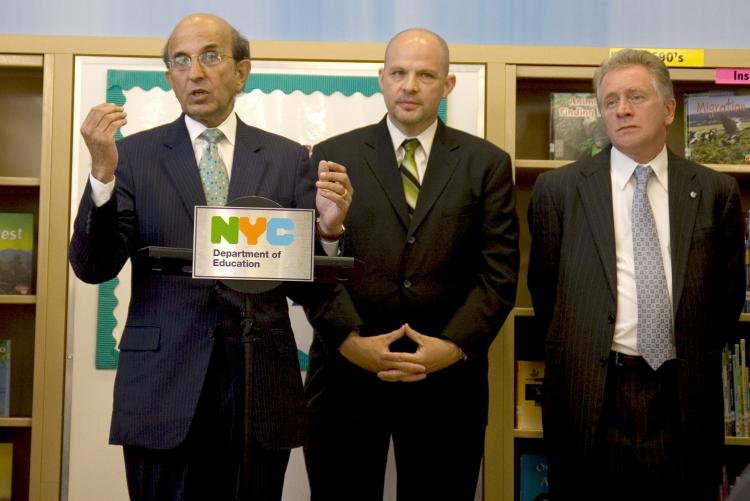
NEW YORK—School Chancellor Joel I. Klein announced the Third Annual Public School Progress Reports at a press conference this Wednesday—revealing that 84 percent of the 1,058 schools in New York City earned an A.
“These results mean 84 percent of our schools made great progress this year, not that 84 percent of schools are perfect. We won’t be satisfied until we have 1,500 great schools,” said Chancellor Klein, in a press release.
Klein says that for these particular tests, to score an A, the school had to have a minimum score of 68 percent. He said that next year the criteria for getting an A could be raised, and tests may also be made more demanding. “We will make the bar higher,” said Klein.
The press conference was held at PS 189 located in District 6. The elementary school runs from pre-Kindergarten to grade five and has a population of 1,100 students. The school’s principal, Theresa Luger, said that this year they scored an A, an improvement from the B’s and C’s in the past.
“It’s gratifying for our parents to know here is a school that’s making progress,” said Luger. Luger says that the progress reports are only one piece of data, but it can be used as a tool for teachers to examine in what areas kids fall short and address those problems.
“The information we get from the progress report and other accountability tools helps our teachers create instructional plans tailored to the unique needs of each student, so that all our students can meet the high expectations we set for them,” said Principal Luger.
Klein said that although he always looks at a variety of other elements to evaluate schools, the test scores are still good indicators.
Aside from test scores, the president of the United Federation of Teachers, Michael Mulgrew, urged parents to visit schools when deciding which one is right for their children.
“Yes the test scores are important, but it’s important to match the child to the culture of the school. That’s the best way for a school to be judged,” said Mulgrew.
Jessica Garbiner is a fifth grade teacher at PS 189 who is very pleased with the progress made. “It’s through setting high expectations and sharing the love of learning that we’ve succeeded. Teachers here at PS 189 set high expectations for each student,” said Garbiner.
Principle Luger was especially pleased with the performance of the English learning students, which make up 53 percent of the school population and the special education students, which account for fewer than 20 percent. “I couldn’t be prouder. I have high expectations for special education and English language learners,” said Luger.
The progress reports for schools summarized are made of three parts. The school environment is measured by how over 850,000 parents, students, and teachers rated the school last spring, as well as attendance rates. In addition, students’ performance in math and reading, and students’ progress were also evaluated. As a bonus, schools that successfully closed racial and ethnic gaps were given higher scores.
“These results mean 84 percent of our schools made great progress this year, not that 84 percent of schools are perfect. We won’t be satisfied until we have 1,500 great schools,” said Chancellor Klein, in a press release.
Klein says that for these particular tests, to score an A, the school had to have a minimum score of 68 percent. He said that next year the criteria for getting an A could be raised, and tests may also be made more demanding. “We will make the bar higher,” said Klein.
The press conference was held at PS 189 located in District 6. The elementary school runs from pre-Kindergarten to grade five and has a population of 1,100 students. The school’s principal, Theresa Luger, said that this year they scored an A, an improvement from the B’s and C’s in the past.
“It’s gratifying for our parents to know here is a school that’s making progress,” said Luger. Luger says that the progress reports are only one piece of data, but it can be used as a tool for teachers to examine in what areas kids fall short and address those problems.
“The information we get from the progress report and other accountability tools helps our teachers create instructional plans tailored to the unique needs of each student, so that all our students can meet the high expectations we set for them,” said Principal Luger.
Klein said that although he always looks at a variety of other elements to evaluate schools, the test scores are still good indicators.
Aside from test scores, the president of the United Federation of Teachers, Michael Mulgrew, urged parents to visit schools when deciding which one is right for their children.
“Yes the test scores are important, but it’s important to match the child to the culture of the school. That’s the best way for a school to be judged,” said Mulgrew.
Jessica Garbiner is a fifth grade teacher at PS 189 who is very pleased with the progress made. “It’s through setting high expectations and sharing the love of learning that we’ve succeeded. Teachers here at PS 189 set high expectations for each student,” said Garbiner.
Principle Luger was especially pleased with the performance of the English learning students, which make up 53 percent of the school population and the special education students, which account for fewer than 20 percent. “I couldn’t be prouder. I have high expectations for special education and English language learners,” said Luger.
The progress reports for schools summarized are made of three parts. The school environment is measured by how over 850,000 parents, students, and teachers rated the school last spring, as well as attendance rates. In addition, students’ performance in math and reading, and students’ progress were also evaluated. As a bonus, schools that successfully closed racial and ethnic gaps were given higher scores.