ATLANTA—Muhammad Yunus was a professor of economics, but his academic knowledge had left him ignorant, he said at Atlanta University Center (AUC) on Aug. 27.
“I didn’t know anything,” he confessed, revealing that he hadn’t realized the lives of the poor were completely controlled by loan sharks. “My textbook did not have a chapter about this.”
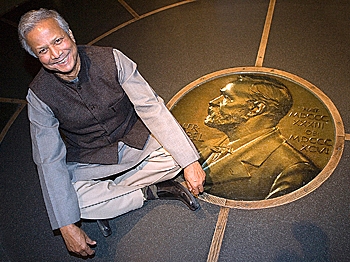
In his native Bangladesh, Yunus had famously loaned $27 from his own pocket to a woman so that she could buy bamboo to weave mats to sell. They agreed that she would repay the loan in small weekly installments and Grameen Bank was born. Dr. Yunus’s efforts with the Grameen Bank won him a Nobel Peace Prize in 2006.
Grameen means village, and Yunus designed the business model so that the bank would be owned and run by the lenders themselves. Yunus, the founder, is an employee.
The Grameen business model has now arrived in New York City’s boroughs of Brooklyn and Queens, where poor people are as troubled by loan sharks as they are in the villages of Bangladesh, Yunus explained. “I thought this was peculiar to Bangladesh, but it is global.”
A bank will not allow a non-account holder to cash a check, but a check cashing storefront will—for a stiff fee. “You can’t go to the bank with your $1,000 check and get $1,000. The bank says no. So you go to the payday lender.”
New York currently has four Grameen banks. Their average loan is $1,500, no collateral required.
“We sent people from Bangladesh to New York City. They said, ‘We don’t know anything about New York City.’ I said, ‘Do it just the way you do it in Bangladesh. You already know everything. People are the same.'”
Grameen is unique because of the convenience they provide their customers. Bankers actually visit their clients at home, and no one has to stand in line. The bank doesn’t even have forms or paperwork—an aspect that developed because the bank’s first clients were illiterate.
Clients who make good on their loans become Grameen board members and make decisions. They also make friends, Yunus explains, “friends they had not had before. We have no lawyers. Sorry to the lawyers.”
From the beginning Grameen has focused on providing their service to women—90 percent of the bank’s client base. Yunus said women are most likely to use money they make to take care of their children.
Yunus explained that poor people have unlimited potential, just like everybody else, but they are not able to express it because of their restricted opportunities. “Poor people are bonsai people.” Bonsai trees are normal, but kept in a small pot and pruned so they cannot reach normal size. Poverty is like the small pot that restricts the growth of a tree.
“I didn’t know anything,” he confessed, revealing that he hadn’t realized the lives of the poor were completely controlled by loan sharks. “My textbook did not have a chapter about this.”
In his native Bangladesh, Yunus had famously loaned $27 from his own pocket to a woman so that she could buy bamboo to weave mats to sell. They agreed that she would repay the loan in small weekly installments and Grameen Bank was born. Dr. Yunus’s efforts with the Grameen Bank won him a Nobel Peace Prize in 2006.
Grameen means village, and Yunus designed the business model so that the bank would be owned and run by the lenders themselves. Yunus, the founder, is an employee.
The Grameen business model has now arrived in New York City’s boroughs of Brooklyn and Queens, where poor people are as troubled by loan sharks as they are in the villages of Bangladesh, Yunus explained. “I thought this was peculiar to Bangladesh, but it is global.”
A bank will not allow a non-account holder to cash a check, but a check cashing storefront will—for a stiff fee. “You can’t go to the bank with your $1,000 check and get $1,000. The bank says no. So you go to the payday lender.”
New York currently has four Grameen banks. Their average loan is $1,500, no collateral required.
“We sent people from Bangladesh to New York City. They said, ‘We don’t know anything about New York City.’ I said, ‘Do it just the way you do it in Bangladesh. You already know everything. People are the same.'”
Grameen is unique because of the convenience they provide their customers. Bankers actually visit their clients at home, and no one has to stand in line. The bank doesn’t even have forms or paperwork—an aspect that developed because the bank’s first clients were illiterate.
Clients who make good on their loans become Grameen board members and make decisions. They also make friends, Yunus explains, “friends they had not had before. We have no lawyers. Sorry to the lawyers.”
From the beginning Grameen has focused on providing their service to women—90 percent of the bank’s client base. Yunus said women are most likely to use money they make to take care of their children.
Yunus explained that poor people have unlimited potential, just like everybody else, but they are not able to express it because of their restricted opportunities. “Poor people are bonsai people.” Bonsai trees are normal, but kept in a small pot and pruned so they cannot reach normal size. Poverty is like the small pot that restricts the growth of a tree.