Populist Extremism in Europe Here To Stay Report Says

September 28, 2011 Updated: October 1, 2015

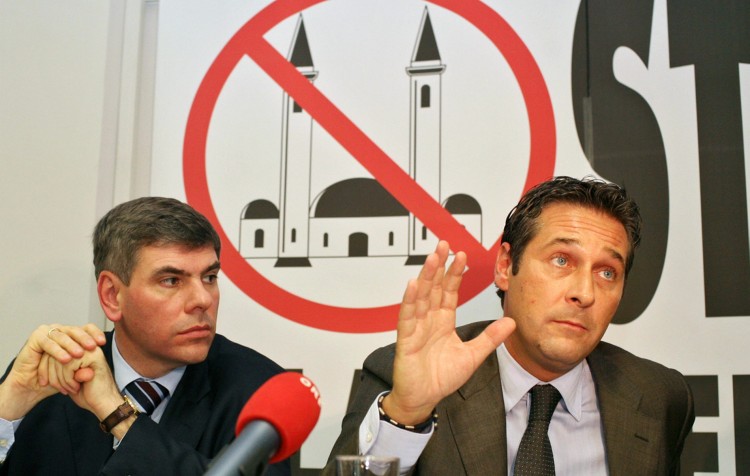
Filip Dewinter (L) of Belgian right wing party Vlaams Belang, and Heinz-Christian Strache (R), of Austrian right-wing party FPO (Freedom Party of Austria) attend a press conference to present the organization of 'Cities against Islamization' in Antwerp, Jan. 2008. (Jorge Dirxx/AFP/Getty Images)
Extremist parties with a populist and xenophobic agenda "present one of the most pressing challenges to European democracies", according to a new report from Chatham House.

The report says extremist supporters have often been dismissed as a motley band of economically deprived malcontents who are united only in their dissatisfaction with the way things are, but this is an inaccurate assessment. It shows that people who are drawn to populist extremist parties are anchored in specific social groups and share a specific feeling: Their culture is under threat from immigration and multiculturalism. And they are not likely to go away soon.

Titled "Right Response," the report is a serious attempt to investigate not only what these parties across all parts of Europe are about, but also who votes for them and why. Furthermore, it seeks to answer the uncomfortable question of whether there is broader appeal for the messages these parties spread. Finally, it gives some recommendations about how traditional parties that have often done a poor job in facing this challenge, can do better.


European populist extremism—as the report chooses to label it—encompasses very different parties. They range from large and influential parties, some of which have even been in government such as FPO in Austria, to small groups, which cannot get elected to national parliaments. They are also very different in their political views. Some, such as the True Finns in Finland, are fairly moderate, center-right with some extremist elements among them, while others, such as the German NPD, are more openly racist and considered by many to be neo-Nazis.

Emerged Over Time

They have emerged in three waves, according to studies quoted in the report: One directly following World War II, where overt fascist or Nazi ideas lived on; one in the ’70s which was largely an anti-tax populist movement; and again in the mid ’80s, from which support has slowly grown and become more durable. In recent years even countries like Sweden, reportedly immune to these kinds of parties, have found them in their parliaments nonetheless.

What unites these parties, according to the report, is their opposition to immigration plus their attacks on the establishment, and traditional parties, for being corrupt, distant, and not listening to the people. Their voters, on the other hand, are united by deep hostility toward immigration, multiculturalism, and ethnic diversity. Supporters of extremist parties are, on the whole, not irrational, but guided by a deep concern about these issues, although their views may seem distasteful to the majority, the report says.

Supporters also represent a relatively homogenous group of very young or very old males from lower middle or working classes, with little or no education and who are "deeply pessimistic about their economic prospects."

Culture Unity Concerns

Another popular myth about supporters of populist extremist parties, or PEP’s as the report calls them, is that they are mainly concerned about the economy, particularly the loss of jobs, the lowering of salaries, and overloading of the welfare system due to immigration. Surveys have instead shown that the single most important issue for these voters is their perception that their culture is under attack from foreign elements. Cultural unity issues were discovered to be nine times as important as concerns about crimes and five times as important as concerns about national economy.

Ever since 9/11, many of these parties have targeted Muslims and Islam, although some, specifically in Eastern Europe, still focus more on Roma and Jews in their xenophobic rhetoric and policies. Today, many of the parties are riding on a wave of anti-Muslim sentiment in Europe, which is much broader than their own voter support. For instance, according to a 2011 survey, just under half of British, German, Italian, Polish, and Dutch respondents agreed with the statement, "There are too many Muslims in the country," and even more than half agreed, "Islam is a religion of intolerance."

According to the report, mainstream parties have banked a little too much on extremist parties fading away as economies improve, immigration policies are tightened, or as their charismatic leaders step down. But the PEP’s of Europe have shown themselves to be more resistant perhaps, as surveys over the years have indicated, because immigration remains an important issue to many Europeans. Thus extremist parties have a favorable environment to work in.

The report recommends that politicians stop ignoring or excluding these parties, but also warns against adopting extremist policies in the hope of winning over their supporters. Instead, the report suggests engagement at the grass-roots level and, at the same time, interaction at the international level in the way many of these parties have been doing for the past two decades. "Until the mainstream parties similarly begin to exchange lessons, root their responses in the evidence, and address the actual anxieties of PEP voters, populist extremists will continue to rally support among a new generation of citizens," the authors of the report state.