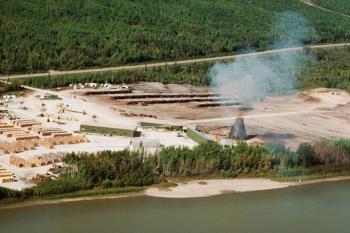
RONA’s Wood Products Procurement Policy sets a timetable for increasing its purchases of certified sustainable wood products and was designed to help protect Canada’s ancient Boreal forest.
“RONA wants to play a major role in wilderness conservation as well as in the sustainability of natural resources, while supporting Canadian consumers in their efforts to adopt sustainable behaviors,” said Robert Dutton, president and CEO of RONA, which is based in Bourcherville, Québec.
RONA’s main competitors in Canada, U.S.-based Home Depot and Lowe’s, have similar policies that favour wood certified by a third-party sustainable forest management system. All three give preference to wood certified by the Forest Stewardship Council (FSC).
“Other companies have also stated a preference for FSC, but it’s the targets that … will lead to major change on the ground, because RONA is such a large purchaser of wood products in Canada,” said Richard Books, forest campaign coordinator at Greenpeace.
Canada uses three internationally recognized certification systems: Canadian Standards Association (CSA), FSC, and Sustainable Forest Initiative (SFI).
“By setting the very ambitious but realistic target of acquiring 25 per cent of their [spruce, pine, and fir (SPF)] lumber products from FSC-certified sources by 2012, it sets the direction for their suppliers,” Mr. Brooks said.
RONA’s policy says FSC certification shows higher standards regarding “the importance of solid and respectful relationships with indigenous communities and the conservation of biodiversity.”
Although controversy surrounds the merits of one certification system over another, sustainable forest management certification has been gaining momentum worldwide amidst rising consumer demand for green products.
The Boreal forest, named for Boreas, the Greek god of the North Wind, is said to be the world’s largest ecosystem. Canada is home to 30 per cent of the world’s Boreal forest.
According to Natural Resources Canada (NRCan), Canada has 402.1 million hectares of forest and other wooded land. By December 2007, more than 137 million hectares were certified under one or more of the three certification standards.
Canada’s Boreal forest covers 310 million hectares that sweeps across the country and comprises 30 per cent of Canada’s landmass.
Seventy-seven per cent of Canada’s forest land are under provincial or territorial jurisdiction. By law, all jurisdictions require logging companies to promptly regenerate harvested forest areas as a condition of licence.
While NRCan reports that less than one per cent of forests are harvested across Canada annually, Mr. Brooks said the vast area under licence to logging companies faces “a very dire situation.”
More than two thirds of the country’s commercial Boreal forest have already been fragmented and degraded, Greenpeace says, mostly by clear cuts. Some cut areas are as large as 10,000 hectares, or 17,000 football fields.
Along with a large, expanding network of logging roads and sorting yards, development is slowly disrupting and shrinking the forest home of wildlife. For example, the woodland caribou, featured on Canada’s 25-cent coin, is a threatened species likely to become endangered if the situation does not change.
RONA also pledges to buy all of its SPF lumber and Western Red Cedar from certified sources by 2010, and all plywood panel products from certified sources by 2009. Currently it already acquires 90 and 95 per cent, respectively, of these products from certified forests.
Mr. Brooks said another “very significant” strength of RONA’s policy is that it “severely restricts the purchase of lumber products from high-conservation-value and endangered forests.”
The policy not only covers wood from Canada’s Boreal forest but all forests globally. These products represent about 10 per cent of RONA’s annual retail sales of over $6.3 billion.
For lumber and forest products suppliers like AbitibiBowater, Tembec, West Fraser Timber, and Canfor, the new policy ensures that suppliers that want to retain and enhance their relationship with RONA also move in that direction, said Mr. Brooks.
“Depending on where [their] products are coming from, they could benefit as a result of this policy, or lose out,” he said.
“Some are doing better forestry, others are not doing forestry very well, and what the policy does is it restricts wood products from companies that are destroying the Boreal forests.”