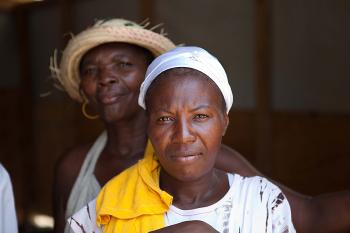
One of the most devastating earthquakes of our time left 3 million people homeless, deprived them of their loved ones, and forced them live in camps where they lack food, clean water, and basic necessities.
More than half of the 1.5 million Haitians in the temporary shelters are women and young girls. But despite being in the majority, they are still the most vulnerable and most easily taken advantage of. Lamercie Charles-Pierre, general coordinator of OFAVA, a Port-au-Prince-based organization working to protect the rights of Haitian women, says living conditions in the camps have gotten worse.
“Women are subject of violence and suffer from mental problems. Typhoid fever and malaria are widely spread. The lack of working opportunities makes things even harder for women to survive,” said Charles-Pierre by phone from Haiti.

“Women and girls are forced into prostitution in order to obtain basic necessities like food, etc. They are raped on a regular basis by members of the camps committee, who are in charge of distribution of food supplies in the camps. These committees consist of men,” said Jocie Philistin, KOFAVIV Project Coordinator in a telephone interview from Haiti.
According to Diana Duarte, Media Coordinator of the New York-based women rights organization MADRE, rape is a constant threat to Haitian women in the camps.
“We have heard stories of women attacked in their tents or attacked as they walk to the bathrooms at night. Women who face these violations often do not have access to necessary medical services and are treated dismissively by the police,” says Duarte.
Now MADRE is appealing to the United Nations, the Haitian government, and major aid agencies to exert pressure to ensure that immediate measures are taken to improve security in the camps, such as through installing lighting.
Steps Toward Solutions

Megevand says that the Ministry of Women’s Affairs, Ministry of Justice, Ministry of Public Health, and the national police are all prepared to deal with home violence, sexual abuse, or other forms of exploitation.
“The scale of the issue is huge and the coordination and collaboration need to be continuously dealt with. The question now is how to respond to the abuses on a wider scale and more effectively,” said Megevand by phone from Haiti.
So far ARC has provided shelter assistance to three camps with a total of 30,000 inhabitants.
ARC also works with men, offering training and education. “If men are not seen as essential actors in the community to keep women safe, the prevention of violence against women will be unsuccessful,” says Megevand. She reports that there has been a “small but steadily increasing number of men” seeking help at the women’s centers.
Giordano Cossu, an investigative journalist from Italy who focuses on problems typically forgotten by the international media, sees a more complicated picture.
“The action of service is too slow and stays at the level of ideas. What Haitians see is that with all the money that has been donated, basic problems are not tackled, and the international aid organizations spend weeks discussing, most of the times with no Haitians present, what should be more appropriate to do, rather than implementing solutions quickly and on a large scale in all camps,” says Cossu.
Cossu, together with French web reporter Benoit Cassegrain, runs the Solidar’IT project that aims to give voice to locals in Haiti as well as to show the reality of Haiti’s reconstruction. From his observations, the problem would not go away even if by magic all tents turned into wooden huts. There are many other causes beyond basic housing that need to be addressed—the lack of lighting, families that have been separated, the lack of information about whom to contact for justice and help, the total lack of interest by the police to investigate the crimes, and of course, the male culture.
Continued on the next page…