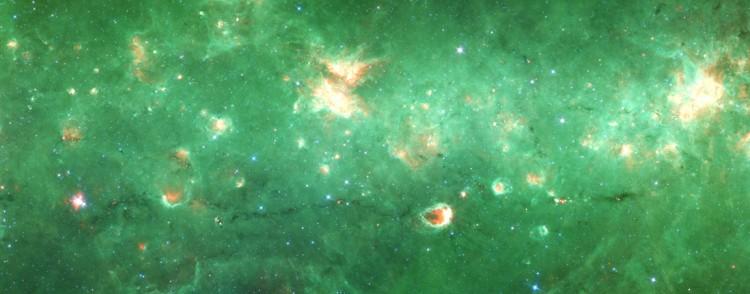
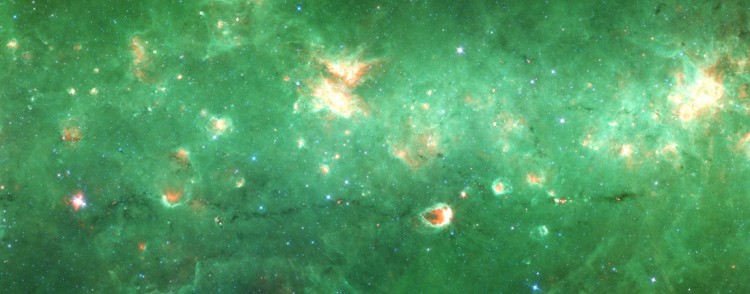
New planets may be able to form in our galaxy’s Galactic Center, despite being the site of intense cosmic forces like supernova shock waves and the gravitational tides of a supermassive black hole.
A new U.S. study suggests that a cloud of helium and hydrogen discovered there last year could be all that remains of a planet-forming disk of dust and gas that was orbiting a star.
“This unfortunate star got tossed toward the central black hole,” said study lead author Ruth Murray-Clay at the Harvard-Smithsonian Center for Astrophysics (CfA) in a press release.
“Now it’s on the ride of its life, and while it will survive the encounter, its protoplanetary disk won’t be so lucky.”
The star may have been part of a ring of hot, bright O-type stars orbiting about one-tenth of a light-year from the Galactic Center, which may also be home to many fainter sun-like stars.
These stars can interact, causing some to be pushed in toward the black hole along with their protoplanetary disks. But those located in the ring can retain their disks and could still form planets, regardless of their inhospitable environment.
“It’s fascinating to think about planets forming so close to a black hole,” said study co-author Avi Loeb, also at CfA, in the release.
“If our civilization inhabited such a planet, we could have tested Einstein’s theory of gravity much better, and we could have harvested clean energy from throwing our waste into the black hole.”
The findings will be published in Nature on Sept. 13.
The Epoch Times publishes in 35 countries and in 19 languages. Subscribe to our e-newsletter.