
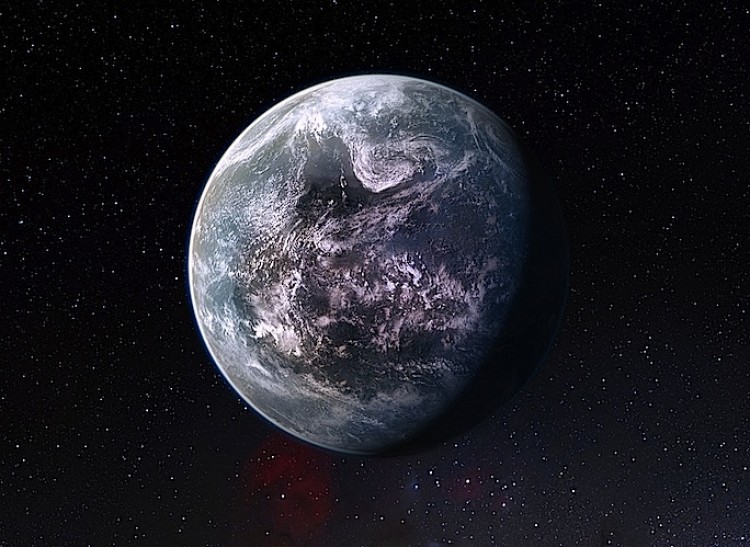
More than 50 new extra-solar planets have been found by the European Space Observatory’s (ESO) High Accuracy Radial Velocity Planet Searcher (HARPS), 16 of which are super-Earths, including one that is in the habitable zone.
“The harvest of discoveries from HARPS has exceeded all expectations and includes an exceptionally rich population of super-Earths and Neptune-type planets hosted by stars very similar to our sun,” said HARPS team leader Michel Mayor of Switzerland’s University of Geneva in a press release.
“And even better—the new results show that the pace of discovery is accelerating.”
HARPS is located on the 3.6-metre telescope at ESO’s La Silla Observatory in Chile. It uses s radial velocity technique also known as Doppler spectroscopy to hunt for planets.
A planet orbiting its star generates small gravitational effects on the star that cause speed variations in the star’s movement toward and away from Earth. These tiny fluctuations in the star’s radial velocity relative to Earth are used to confirm the planet’s presence.
HARPS is receiving hardware and software upgrades to increase its sensitivity for detecting habitable rocky planets. A new survey of sun-like stars has revealed five planets that are each less than five times Earth’s mass.
“These planets will be among the best targets for future space telescopes to look for signs of life in the planet’s atmosphere by looking for chemical signatures such as evidence of oxygen,” said Francesco Pepe of Geneva Observatory, in the release.
One of the newly discovered super-Earths is named HD 85512 b, and is orbiting its star at the edge of the habitable zone or “Goldilocks zone.” This means there is the possibility for life-supporting liquid water to be present, because if it were closer to its sun, water would tend to vaporize, and if it were further away, it would tend to freeze.
“This is the lowest-mass confirmed planet discovered by the radial velocity method that potentially lies in the habitable zone of its star, and the second low-mass planet discovered by HARPS inside the habitable zone,” said Lisa Kaltenegger of the Harvard Smithsonian Center for Astrophysics (CfA) in the release.
HARPS' increased sensitivity means it can now find planets with a mass less than two times that of Earth and a radial velocity that is slower than walking speed.
“The detection of HD 85512 b is far from the limit of HARPS and demonstrates the possibility of discovering other super-Earths in the habitable zones around stars similar to the Sun,” Mayor said.
Other precision instruments will aid the ongoing hunt for habitable exoplanets. For example, a new generation planet-finder called Echelle SPectrograph for Rocky Exoplanet- and Stable Spectroscopic Observations (ESPRESSO) will be installed on the ESO’s Very Large Telescope (VLT) in 2016.
“In the coming ten to twenty years we should have the first list of potentially habitable planets in the Sun’s neighbourhood. Making such a list is essential before future experiments can search for possible spectroscopic signatures of life in the exoplanet atmospheres,” Mayor said.
The Epoch Times publishes in 35 countries and in 19 languages. Subscribe to our e-newsletter.