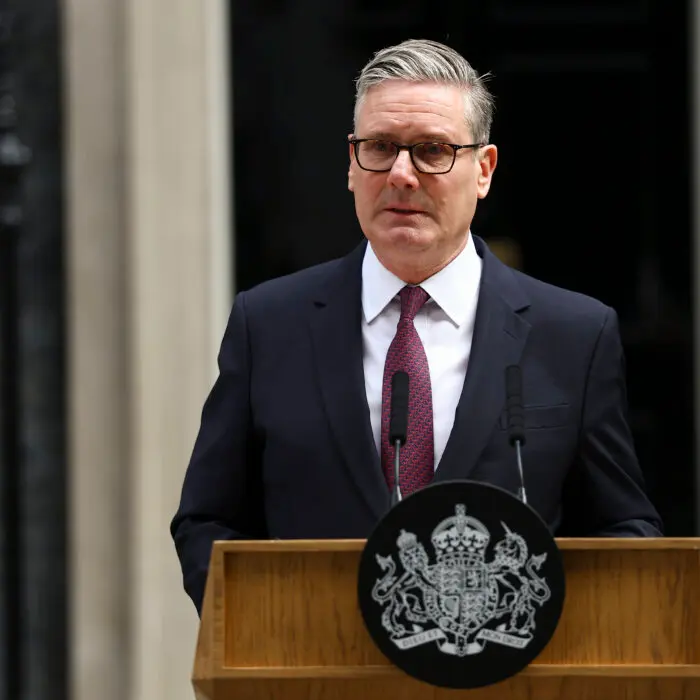
Keir Starmer, the caretaker British prime minister, has resigned to jeers and denunciation, the sixth person to occupy that office in the past decade. He leaves in a storm of outrage over endemic crime, population-wide censorship, authoritarian arrests for social media postings, a failure to deal with the immigration crisis, and with no viable plan to handle falling living standards.
This follows Rishi Sunak, October 2022 to October 2024; Liz Truss, September 2022 to October 2022; Boris Johnson, July 2019 to September 2022; Theresa May, July 2016 to July 2019; and David Cameron, May 2010 to July 2016. The only one among them who had a clear and viable plan for restoring British life had the shortest tenure; that was Truss, who was drummed out of office by a bold market in revolt against budget cuts.
This unrelenting upheaval is how the UK is managing the underlying crisis of the West: the huge chasm that separates the parasitical overclass of the corporate/administrative state versus the longings of the people for emancipation from misrule.
Welcome to the aftermath of the late-empire miasma, a dark period of UK history that was kicked off with a revolt against the centralization of the dream of the European Union. Brexit—the secession of the UK from European statism—offered genuine hope, but it has been resisted by the entire UK corporate, political, and administrative establishment. We’ll get there eventually, but these are the pangs of the great transition.
The problems of this country and former empire are not insurmountable, but they will require that very thing that is so much resisted in our times: a rediscovery of what it means to be British, a reclamation of the principles of the past, and a new pride in the unique values cultivated over centuries against which an overeducated elite turned over decades, leaving only a morass of multicultural wokeness that provides no guidance at all.

Once you understand that, all the rest is just data to fill out the underlying theme, which amounts to a wonderful nation having turned its back on the ideals of the Magna Carta that kicked off the modern commitment to freedom as the ambition of the people. In historical terms, this was the aristocracy standing up against the king with the central point: You are not all-powerful and it is our role to restrain you. The landed aristocracy forced the signing.
The bigger message brought into question the omnipotence of government itself. That message unfolded over the centuries and migrated around the world to produce the great liberal revolutions of the 18th century that secured what is today the consensus in the West. The idea is that the people should have a great measure of control over the regime under which they live, that a powerful elite cannot expect forever to rule with its own discretion at the expense of the people.
The electorate of the UK in 2016 made it clear in a vote that they wanted the UK to leave the grand European project and thereby take back its traditional sovereignty. The vote to leave was 52 percent, enough to trigger the change. The mainstream media were universally against the idea. They were only echoing the views of the elites who had spent decades plotting a united Europe and could not stand the idea of unraveling all their work.
The line at the time was that Brexit was being pushed by a revanchist minority of voters who were filled with racially-tinged fury at immigration, that they were essentially unenlightened nativists turning their backs on modernity. Watching from across the pond, I was sympathetic to the sovereignty point but the propaganda was so overwhelming that I actually had misgivings about Brexit as a result. My knowledge of how mass media work has only improved since those times, such that I don’t think that I would fall for this line again.
In any case, it was Johnson’s main job to transition the country from its European ties to regaining its independence. The deadline was January 2020, a month that you might recognize as that in which the news started spilling out about a virus originating in China that might be spreading to Europe and the Americas. Panic was already starting to be palpable at about the time of the Brexit deadline.
That is not a coincidence. Johnson’s term as prime minister became filled with efforts over virus mitigation rather than the job he was elected to do. In terms of the U.S. politics, this was U.S. President Donald Trump’s final year of his first term. Both Trump and Johnson had the same view of the coronavirus: Deal with it normally as a public health matter but don’t panic, much less lock down. Both Trump and Johnson were able to maintain that position for two months until both of them gave in at the same time. Under the advice of experts, they each locked down their countries, which contradicted their voter mandates and their long histories of guarding freedom above all else.
Johnson in particular was reduced to the position of a schoolmarm, warning the public always to wash hands, wear a mask, and stand apart from other people. These condescending lectures were backed by graphics suitable for posting in kindergarten classrooms, with hands, masks, and distance featured in cartoons that presumed an illiterate population. The censoring of dissenting views followed, as did the economic wreckage of money printing, vast spending, and business failures in gigantic waves of commercial calamity.
The COVID-19 pandemic period is what destroyed Johnson, just as it enabled the mail-in ballots that swept Trump out of office eight months after the lockdowns. Leviathan had been unleashed in both countries as never before seen by the living. Johnson’s successor was the eminently wise Truss, who faced a blithering barrage of attacks for her Thatcherite plans to restore UK liberty. She had hardly sat down in the prime minister chair before she was forced out.
Following Sunak’s disastrous reign of two years, the Tory Party lost public confidence and the Labour Party had its turn at bat with Starmer. He was in no position to deal with the ensuing economic, cultural, demographic, and social chaos but instead presided over a period in which woke elites had the run of the country, biasing the policing of the country against actual Britons and in favor of immigrant populations. That included turning a blind eye to actual crime while criminalizing free speech that had been protected in the UK for centuries.
The entanglements of Starmer with Peter Mandelson, the architect of New Labor who gained the ambassadorship to the United States, highlight how this shadowy network operates out of public scrutiny. Mandelson was close friends with Jeffrey Epstein, and Starmer was warned about this relationship before the appointment. When Mandelson became a political liability, Starmer removed him and denounced him with a series of statements that were clearly damage control and nothing more. More resignations followed and still more are possible.
The humiliation to the country now from Starmer’s failures calls forth a national reckoning and truth-telling. However, that is not likely to happen. With the Labour Party now in control, Starmer’s likely successor is member of Parliament Andy Burnham, originally a working-class Catholic who trod the familiar path through Cambridge University to be trained in all the fashionable tropes about the merits of soft socialism. He is a redistributionist, a collectivist, and an internationalist.
Nothing about Burnham’s views and biography suggests that he is the man for the job. Nothing. His term could be long or short, but I would be shocked to see it become a success.
When I say that the country needs a fundamental reckoning over the philosophical foundations of the British idea, I’m not saying anything shocking. Even the industrial and political elites know this; they just do not want one. They don’t want to tell the truth about crime, corruption, and the COVID-19 pandemic period, much less come to terms with the demographic and economic crisis that the UK now faces. That will happen eventually, but not just yet.