People may enter into all sorts of joint living arrangements without formal state recognition. However, all states have adopted civil marriage statutes to confer benefits on certain kinds of unions. For centuries, American colonial and state legislatures granted the benefits of civil marriage to unions between a single man and a single woman, where the parties consented, were not closely related, were not married to others, and met certain age requirements. The legislatures were motivated by concern for children, traditional values, health considerations, and the interests of public peace and stability. Their rules were based on 6,000 years of historical experience.
‘The Most Radical Decision Ever’
Shortly after the ruling, I wrote that Obergefell might be the Supreme Court’s “most radical decision ever.” A decade later, that assessment seems correct.Obergefell transferred a core area of state responsibility to federal supervision. It redefined marriage in an unprecedented way and imposed that new definition on the entire country. Moreover, the decision was astonishingly anti-democratic: Over the previous 20 years, the American people had considered same-sex marriage in 30 consecutive state referenda, and the people rejected it in every one—usually by towering majorities.
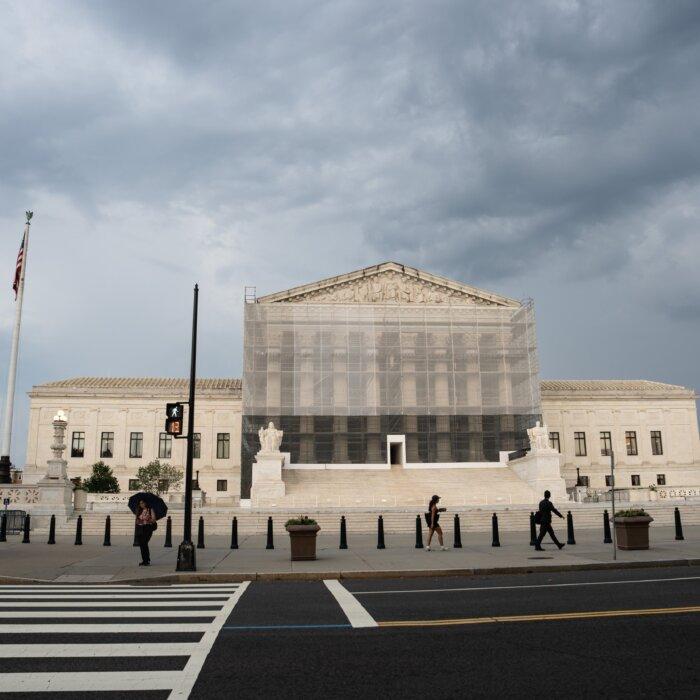
There are times, to be sure, when the Constitution requires the Supreme Court to make bold and unpopular decisions. But this was not true in Obergefell. On the contrary, to reach its conclusion, the court had to engage in shameless legal legerdemain. For example, the court noted that “marriage” was a core societal institution, but disregarded the fact that “marriage” had always been defined as heterosexual. Justice Kennedy’s majority opinion simply redefined the word “marriage” to force it into a desired legal category.
There was more: To find that limiting civil marriage to mixed-sex unions violated the equal Protection clause, the court first needed to conclude that it violated the due process clause. And to find that it violated the due process clause, the court had to disregard its own precedents for judging due process clause cases.
Additionally, in finding that traditional marriage rules violated the equal protection clause, the court applied cases dealing with race to an area in which they were not relevant. As the principal Senate sponsor of the 14th Amendment observed, government distinctions based on sex could be rational in a way that distinctions based on race were not.
Obergefell represented sweeping judicial law-making. It substituted the policy preferences of five unelected justices for those of the people and elected state lawmakers.
To illustrate: I have a right to own a home, and I may choose among houses with different numbers of bedrooms. But state lawmakers may decide to offer subsidized mortgage rates only for smaller, two- and three-bedroom homes. Nothing in the Constitution says that if I choose to buy a four-bedroom house, the state must subsidize me. (Whether policymakers should make such choices is a different question.) In like manner, whether I enter into a same-sex union is my decision, but nothing in the Constitution says the state must subsidize it.
Reliance Issues
Defenders of Obergefell argue that the court should preserve the decision because overturning it would be too disruptive. They point out that in the intervening decade, many people have contracted same-sex marriages, so a departure could upset what lawyers call “reliance interests.” This is an odd argument coming from people who celebrated when the court upended 6,000 years’ worth of reliance.In any event, the “reliance” argument for retaining Obergefell is weak.
First, of course, the reliance interests of a decade are insignificant compared with the social and financial disruption Obergefell caused and continues to cause. And the actual amount of reliance on Obergefell is probably overstated. Many post-2015 same-sex marriages occurred in states that permitted them before Obergefell or would continue to recognize them if the decision were overturned.
Religious and Social Issues
Obergefell has spawned some other problems. One is the threat to freedom of religion. State officials hostile to traditional faiths have been encouraged to persecute adherents of those faiths. The opinion for the court in Obergefell tried to discourage this, but as I predicted at the time, it has happened anyway. The Supreme Court has had to deal with religious persecution in several recent cases (see here, here, and here), and the cases the Supreme Court sees are just the tip of the iceberg.Will the Court Act?
The Supreme Court is understandably reluctant to overrule its own cases. But Obergefell is not just another case. It is fundamentally inconsistent with our constitutional system, and it continues to cause damage.We can take hope from the fact that three of the five justices who decided Obergefell are no longer on the court, but three of the four who dissented still are. One of those dissenters was Chief Justice John Roberts, who expressed his outrage by asking, “Just who do we think we are?”
Although the court usually acts slowly, delay in this instance is not advisable. The justices should overrule Obergefell at the earliest appropriate opportunity.