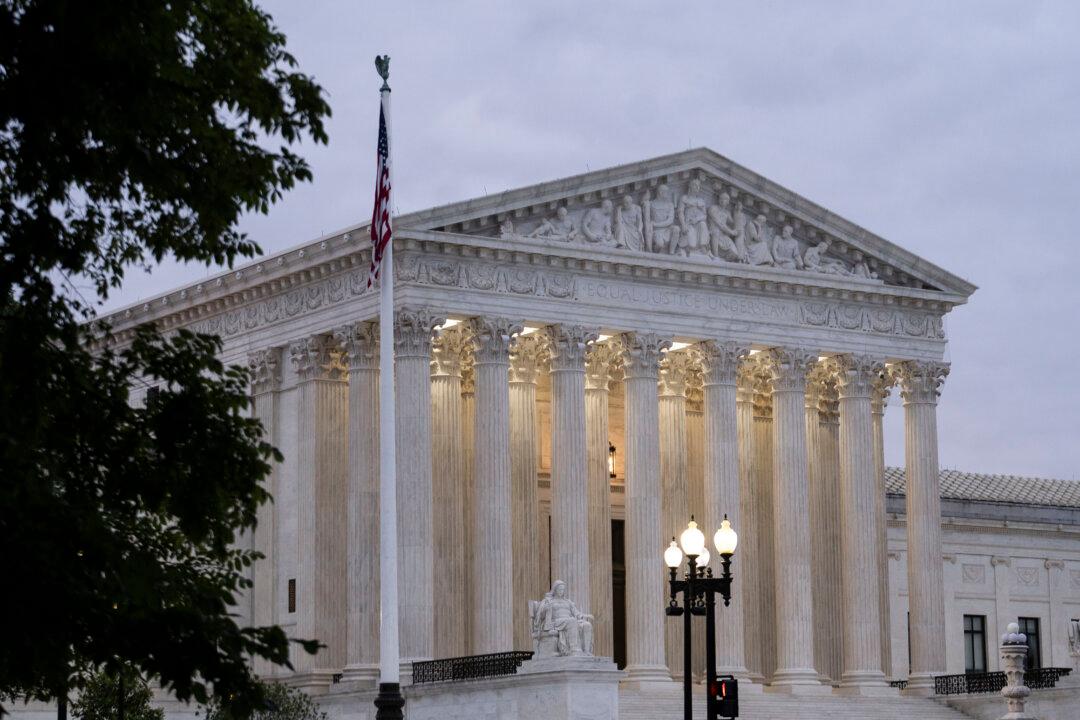
On April 28, the Supreme Court heard oral argument in Cisco Systems Inc. v. Doe, a case that may appear technical to non-lawyers. The justices and lawyers discussed the Alien Tort Statute, the Torture Victim Protection Act, aiding and abetting liability, extraterritoriality, and separation of powers. Yet beneath these legal doctrines lies a direct question of public accountability: Can a U.S. technology company be held answerable in an American court when it is alleged to have helped a foreign government identify, track, detain, and torture members of a persecuted religious group?
The case concerns Falun Gong practitioners who allege that they or their family members suffered grave human rights abuses committed by Chinese Communist Party (CCP) and Chinese regime officials. Falun Gong is a spiritual discipline with moral teachings based on the principles of truthfulness, compassion, and tolerance. According to the U.S. Court of Appeals for the Ninth Circuit’s summary of the complaint, the plaintiffs allege that Cisco Systems and two executives aided and abetted the CCP’s abuses by helping design and maintain the Golden Shield, a surveillance and internal security system used to identify Falun Gong practitioners and place them within a system of detention, forced labor, torture, and other severe abuses.
From Generic Equipment to Customized Repression
One way to minimize the case is to describe it as the sale of ordinary networking equipment. But that framing does not match the allegations as they reached the Supreme Court. During oral argument, Justice Sonia Sotomayor summarized the case in much sharper terms: Cisco allegedly knew that Chinese authorities were going to torture Falun Gong practitioners, promoted its technology by telling Chinese authorities that it could help identify them, custom-made the technology for that purpose, and “bragged to the Senate” that the technology could identify 90 percent of such practitioners. She further noted that, according to the allegations, Cisco’s internal and public statements showed that it knew that those people would be tortured.That recitation captures the central factual point. The case is not about whether an American company sold ordinary routers that were later misused by a foreign government. It is about allegations that Cisco helped solve a specific repression problem for the CCP: how to identify, track, and suppress Falun Gong believers across China.
The respondents’ Supreme Court brief gives the fuller context. It states that the CCP needed sophisticated internet surveillance tools because Falun Gong believers were spread across China and used the internet as part of their faith. The CCP therefore incorporated that goal into the Golden Shield project, a proposed “vast and multi-tiered surveillance system” with the capacity to capture Falun Gong activity throughout China. Because Chinese engineers allegedly lacked the needed expertise, the CCP looked to Western technology companies, including Cisco.
According to the respondents, Cisco answered that call. The brief states that Cisco’s former CEO, John Chambers, met with China’s president and promised support for the crackdown on Falun Gong, while Cisco materials advertised how its technology could be used to “douzheng” Falun Gong. (In China, douzheng refers to a campaign of “violent struggle” against a designated enemy, often involving coercion, ideological conversion, detention, and violence.) China then selected Cisco to submit high-level designs for the Golden Shield, and Cisco later received contracts for component systems targeted at Falun Gong.
The alleged customization is the key. The respondents state that Cisco engineers in San Jose, California, designed “first-of-their-kind features” to aid in the detection, apprehension, and interrogation of Falun Gong practitioners. They further allege that Cisco’s experts used early machine-learning algorithms to identify patterns of Falun Gong internet activity, generate real-time alerts, and support automated surveillance. Cisco also allegedly created databases that collected and delivered sensitive personal information about believers to detention centers, where officials tortured them to force renunciations of faith.
These allegations matter because the legal question turns in part on whether Cisco’s alleged assistance was both substantial and knowing. The Ninth Circuit held that the plaintiffs plausibly alleged both. It further held that the case involved a permissible domestic application of the Alien Tort Statute against Cisco because much of the alleged aiding and abetting conduct occurred in the United States.
The Diplomacy Defense
Cisco’s argument before the Supreme Court placed heavy weight on separation of powers and foreign relations. Its counsel argued that aiding and abetting liability would be a significant expansion of civil liability, that neither the Alien Tort Statute nor the Torture Victim Protection Act expressly provides for such liability, and that recognizing it would raise substantial foreign policy concerns because the case involves alleged wrongdoing by a foreign government in a foreign country.This concern is not frivolous. Courts are not foreign ministries. Judges are not diplomats. A case involving the conduct of Chinese officials may touch sensitive relations between the United States and China.
But there is a crucial difference between a real foreign policy conflict and a general warning that litigation might cause diplomatic discomfort. The respondents argue that the United States raised no case-specific foreign policy objection to this litigation and that U.S. law should not categorically exclude aiding and abetting claims for serious international law violations.
The Ninth Circuit took a similar view. It concluded that no general or case-specific foreign policy consideration required barring accomplice liability under the Alien Tort Statute in this case. It also rejected the idea that the absence of export restrictions on networking technology amounted to an affirmative policy decision to immunize Cisco from civil liability.
‘What if China Were Iran?’
During the Supreme Court argument, the foreign policy concern was tested in a sharper form. The respondents’ counsel, Paul Hoffman, asked the court to consider a hypothetical involving Iran: If an American company helped an authoritarian regime identify protesters so they could be summarily executed, would the victims’ families have no claim in an American court merely because the case might create foreign policy discomfort?The point of the hypothetical was not to equate all regimes or all factual settings. It was to expose the danger of a categorical rule. If courts are barred from hearing such claims whenever a foreign government’s conduct is involved, then U.S. corporations may be encouraged to externalize human rights risk: design at home, deploy abroad, profit globally, and invoke diplomacy when victims seek accountability.
Justice Ketanji Brown Jackson also pressed the categorical nature of Cisco’s argument. She questioned why aiding and abetting liability should be treated as a sweeping expansion rather than as a question about the scope of liability for already recognized wrongs. Justice Elena Kagan similarly suggested that neither side’s categorical approach may be fully satisfactory, and that the better inquiry may be norm by norm: First ask whether the underlying norm is covered, and then ask what scope of secondary liability attaches to that norm.
Aiding and Abetting Is Not a Legal Novelty
Cisco argues that the statutes do not expressly mention aiding and abetting. The respondents answer that aiding and abetting liability has long been part of the law of nations and that excluding it would undermine accountability for torture and extrajudicial killing.The Ninth Circuit agreed with much of that position. It held that aiding and abetting liability is sufficiently definite and universal to be recognized under the Alien Tort Statute, and it also held that the Torture Victim Protection Act provides a private right of action against those who aid and abet torture or extrajudicial killing.
This is not an exotic theory. In ordinary moral reasoning, a person who knowingly provides the essential tool for a crime cannot always escape responsibility by saying that he did not personally strike the blow. As Sotomayor stated during oral argument, that would mean that someone who hands the torture instrument to the torturer but does not actually inflict the injury could not be held liable.
Justice and Diplomacy
The Supreme Court need not turn the Alien Tort Statute into a general global human rights code. Nor must it ignore the constitutional role of Congress and the executive branch in foreign affairs. The real question is narrower: When plaintiffs plausibly allege that a U.S. corporation, acting substantially from U.S. territory, knowingly provided customized and substantial assistance to torture or extrajudicial killing, should American courts be categorically closed to them?A categorical bar would send a troubling message. It would tell corporations that the greater the geopolitical sensitivity of the customer, the stronger the shield. It would suggest that the law is strong enough to govern small actors, but too delicate to reach powerful companies when their business touches powerful states.
Justice and diplomacy need not be enemies. Diplomacy manages relations between governments. Justice asks whether concrete actors violated concrete legal duties. When a case presents a real and specific conflict with foreign policy, courts can take that seriously. But when “foreign relations” becomes a broad excuse to avoid any inquiry, it ceases to be prudence and becomes impunity.
The case against Cisco remains based on allegations, and Cisco disputes them. The plaintiffs have not yet proved their claims at trial. But the question before the court is whether they may try. On that question, the principle should be clear: A technology giant should not be able to hide behind diplomacy when the claim is that it knowingly built tools of persecution from American soil.