



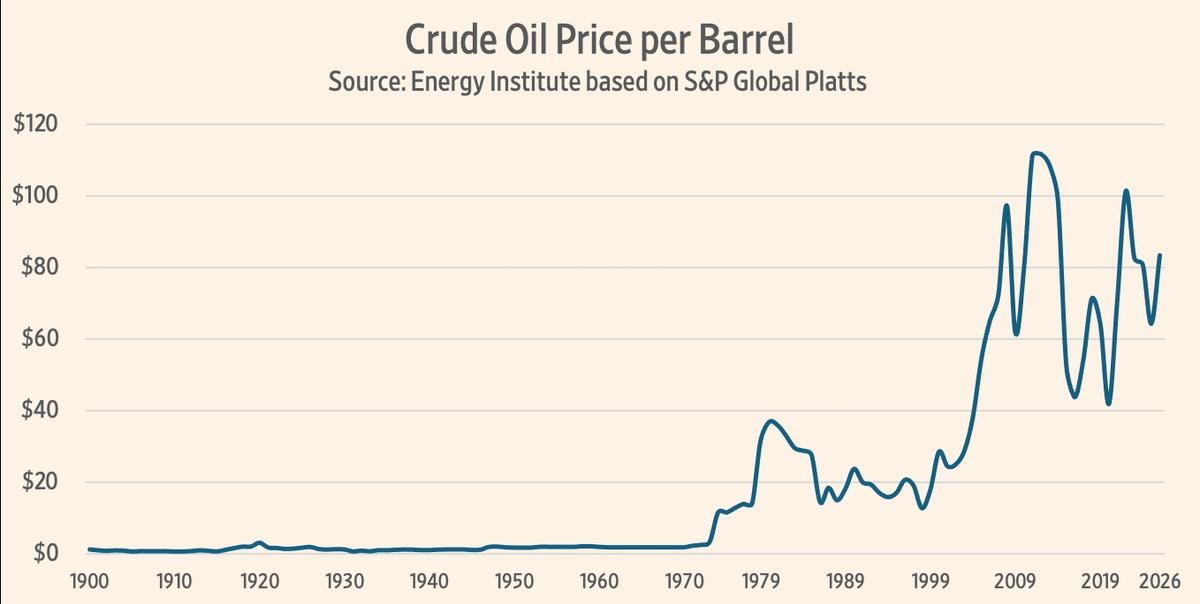
But dollar prices are only half the equation. The real question is not “What does oil cost?” but “How much of my time does a barrel require?” To answer this question we must take a look at hourly wages. For example, blue-collar compensation (wages and benefits) has increased 326 percent since 1980.
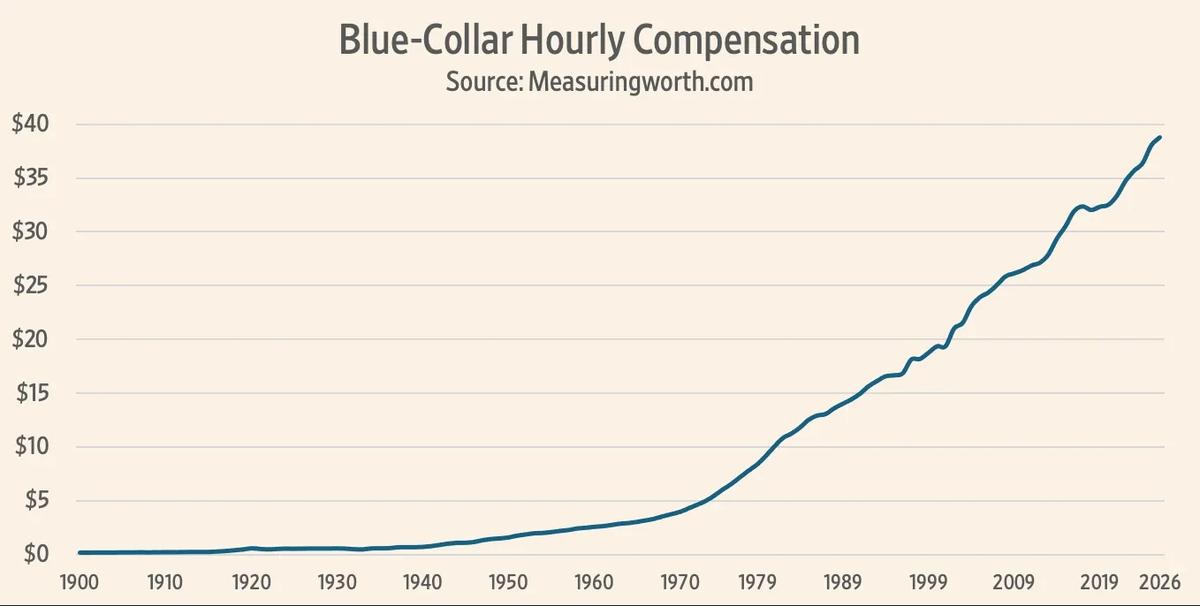
Once we divide the money price by hourly compensation, we obtain the time price: the number of hours required to earn one barrel of oil.
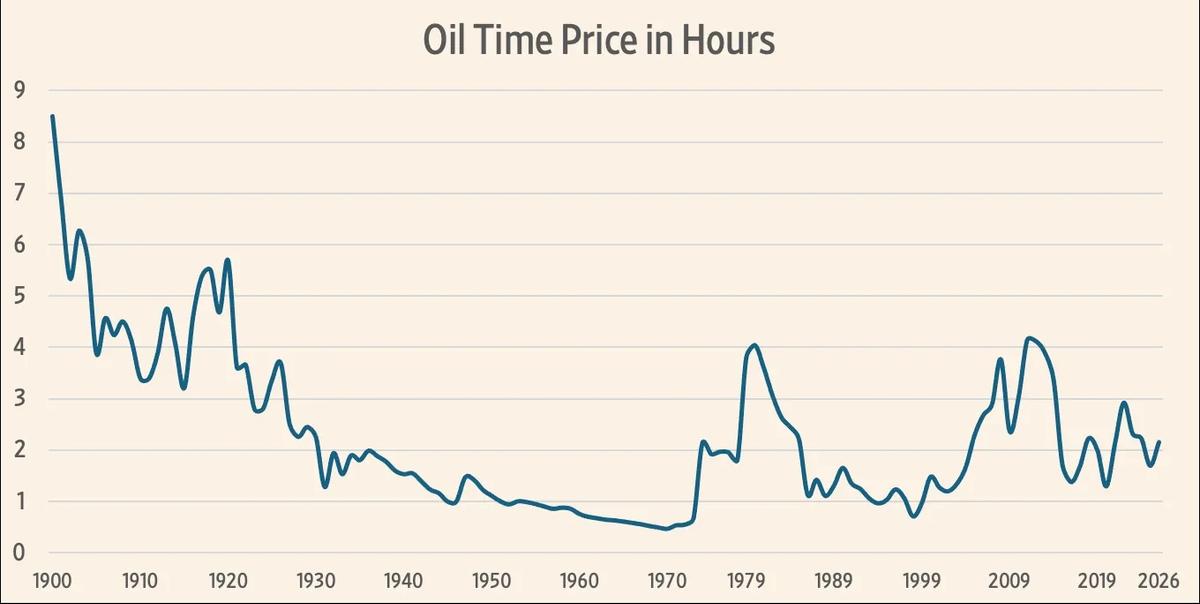
The true price of oil is measured in time, not dollars. In 1900 oil was only $1.19 a barrel, but blue-collar workers were only earning 14 cents an hour, putting the time price at 8.5 hours. In 1900 oil cost less in dollars, but much more in hours. The time price eventually fell to just 0.46 hours in 1970. Then OPEC showed up and pushed the price to over four hours by 1980. The price fell back to 0.7 hours in 1998 and then back up to 4.14 hours in 2011. Today the time price is barely over two hours, nearly half the 2011 peak.


Human ingenuity creates abundance in two ways. First, it discovers more oil. Second, it helps us accomplish more with every gallon we consume. In 1980, America’s best-selling car was the Oldsmobile Cutlass, which averaged about 20 miles per gallon: 17 in the city and 23 on the highway. By 2025, the Honda CR-V had become the most popular two-wheel-drive vehicle. Its gasoline model delivers about 31 miles per gallon, while the hybrid reaches roughly 40 miles per gallon. That represents an improvement of 55 to 100 percent over 45 years.
The hybrid performs especially well in city driving because it relies more heavily on its electric motor, captures energy through regenerative braking, and shuts off the gasoline engine while stopped.
In 1980, a blue-collar worker had to work over four hours to buy a barrel of oil, and the typical car traveled about 20 miles per gallon. Today, that same barrel costs just 2.15 hours of work, while modern hybrids travel about 40 miles per gallon. Put those gains together, and each hour of work now buys 3.72 times more transportation than it did in 1980.
America has helped energize the world by giving its citizens the freedom and property rights to discover new knowledge. That freedom has unlocked vast new supplies of oil, not because the Earth created more petroleum, but because human ingenuity learned how to find and extract what was once beyond reach. The relationship is a virtuous circle. More knowledge gives us access to more energy, and more energy empowers us to create even more knowledge. Every new oil well is also a new lesson in geology, engineering, materials science, and entrepreneurship. The ultimate resource is not oil, but human freedom. Free people create new knowledge, and new knowledge transforms finite physical atoms into ever greater resource abundance.