Napoleon Bonaparte was a man of limitless ambition and unbounded ego. Europe had not seen a man like him since the days of the Caesars: a soldier of obscure origins, rising to power, and holding a continent under his sway. From Corsican military cadet, to Revolutionary artillery officer, to conquering general, to First Consul, to Emperor of the French, making and unmaking kings and new nations, decreeing new legal codes, unbeatable in the field, his meteoric ascent dazzled the world.
In 1798, having taken Egypt, his plan was to unite the Arab world behind him and sweep down on British India, snatching the jewel from King George III’s crown. Only the need to dash back to France to seize power there prevented him from creating an Asian empire. In 1812 he had his eye on another imperial crown, that of Russia.
Organizing his forces into three columns with himself leading the central spearhead, Napoleon met no serious military resistance for the first month or so, but heat and disease were already taking their toll. Columns to the south and north of his line of attack were to keep the enemy from uniting their forces. His plan was to bring the Russians to battle quickly, destroy their armies, and seize Moscow, forcing Czar Alexander to agree to peace.

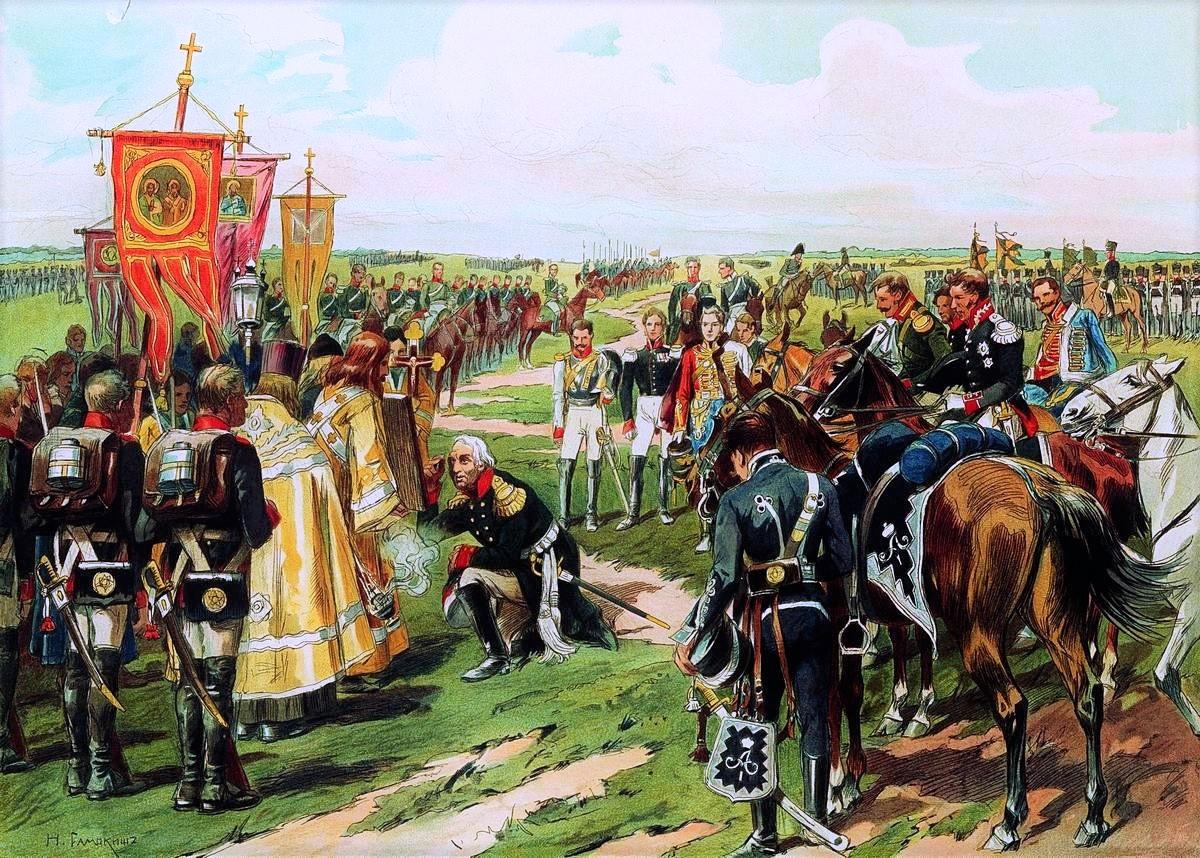
Napoleon expected, rather reasonably, that capturing the enemy’s spiritual and patriotic capital (St. Petersburg was the official capital city) meant that he had won the war—surely Russian officials would soon appear and sign the surrender. No such officials appeared. In fact, the Russians set Moscow on fire, which prompted the French army, at the end of an impossibly long supply chain constantly under attack, to retreat.
Winter snows arrived with temperatures at minus 35, and Napoleon had to withdraw through territory that had already been looted and burnt over. French armies were notorious for being poorly supplied and obliged to live off the land, but now the land offered them nothing. His massive army dwindled daily, harassed by Cossacks and guerillas; his troops were freezing, starving, and dying from disease, with Kutuzov always at their heels. The 40,000 wagons full of loot that the French had pillaged, and the artillery, were gradually abandoned as horses and mules, bereft of fodder, perished in the cold. Those men who could not walk were left behind to die.
Just as he had done in Egypt, Napoleon abandoned his troops. He had heard of a conspiracy back home to overthrow him so he took to a sled on Dec. 5 and, guarded by cavalry, fled toward Paris. It is said that when he reached the Nieman River he asked the ferryman who was to carry him across, “Have any deserters come this way?” The man replied, “No, you are the first.” He left behind 20,000 soldiers still living and struggling toward the border.
Napoleon’s Russian adventure had cost the lives of a million men, women, and children.