



One in four is, by chance, about the same percentage of Cambodians who were murdered by the Khmer Rouge government’s policies of political torture, arbitrary execution, forced labor, mass resettlement, and brutal, intentional starvation in the 1970s. Between 2 million and 3 million people were killed in just three years under a “political experiment” run by young people who were, unbelievable as it may seem, convinced they were remaking the country into a peaceful, egalitarian utopia.
Saloth Sar, like many idealistic students at Harvard or Yale, saw Western capitalism as a corrosive force. He believed it was stripping Asian peasants of their nobility and moral worth. He and his friends wanted to create a new national identity and trigger a “Year Zero” event, after which all people would be equal and the needs of the poor and weak would be addressed.
This was 1959: World wars and colonialism had torn Asia apart. Saloth believed the Cambodian people deserved better than to be a puppet state of Japan or Vietnam, or a bombing buffer zone for western militaries. He had returned home to work as a teacher, and was emulating his fellow Marxist and Chinese neighbor, Mao Zedong, when he helped formalize the Communist Party of Kampuchea.


He became convinced that to return people to their natural innocence and equality, his society must be purged of the corrupting influences of banks, factories, hospitals, universities, and other modern influences. Anyone who was highly educated (besides his inner circle, of course) and anyone who chose to live in a city or practice a profession, clearly thought he was too good to be a subsistence farmer. Saloth and his friends saw it as their responsibility to punish and reeducate such people to usher in an agrarian golden age of egalitarianism.
Only after returning to Cambodia would he take on the name by which he is now known, though culturally, it is a placeholding non-name, akin to Jane Doe, John Q. Public, or Joe Schmoe: Pol Pot.
The Communist Party of Kampuchea (the name for Cambodia in Pol Pot’s native Khmer language) would become known to the rest of the world as the Khmer Rouge, a horrifically murderous regime that massacred millions. But it didn’t begin that way.
The mild-mannered farmer’s son fell in love with a political vision of his country and his people, and he believed in that vision so fiercely that he would destroy both trying to perfect it.
Calling what happened in Cambodia “genocide” also risks obscuring the banality of that violence and the twisted idealism of the communist cause. Pol Pot had no interest in ending the genetic legacy of the Khmer people; on the contrary, he saw himself as perfecting his beloved people, purging only those who would undermine the revolution or were insufficiently committed to the future, perfect society. As the communist regime failed (as all communist regimes do), the search for scapegoats and traitors turned more and more people into acceptable sacrifices for the greater good.
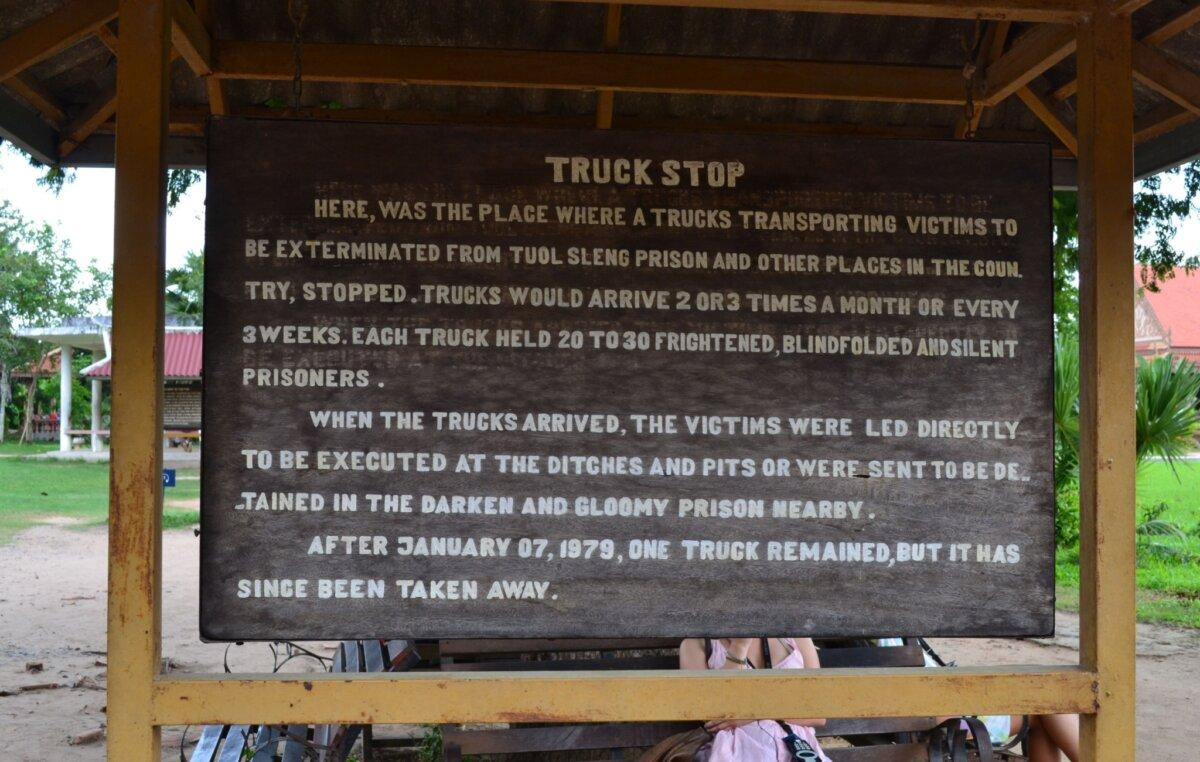
And Pol Pot could not have done such horrors alone. Thousands of people helped him. Once the vision of a perfect, Communist Kampuchea took hold, many people—even as they saw their own families murdered, their children kidnapped, their homes burned, their friends exiled, their cities emptied—would continue to believe in the dewy, sepia-tone vision that had begun germinating in intellectual salons in Paris. The intellectuals who survived defended their participation in the communist “political experiment” that made them literal slaves to the state.
“To keep you is no benefit,” went the Khmer Rogue slogan, “to destroy you is no loss.”
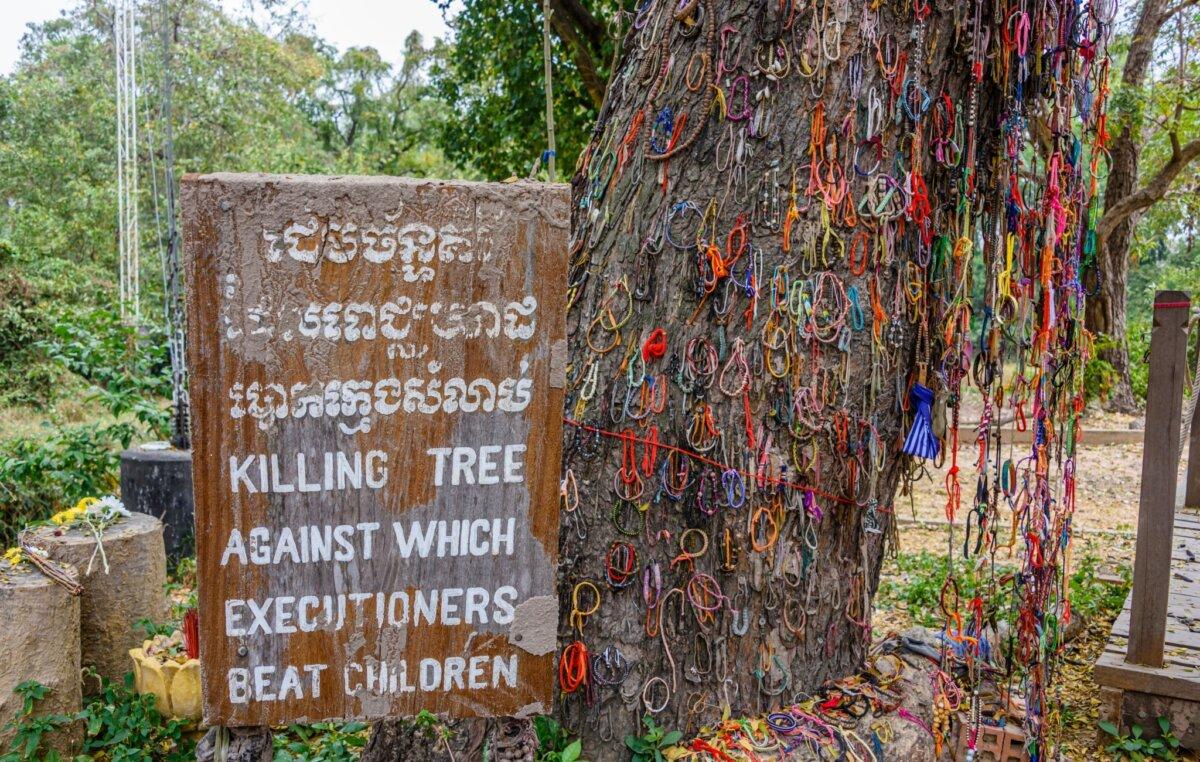
Money was abolished. Mass communications—radio, newspapers, even public gatherings—were eliminated. Private travel was banned, cutting people off from one another completely.
Religious practices, including Buddhism, were also banned. The Khmer Rouge controlled all sources of information, and few could resist the ideological narrative of government power being used to reorder humanity for its own benefit. Those who tried to resist were imprisoned, tortured, disappeared, or executed.
One architect of the Khmer killing fields, Khieu Samphan said, returning to the capital 20 years after the slaughter: “I would like to say sorry to the people. Please forget the past and please be sorry for me.” Such was the recompense for a terroristic regime, what The Guardian called, “a four year reign of homicidal terror that, even in a century featuring such butchers as Stalin, Hitler, and Mao, was almost too shocking to believe.”
But the world didn’t just look away. Many around the world, experimenting with mid-century Marxism, wanted to believe in Pol Pot’s vision for Cambodia, too. Western powers, already exhausted by proxy wars in Southeast Asia, watched with indifference. And western journalists, many of whom were Marxists themselves, reported glowingly of Pol Pot’s “experiments.”
“It remains a mystery to me that we could have been so fooled,” wrote Gunnar Bergstrom, a Swedish journalist who took a propaganda tour in 1978. He said, in a later apology, “we were fooled by the smiles, but maybe most of all by our own Mao-glasses.”
In “The Road to Serfdom,” Hayek reassured readers that the intellectuals and central planners of our acquaintance “would recoil if they became convinced that the realization of their program would mean the destruction of freedom.” But Saloth Sar is one poignant reminder that few leaders can be stopped, or will stop themselves, from imposing their tyrannical will “for our own good.” And that too many of us will be willing to look away.
Radicals and revolutionaries might capture the hearts of young people, but they cannot be allowed to capture centralized power. Only a respect for the individual and a respect for civil liberties can shield us from the “good intentions” of idealistic social planners with all their devastating, murderous, totalitarian consequences.
