Long before the Declaration of Independence declared that all men are created equal, and was adopted by 56 individuals in July 1776, colonists from Europe attempted a colony in North Carolina in 1585. However, its inhabitants, led by Sir Walter Raleigh, disappeared and became known as the Lost Colony.
The first established colony developed in Virginia in 1607, and 12 other colonies along the East Coast were recognized over several decades.
These colonists left everything behind in England and took the risk of seeking freedom of association and religion in a new land.
Over time, these American (sometimes called British) colonies became states and formed their own commercial enterprises and governing systems. However, they were still influenced by British officials and soldiers in their cities and towns. They chafed from an intrusive micromanagement in the form of English edicts and taxation without representation.
Their grievances came to a boil over many years and erupted in the American Revolution that unfolded in 1775. It lasted for eight years until the British were defeated and acknowledged American independence in 1783, which allowed the states to seize greater freedom to forge their own destinies.
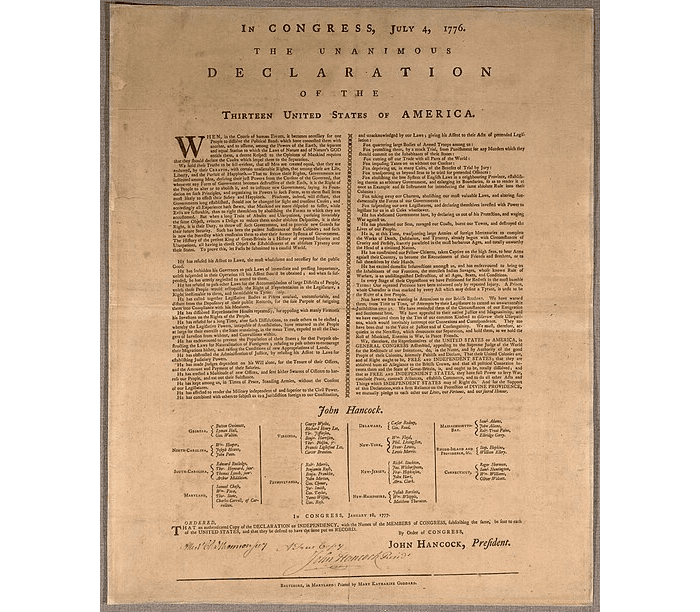
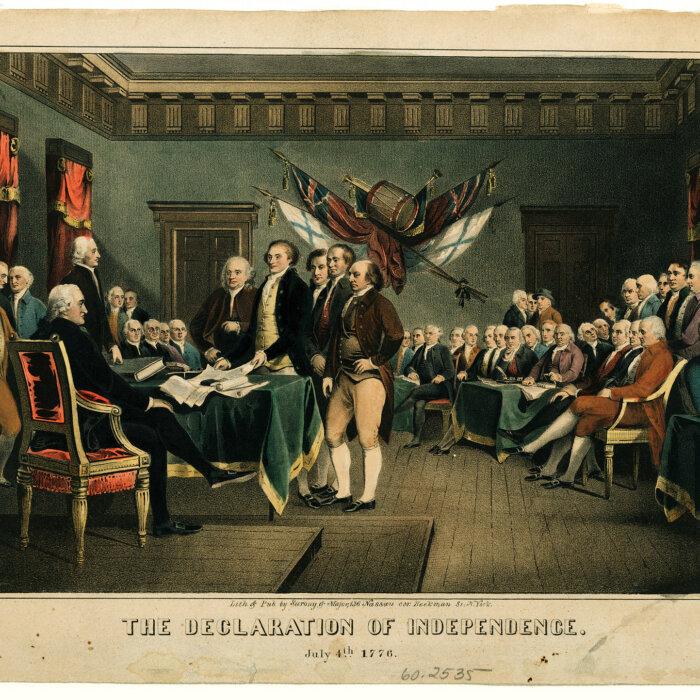
While some colonists were pro-British and were dependent on English traditions, most colonists wanted to escape the unbearable yoke of British rule once and for all. They set about forming local and state governing systems based on democratic principles, and over time came up with the wise idea of uniting these 13 states.
The Articles of Confederation and the U.S. Constitution accelerated the process of uniting 13 diverse states. The Constitution advanced the concept of liberty and equal representation with three branches of government, devoted to creating laws (legislative), enforcing laws (executive), and interpreting laws (judicial).
George Washington was unanimously elected as the first president of these United States (he would serve from 1789 to 1797). He had led the Continental Army to victory in the Revolutionary War and was pivotal in forging a federal government that delegated many powers to individuals and the states.
Declaration Is More Than a Document
The Founders of the republic never intended that the declaration would merely articulate the meaning of independence on a piece of paper only to be forgotten. It should be a constantly referenced heritage document that informs the lives of citizens and generates institutional memory, as it charts a future course of liberty and self-governance. Independence could mean freedom from the undue influence of individuals, external governments, and an overbearing government from within. The Founders were specific about keeping an arm’s length away from highly entangling relations with foreign nations.Our Founders emphasized limited government, economic freedom, property rights, just laws, and the common defense. They also believed that Divine Providence played a role in human interactions in a democratic system of governance within a civil society.
It’s possible that our Founders would be disappointed by the current state of affairs wherein America is dependent on foreign nations, both adversaries and alleged allies, for critical goods that could be produced at home.
Likewise, many Americans have become overly dependent on tax-funded social services instead of relying on their own work ethic. It’s unhealthy to be dependent on an assortment of entities, because any relationship can change or be withdrawn. One doesn’t have to be a hermit, but a balance between autonomy and social relationships is healthy.
What does independence mean in a modern context? It means the freedom to do as you please as long as you do not infringe on the rights of others to pursue their dreams. It means that you can only yell “fire” in a crowded theater if a fire has actually broken out, not when there’s an absence of fire. The Constitution protects our individual liberties, but we also must be accountable for the decisions we make, good or ill.
As we experience the 250th anniversary (semiquincentennial or sestercentennial) of the declaration this year, we ought to bear in mind some crucial principles. Abolitionist Wendell Phillips once said, “Eternal vigilance is the price of liberty; power is ever stealing from the many to the few.” If we don’t defend our God-given human natural rights, they can be eroded by the government as well as foreign adversaries.
Regressive socialists treat all-encompassing government like a deity that will solve all of our problems. They quadruple down on the devastating failures of the socialist experiment since 1917 by immorally seizing much from the productive to hand over to the slothful. What happens when they run out of the producer’s money?
Moreover, when our nation is mired in federal debt and Americans are saddled with burdensome regulations and taxation without representation to fund ineffective social programs, independence can be chipped away bit by bit via the nanny state.
On this July 4, let us carefully read the declaration in the hope of restoring its principles in our lives. We all have a role to play in enhancing common sense, responsible liberty, property rights, reasonable laws, and national security. Happy 250th, America!