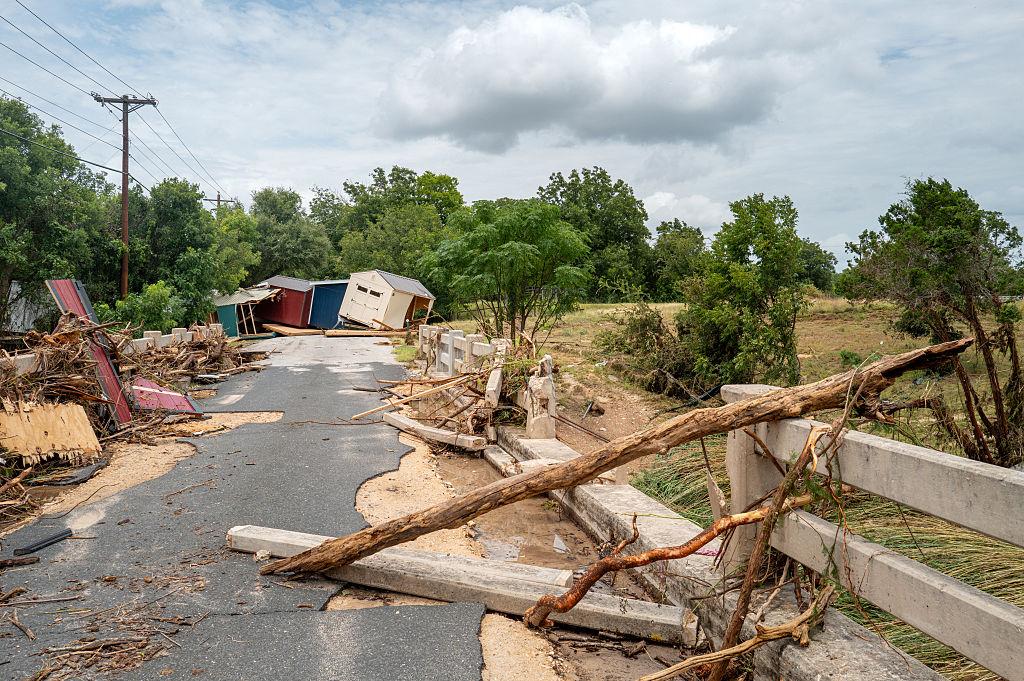
We are coming up on the first anniversary of the floods here in Texas, and I am realizing how neatly the body can hide trauma until something small calls it back. For me, it happened the other day while I was driving through Comfort. It had just started to sprinkle as I crossed over the Guadalupe River, and I could feel something shift in me physically. It was as if all the memories I had packed away in a box came loose at once.
I had forgotten, or maybe forced myself to forget, what it felt like to spend hour after hour delivering meals into devastated communities. You would drive to one place and find the wreckage of someone’s life scattered across the landscape. You would show up somewhere else, and there might be a dead body. There is only so much of that the mind can hold at once, so it stores it away until rain on a windshield, a river crossing, a certain light in the sky, reminds you that it is still there.
There is an interesting paradox in living here. We live in a place rooted in drought, where water is always part of the conversation and every season carries questions about shortage and depletion. Yet in that same place, in that same year, we experienced some of the worst flooding in local history. We know what it means to not have enough water, and we know what it means to have far too much of it all at once.
That paradox should tell us something important.
When we talk about water in Texas, we often talk about it through the language of scarcity. We talk about how many straws are in the milkshake. We talk about how many developments are going in, how many wells are being drilled, how much is being drawn out of the aquifer, and how much technology is being layered onto the land. We measure extraction far more than we measure replenishment.


What we do not talk about enough is recharge.
Every time we build, every time we pave, every time we develop land, we are creating surfaces where water sheets off quickly instead of soaking in. We accelerate the movement of water off the land and call it progress. With that same intention, we should be required to create areas of equal or greater size that capture, slow, and collect that water.
If we are going to build, we must also rebuild function. This work has to happen largely on private land, especially here in Texas, where there is very little federal land. In the Texas Hill Country, where I live, we are ground zero for both sides of this issue. We carry the flood liability and the water scarcity at the same time, and we feel it in our bodies, in our businesses, and in our land.
If we are serious about water, we have to get serious about catching it. That means swales on contour. It means slowing the flow of water across property instead of letting it rush off. It means digging with intention so water can spread, sink, and move gradually. It means creating long, level channels that hold water where it falls, allowing it to pool, infiltrate, and recharge the aquifer rather than destroy everything in its path.
The flood liability becomes a water asset, and that is not just a poetic idea. It is a practical one. When water is slowed down and given time to interact with soil, with roots, and with limestone, it filters through the earth itself. This is not the same as pumping water back into the ground through a pipe. This is filtration through living systems, through soil biology, through rock, through time. It is, quite literally, a perfect design.
And yet, the main obstacle for most landowners is cost. I know that because it is the obstacle for me. This kind of work requires equipment, planning, labor, and time. It is not out of reach, but it is out of reach for many without support.
That is why I believe that the largest water users should contribute to this work at scale. Every major development, every large industrial user, and every data center that depends on massive water consumption should put money into land-based water recharge. If we are going to pull from the system, we should also be required to put back into it in a meaningful way—not through paperwork but through actual dirt work on actual land.
There is a difference between water being cycled mechanically and water being cycled through the earth. When it moves through soil and limestone, it is cleaned, structured, and restored in a way no machine can replicate. If we want long-term water security, we have to invest in the systems that actually build it.
The other night at the ranch, during a Brownstone dinner, we had the newly nominated Republican candidate for Texas agriculture commissioner, Nate Sheets, with us. He was flooded with questions about water. Not abstract questions, but practical ones about how we manage water better and what real change actually looks like.
We were able to walk him up what we are calling trails to swales and swales to trails, showing him the work in real time. Showing him men on the land, deeply engaged, highly motivated, doing the work that actually changes outcomes. It is one thing to talk about water policy in a room. It is another thing entirely to stand on land that is being reshaped to hold water differently.
I have had the honor over the past several weeks of having incredible men on my land doing this work alongside me. People such as Bryan Hummel and Jess Mayes, in partnership with Terra Advocati, Water Ranching, and DPTX. What they are doing is not theoretical. It is not something you read about. It is dirt work. It is contour work. It is long days shaping land so that water moves differently. Watching it happen on my own property has made it undeniable to me that this is the work that needs to be done, not someday, but now.
What became clear in those conversations is that people are ready. Landowners are ready. Communities are ready. The missing piece is not willingness. It is alignment and support.
When beavers were removed from much of the American landscape, we did not just lose an animal. We lost a system. Beavers slow water. They spread it. They force it to interact with the land in ways that allow it to infiltrate and recharge. The long-term effects of removing them have been felt across the country.
But there is another keystone species that has the ability to do similar work, and it is us. We have the capacity to shape land, to slow water, to spread it, and to help it sink back into the earth. The question is whether we will step into that role or continue to act as though we are only capable of damage.
One of the most exhausting narratives of our time is the idea that humans only ruin things. That our presence is inherently destructive. It is not true. Humans can destroy, but we can also restore. We can shape land in ways that bring water back into relationship with it, and we can take responsibility for what we have altered and begin to repair it.
We have been taught to fear water when it comes too fast and to fear its absence when it does not come at all, but water itself is not the enemy. The question is whether the land is ready to receive it. There is so much conversation about what is happening to our water and so little conversation about what we can do to catch more of it.
The rain that brought devastation can also bring replenishment. The same water that terrified us can begin to heal the land if we are willing to slow it down, spread it out, and let it sink in. There is grief tied up in what we experienced last year. I feel it in my body every time the sky turns and the rain begins, but grief, if it is going to serve us, has to move. It has to become action.
As the anniversary of those floods approaches, I still remember what the water took, but I also know we cannot afford to stay in that memory alone. The work in front of us is not abstract. It is on the land, in the soil, and in the decisions we make about how water moves across every acre we touch. The difference between a flood and a future often comes down to what we did before the rain fell.