A real-life example of the Chinese regime’s United Front in action just unfolded in Texas.
The U.S.-China Catholic Association (USCCA), founded in 1989 to educate Catholics in America about the plight of their co-religionists in China, is now taking orders from—if not effectively run by—the United Front Work Department of the Chinese Communist Party (CCP).
Here’s the evidence.
The recent biennial USCCA conference at the University of St. Thomas in Houston was supposed to have been headlined by professor Fenggang Yang of Purdue University. Yang is a well-known advocate for religious freedom who has not only spoken out against the CCP’s persecution of Christians but has also specifically criticized the secret 2018 Vatican–China deal.
At the conference, however, Yang did not plan to address these politically sensitive topics. In fact, his speech was innocuously titled “Transforming Guanxi: Chinese Christian Transnational Ties and the Making of Social and Spiritual Capital.”
It fit well into the overall theme of the conference, which was titled “Following the Way of Christ: Nourishing Trust and Friendship.”
Even so, when Beijing got wind of the fact that Yang had been invited to speak, it dropped the hammer.
Peter Tan, the chairman of the Board of Directors of the USCCA, was told by two Chinese officials to cancel Yang’s keynote address and remove him from the list of speakers. And Tan did as instructed.
We know this because, in an exclusive statement to LifeSiteNews, Yang recounts in detail how the matter unfolded. He had been invited to keynote the July 31–Aug. 2, 2026 USCCA conference the year before. But in May of this year, he received an email from Tan, saying that Chinese officials had raised objections to his inclusion in the conference.
“I just returned from China. While I was in Shanghai, I was confronted by two government officials regarding your participation in our conference,” the email reads.
Yang then called Tan, who reiterated that two Chinese officials had asked for his removal from the program. Tan then asked Yang to voluntarily withdraw from the conference.
Yang responded: Who exactly were these unnamed officials, where did they work, and what were the specific reasons they wanted him dropped?
The board chair of the USCCA immediately became evasive. He told Yang he wasn’t sure who they were or why they would want him removed.
Then, in a clumsy effort to steer the conversation away from China, Tan made the absurd claim that the University of St. Thomas and the Archdiocese of Houston—both co-sponsors of the conference—would cancel the conference if Yang did not withdraw.
None of this was good enough for the good professor. He told Tan that he intended to attend the conference and give his planned speech—unless the USCCA’s Board of Directors formally disinvited him.
Two weeks later, Yang found that his name had been removed from the conference program. When he contacted several USCCA board members to ask why, no one had any answers. An official letter of “disinvitation” eventually arrived, but it, too, gave no reason for his cancellation. At the same time, it asked him to “keep this letter and the details of this situation strictly confidential.”
This Yang has refused to do. He questions why Chinese officials apparently “have the authority to require a U.S. organization to remove a speaker from its conference program for unspecified reasons.”
He reasonably asks: “Who is Peter Tan? Why does he take Chinese officials’ instruction to silence me for an academic presentation at a religious association’s conference?”
Yang rightly calls this transnational repression. This is true on its face, but is it more?
Is the USCCA still a U.S. organization, or has it been compromised by the CCP’s United Front Works Department (UFWD)?
The UFWD, which has overall charge of religious affairs in China, is engaged across multiple fronts to shape and control public opinion in the United States—suppressing voices critical of China while advancing narratives and promoting individuals who support the Party’s policies.
If you wanted to control the narrative about the persecution of Christians in China, having friends, not to say agents, at the U.S.-China Catholic Association would be a good place to start.
I do not seem to be alone in the opinion that the organization has been compromised.
After Yang’s cancellation, LifeSiteNews reported that distinguished sociologist professor Richard Madsen refused to attend the conference and resigned from the board.
Another sign that the USCCA is now marching in lockstep with the CCP comes in its revised mission statement.
Originally set up to educate Americans about the plight of their suffering co-religionists in China, the organization now states that its purpose is to build fraternal ties between “the Catholic communities on both sides of the Pacific.”
Under Tan’s leadership, the USCCA has been silencing individuals who have spoken out about the underground Catholic Church, while at the same time promoting voices who support the CCP’s policy of “Sinicization.”
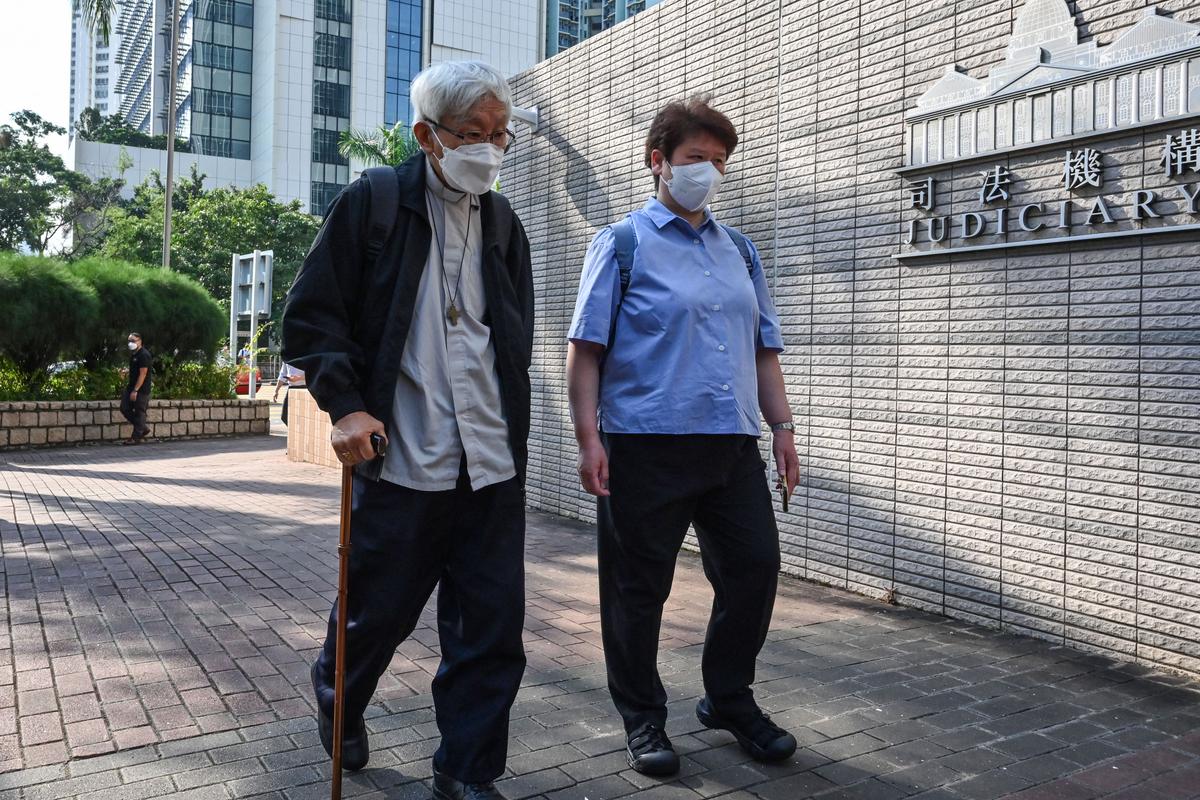
At least one USCCA board member has been removed for expressing sympathy for Cardinal Joseph Zen, persecuted Chinese Catholic businessman Jimmy Lai, and the Underground Church. The ejected board member was also skeptical of the CCP’s goal of Sinicization, as most Chinese Catholics are as well.
They understand, as most Americans do not, that the CCP’s policy of Sinicization is not really about Chinese culture. It is rather about political control and forcing the Chinese faithful to adapt to its Marxist ideology.
Shi Taifeng, who heads the Party’s United Front Work Department and is overall in charge of the Sinicization project, openly admits that the policy of Sinicization has a political rather than a cultural meaning.
That is to say, Sinicization has nothing to do with Chinese cultural traditions. Rather, it means that Catholics in China must adapt to the Marxist–Leninist–Maoist state and its ideology.
It would be more accurate to call it ‘Marxification.” We have seen this at play before—in Nazi Germany. Just as Lutheran and Catholic churches in Germany were forced to serve the goals of the Third Reich, so are churches in China forced to foster the worship of the CCP and its “core leader” Xi Jinping.
Sinicization is also closely tied to the officially secret Sino–Vatican deal signed in 2018, which is believed to recognize the state-approved church in China and to allow the CCP to appoint bishops.
The evidence shows that USCCA has devolved into an organization that works closely with China to manage Western perceptions of “Sinicization,” the Sino–Vatican Agreement, and the broader persecution of the Church in China. It downplays and suppresses critical accounts and voices.
Has it been captured by the CCP’s United Front Work Department?
I suspect that professor Fenggang Yang would say yes.