



While censorship is often the main focus of discussions about free speech, there’s a related phenomenon that can do just as much damage to a free society. Not by preventing people from saying things they believe in, but by forcing them to say things they do not.
Compelled speech requires people to use certain words or phrases, or to partake in upholding certain ideological beliefs. It is just as dangerous to free expression as overt censorship.
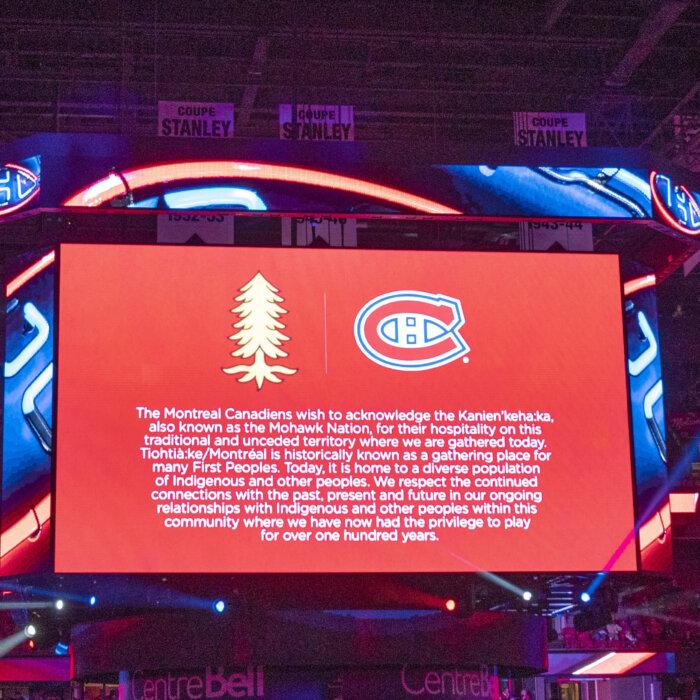
The constant recitation of indigenous “land acknowledgements” illustrates Canada’s shift towards enforced mass-compliance on complicated social issues. These statements have become ubiquitous in Canadian public life: at schools, workplaces, government functions, ceremonies, and sporting events. Institutions display them on websites, documents, email signatures, and social media. A busy person in Canada may come across dozens of land acknowledgements per day in various contexts.
Although framed as optional gestures of respect, many organizations now have policies mandating land acknowledgements; in other circumstances, social pressure can make them seem obligatory even if they’re not.
Land acknowledgements have morphed well beyond a simple sharing of history into something much more problematic: they have become a sort of sacred ritual with near-spiritual implications, tying certain ethnic groups to ownership over nature itself. When unpacked, there is a lot being said between the lines.
“I don’t think there is anything good that can come out of the idea that a certain ethnic group are the true inheritors of this land,” Horsman said in an interview. But when he raised his objections about the practice, he encountered immediate resistance. In a series of meetings with Waterloo Region District School Board staff, he was told that even discussing the issue was off the table. He has since brought a legal case against the board.
Horsman’s and Kronas’s cases are both about indigenous land acknowledgements, but the issues they raise run deeper. They could have been challenging any form of imposed ideological speech. In fact, many Canadian governments and institutions are developing a worrying track record of legally enforcing ideological language on a number of topics.
Compelled speech, or compelled support for any position, quells discourse and creates a type of moral injury. Whether you support the notion of land acknowledgements or not, there is a contradiction at the core of the concept: how can words be respectful if they are coerced?
Most Canadians consider themselves polite, kind, and caring, a usually laudable set of characteristics that has lately been weaponized. How might we begin to move on from the current cultural climate of tension and towards a freer and more relaxed Canada?
Retired Manitoba judge Brian Giesbrecht has some suggestions. In an interview, Giesbrecht agrees that today’s land acknowledgements “create a divisive form of belief in which some people only have rights as ‘settlers.’” To shift this situation, he offers a list of possible ways Canadians can object to compelled speech. His list includes making a written complaint, standing up and objecting in public, walking out of a meeting, and using legal channels to challenge attempted ideological coercion.
The future of a prosperous, functional, united Canada depends on being able to say what you believe and having the freedom to remain silent when you do not. This Canada can and must be restored. Next time you encounter a belief you do not feel eager to participate in, consider abstaining or politely pushing back. If we all resist these pressures, it will no longer be an act of bravery to conduct oneself genuinely and truthfully.