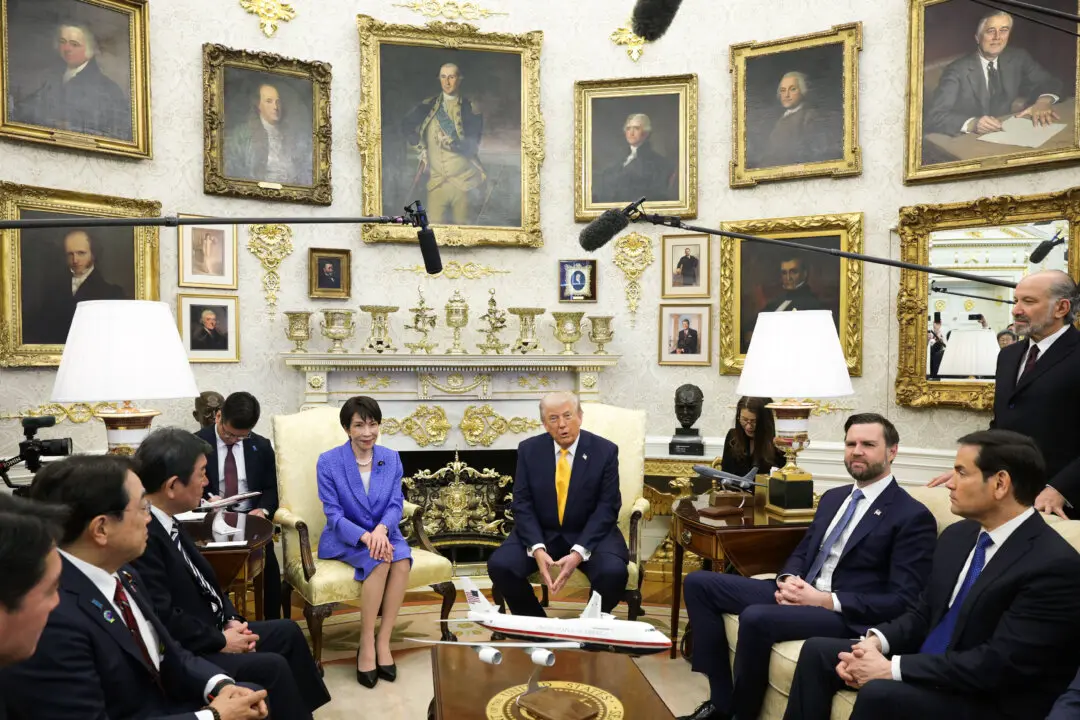
In July 2025, the European Union signed a landmark trade agreement with the United States. U.S. President Donald Trump described it as “the biggest deal ever made.” On paper, it looked like a win-win. But in policy circles across Europe, it landed more like a warning shot than a celebration.
The core terms were stark: The EU agreed to impose a flat 15 percent tariff on all goods it exports to the United States—more than the 10 percent that the UK got in the deal—including autos, auto parts, pharmaceuticals, and semiconductors. Crucially, its steel, aluminum, and copper exports will remain subject to punitive 50 percent tariffs. In return, the United States will pay zero tariffs on all U.S. exports to Europe, covering industrial goods, agricultural products, and digital services.
Perhaps more striking were the European purchase commitments. Under the deal, the EU pledged to import $750 billion of U.S. energy products—liquefied natural gas, crude oil, and refined fuels—by 2028, along with substantial volumes of semiconductors and industrial inputs. Brussels also committed to facilitating $600 billion in new European investment into the United States over the course of Trump’s second term.
European Commission President Ursula von der Leyen framed the agreement as necessary pragmatism. “You’re known as a tough negotiator and dealmaker,” she told Trump, adding that the deal “delivers stability and predictability.” But her tone was notably defensive. When pressed on the 15 percent tariff for European carmakers, she conceded it was ”the best we could get.”
German Chancellor Friedrich Merz struck a similar note: relief over avoiding a full trade rupture, but no illusion about the pain to come. “More simply wasn’t achievable,” he said of a better outcome.
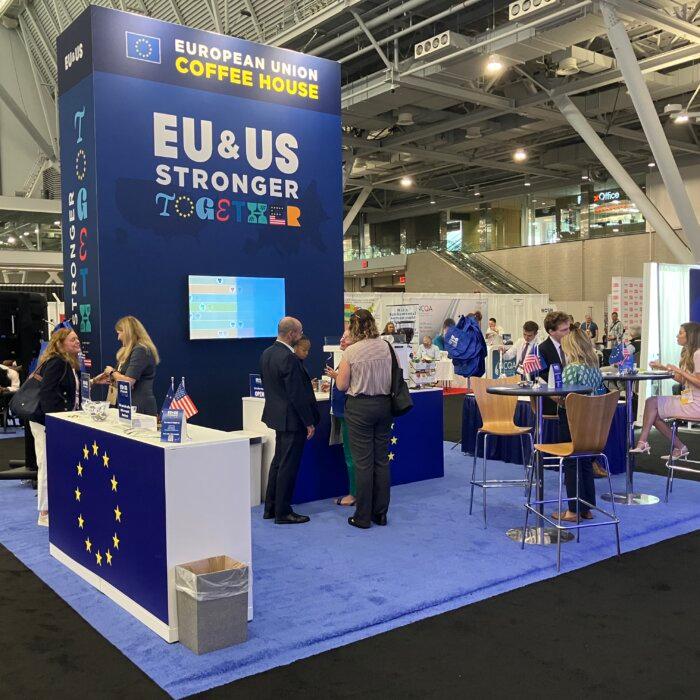

Across the continent, the reaction was muted. The Belgian prime minister called it a “moment of relief but not of celebration.” The French minister for European affairs described the deal as “unbalanced.” Hungarian Prime Minister Viktor Orbán offered perhaps the most vivid summation when he said, “Trump ate Ursula von der Leyen for breakfast.”
Veteran British journalist Andrew Neil, with a dash of post-Brexit schadenfreude, pointed out that the UK had negotiated a “far better deal”—unshackled, as it were, from Brussels.
But this wasn’t just a debate over tariffs. For many observers, the real question was structural: How did a bloc of 27 nations, with 450 million people and immense economic weight, end up looking like a junior partner in negotiations?
The Stealth Path to Unity
The European project was never just about economics. From its earliest postwar visionaries such as Jean Monnet and Robert Schuman, the idea was that lasting peace and prosperity in Europe required a deeper political union.But the path chosen was gradual and elite-driven. Instead of launching a public constitutional process like the United States in 1787, which demanded buy-in from the citizenry, Europe’s leaders opted for incremental integration through treaties and bureaucratic layering. Monetary union was introduced without full political union. Institutions such as the European Commission and the European Central Bank were empowered without always being directly accountable to European citizens.
What emerged was what scholars came to call “integration by stealth.” Not a conspiracy, but a methodology—one that produced a powerful administrative apparatus, but also a weaker sense of civic ownership. Today’s EU sits somewhere between a federation and a confederation. Authority is divided. Responsibilities overlap. This process—of layering authority without fortifying accountability—helped build impressive institutions, but it left Europe ill-prepared to act decisively when it matters most.
A System That Blinks in a Crisis
In stable times, the EU functions. Its institutions regulate markets, coordinate standards, and pool technical expertise. But when the world gets messy—when pandemics hit, energy supplies are weaponized, or trade conflicts erupt—the EU’s slow, multi-speed machinery struggles to respond.Take the COVID-19 crisis. The EU struggled to coordinate vaccine procurement, while national interests quickly reasserted themselves, national borders re-erected. Energy policy offered another: The bloc’s decades-long reliance on Russian gas was well known, yet efforts at diversification remained piecemeal until after Moscow’s 2022 invasion of Ukraine.
On foreign policy, the picture is even starker. While the EU has long aspired to “strategic autonomy,” it continues to rely heavily on U.S. defense guarantees through NATO. Joint military procurement is limited. Diplomacy is often divided. And even in areas in which Brussels speaks for the bloc—on trade or sanctions—individual member states can undercut consensus.
Princeton’s Andrew Moravcsik elucidated back in 2012: “Where basic national interests and regulatory styles have converged, as in the area of trade, governments have developed strong rules to coordinate their policies [...] In the areas where countries have not brought their policies in line, regulation remains voluntary and largely national.”
How Others Exploit the Gaps
External actors have noticed. Over the past two decades, powers such as the United States, China, and Russia have learned to navigate the EU’s divided structure—and have strategically exploited those gaps.The United States has frequently bypassed Brussels to negotiate directly with key capitals. During the Iraq War, the Bush administration built a “coalition of the willing” by engaging newer EU members such as Poland and the Czech Republic, sidelining France and Germany. In trade talks, often Washington preferred dealing with the nations that matter most to its interests at the time.
Russia has played a long game of energy diplomacy—cutting bilateral gas deals with Germany while using supply disruptions to pressure Eastern states. The Nord Stream 1, signed in 2005, was a bilateral pipeline deal between Russia and Germany—negotiated without Brussels. It deepened divisions within the EU just as Eastern states warned that dependency on Russian gas was a strategic mistake. And during crises, such as the 2021 migrant standoff engineered by Belarus, the EU’s disjointed response only confirmed Moscow’s strategic calculations.
The Chinese Communist Party, too, has worked the EU’s seams. Its 17+1 initiative engaged Central and Eastern European countries directly, offering infrastructure deals outside of EU frameworks. In 2017, Greece—after Chinese investment in its port—blocked an EU statement criticizing Beijing’s human rights record. Italy’s 2019 decision to join the Belt and Road Initiative further exposed Brussels’s lack of cohesion. Then Italy was hit hardest during the COVID-19 pandemic, and has in recent times done an about-face.
Even Middle Eastern powers such as Qatar and the United Arab Emirates have learned to deal bilaterally—through energy contracts, arms deals, or cultural diplomacy—with France, Germany, or Italy, bypassing collective EU positions.
Even internally, countries such as Hungary and Poland have repeatedly vetoed or delayed joint EU positions on rule of law, migration, and Ukraine sanctions—further weakening the bloc’s external credibility.
And that gap hasn’t just cost Europe. It has cost the world.
Would China’s strategic rise over the past three decades have gone so uncontested if the EU had been a global actor with real geopolitical weight? Would Russia have deepened its military alignment with Beijing if Europe had projected more than regulation? Would the first Iran nuclear deal—crafted with heavy EU involvement—have been so easily circumvented?
The Shift Toward Sovereignty—and the Importance of Timing
The global mood has changed. The 1990s and early 2000s were characterized by optimism about globalism, supranational governance, and borderless integration—a window of opportunity for the “European project.” Today’s world is more fragmented, more adversarial, and more focused on national sovereignty.From Brexit to Trump, from Eastern Europe to Asia, citizens and leaders are asserting national autonomy. Integration, once assumed to be the future, is now questioned—even by former advocates. More than ever, bold reform requires not just treaties, but also persuasion—of citizens, not just elites. And in this climate, systems that can’t move with clarity risk getting sidelined.
That’s the deeper story behind the 2025 trade deal. It’s not just about tariffs. It’s about the difference between having weight and having force.
The EU still has enormous assets: population, capital, technological capability, and cultural reach. Yet without institutions that combine legitimacy with the capacity to act, those assets remain relatively inert.
As historian Timothy Garton Ash warned back in the year 2000, “Europe’s drive toward unification threatens just the opposite—disunity.” That paradox remains as yet unresolved.