Anthony Fauci, former director of the National Institute of Allergy and Infectious Diseases (NIAID), had no official position as the COVID czar in 2020. He was merely one member of the Coronavirus task force. Nonetheless, through his daily and many media appearances, he did become the face of the pandemic response. He did exercise a significant degree of power.
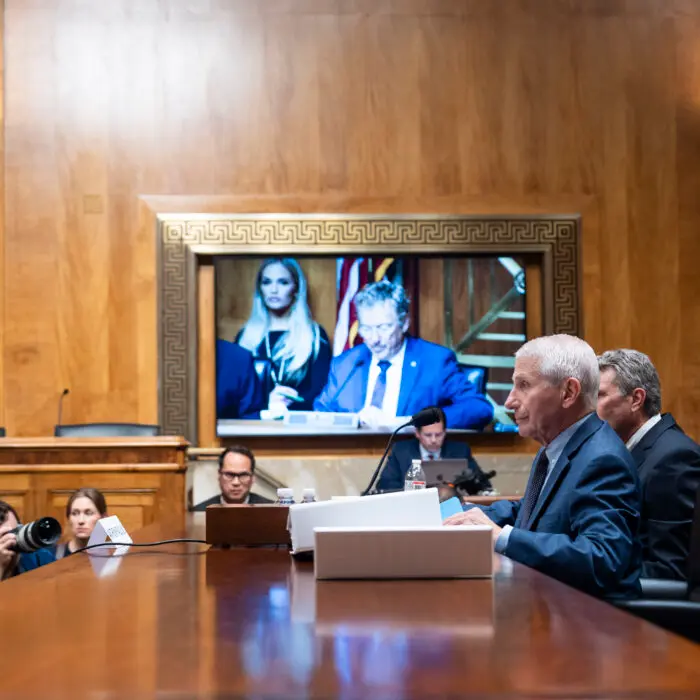
In the hearing, Fauci invoked the Fifth Amendment 111 times. For many foreign readers, this provided an interesting look into how constitutional rights work in the United States. The Fifth Amendment says no one can be “compelled in any criminal case to be a witness against himself.”
It’s actually quite inspiring to see how the Bill of Rights works in a case of such significance. Complicating matters, in this situation, is that Fauci was granted a pardon by the former president, so he was not actually legally vulnerable to be held to account for past deeds.
The irony is deepened upon reflection of the lockdown period itself. During these times, the Bill of Rights that Americans count on to protect their rights and liberties was dramatically weakened under the excuse of emergency.

First Amendment
Churches and synagogues faced capacity limits or outright indoor bans while secular “essential” businesses (liquor stores, big-box retail, casinos in some places) operated with fewer or no comparable limits.Pastors were arrested or charged for holding services (e.g., Rodney Howard-Browne in Tampa; Tony Spell in Louisiana).
Gatherings for worship, protests, or social purposes were restricted or banned for extended periods.
Second Amendment
Some jurisdictions (Los Angeles and Ventura Counties in California, parts of New York, Massachusetts, Michigan, New Mexico, Washington, New Jersey, Pennsylvania) classified gun and ammunition dealers as non-essential and ordered them closed for days to weeks while other retailers stayed open.Third Amendment
Was there quartering of soldiers in private homes? Yes.Fourth Amendment
Contact-tracing programs, exposure-notification apps, and location/data collection were warrantless surveillance.Tracing required data on contacts of infected persons and were extracted and uploaded to bulk metadata programs.
Quarantine enforcement and some testing/isolation orders proceeded with limited due process.
Fifth Amendment
Stay-at-home orders functioned as extended house arrest for healthy people; “non-essential” businesses were shuttered by executive decree, destroying livelihoods and supply chains without individualized hearings.Vaccine mandates for federal workers, contractors, military, healthcare, and (via OSHA) large private employers conditioned employment on an injection—compelled medical treatment without fully informed consent.
Courts struck down the broad OSHA private-employer mandate and some federal ones; military denials of religious exemptions produced extensive litigation and career penalties.
Sixth and Seventh Amendments
Court closures and delays produced massive backlogs. For many people, the courts were effectively closed.Speedy-trial rights and civil jury trials were postponed for months to years in many jurisdictions, leaving defendants and litigants in limbo.
This was treated as logistical necessity rather than deliberate suspension, but the practical effect was widespread justice delayed.
Eighth Amendment
In prisons, COVID-positive or exposed inmates were placed in conditions described as windowless, filthy, high-security isolation cells with severe restrictions on movement, showers, and property—conditions previously associated with disciplinary or death-row housing.Ninth Amendment
Unenumerated rights claims centered on bodily integrity, medical autonomy, freedom of travel and association, parental rights over children’s schooling/masking/vaccination, and the freedom to skateboard, surf, or just take a walk.Tenth Amendment
Federal vaccine mandates (OSHA for private employers, contractor rules) usurped traditional state police powers over public health. The Supreme Court invalidated the OSHA rule as exceeding statutory and constitutional authority. Prolonged emergency declarations by governors suspended ordinary legislative processes in multiple states.The overall package—lockdowns of the healthy, discriminatory religious limits, speech suppression, business destruction, and conditional access to work/society via vaccination—was the greatest peacetime civil-liberties intrusion in modern U.S. history, second only to slavery. Courts ultimately reined in some of the most extreme measures, especially on religion and the federal private-employer mandate, but many policies operated for months or years first. Empirical debates continue over necessity versus excess and net harm.
The Bill of Rights is one of the great achievements in the history of modern government. It should never be made mute due to emergencies. Fauci’s own testimony reminds us of the power of the Constitution. One wishes it had been just as operational while he was in charge of the pandemic response.