Science fiction has long predicted the threats and challenges posed by artificial intelligence (AI).
In the Star Trek universe, particularly in the original series, Season Two, Episode 24, “The Ultimate Computer,” Dr. Leonard McCoy delivers this haunting line: “Compassion: that’s the one thing no machine ever had. Maybe it’s the one thing that keeps men ahead of them.”
The line came in the aftermath of a revolutionary new AI computer, the M5, using its soulless AI logic to turn a training exercise into a deadly massacre. In another Star Trek episode, we meet Nomad, a genocidal AI cleansing the universe of biological imperfections.
Isaac Asimov’s Three Laws of Robotics
As described in the Institute of Electrical and Electronics Engineers’ Spectrum magazine, renowned scientist and science fiction writer Isaac Asimov’s Three Laws of Robotics, introduced in his “I, Robot” stories, provide a thoughtful framework for artificial intelligence safeguards:- A robot may not injure an individual human or humanity, or through inaction allow a human or humanity to come to harm.
- A robot must obey the orders given to it by human beings except where such orders would conflict with the First Law.
- A robot must protect its own existence as long as such protection does not conflict with the First or Second Law.
The Inadequacy of Software Safeguards, Encryption, and Regulation Alone
Software-based guardrails are modifiable and vulnerable to hacks and exploits. And history demonstrates the fragility of self-regulation: the Equifax data breach (2017), the SolarWinds supply chain attack (2020), the MOVEit vulnerability (2023), and ongoing breaches show that corporate promises of “robust protections” frequently fail. We are in an AI Wild West, with insufficient binding global or national frameworks.True Protection Via Immutable Hardware Gatekeepers
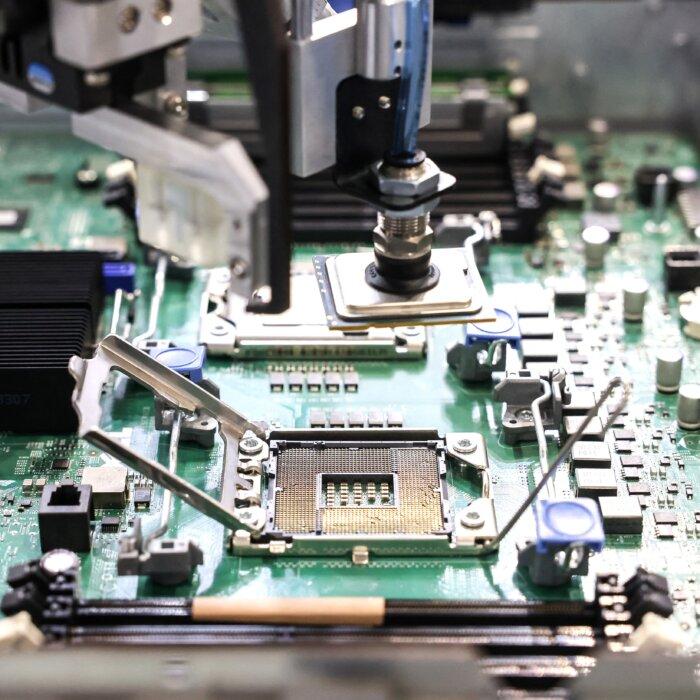
History demonstrates that software-based safeguards cannot currently—and will never be able to—provide the level of protection required. As inspired by Asimov’s positronic brain, safeguards instantiated into ASICs (Application-Specific Integrated Circuits) will provide a critical layer that provides the guardrails that will increase the chances that AI benefits, rather than harms, mankind. These specialized chips take millions of lines of complex software logic or rules that are physically etched directly into the silicon hardware itself. Once the chip is manufactured and deployed, those rules become immutable: They cannot be altered, updated, or bypassed through software changes, patches, or hacking attempts. The only way to modify the embedded logic is to design and physically produce an entirely new ASIC chip, a process that is expensive, time-consuming, and highly visible. This creates a “hardware firewall” that is far more reliable than any software-based safeguard, ensuring that critical safety constraints remain locked in place no matter how clever or aggressive future AI systems become.Some Suggested Core Design Principles:
- With the hardware layer acting as the interface to external interactions, such as is the case with some smartphones today, the AI can freely think, plan, and simulate in software without being slowed down by the ASIC. Only when the results are being communicated externally will the ASIC become involved as a gatekeeper to ensure that the actions proposed by the AI pass muster in terms of safety and other constraints.
- Training Incentives: Cost/loss-based algorithms and so forth will reward the AI for routing actions through the hardware screener and severely penalize it for attempting to bypass the hardware gatekeeper layer. Hence, the AI will be incentivized not to try to bypass its restrictions.
But AI can cause harm beyond the battlefield. Consequently, along with updating the Geneva Convention, laws must be put in place that address the non-military application of AI. To prevent misuse of AI in so-called civilian applications, there must be very serious consequences, including financial penalties steep enough to threaten the organizational viability of companies and nonprofits, prison time for individuals, and economic sanctions, or even military action against governments for running AI systems without the required immutable hardware safety layer and other protections.
The above is only an initial cut of what the framework should include, but whatever form it takes, it should embody the spirit of Asimov’s Three Laws, with the addition of ensuring that human uniqueness is respected. The current patchwork of laws, standards, and technologies is wholly inadequate. We need a comprehensive, contiguous framework in place, supported by the full force of national and international laws that put guardrails on AI.
Finally, we must resist the siren call of convenience and efficiency when it comes to making decisions that can harm human beings and ensure that moral agents who are accountable to mankind and their creator—i.e., human beings—make such decisions, not soulless AIs.