But as someone who lives near Austin, Texas, I’ve seen firsthand that avoiding federal overreach is only part of the solution. States must also resist the temptation to control energy markets—something Texas is starting to get wrong.
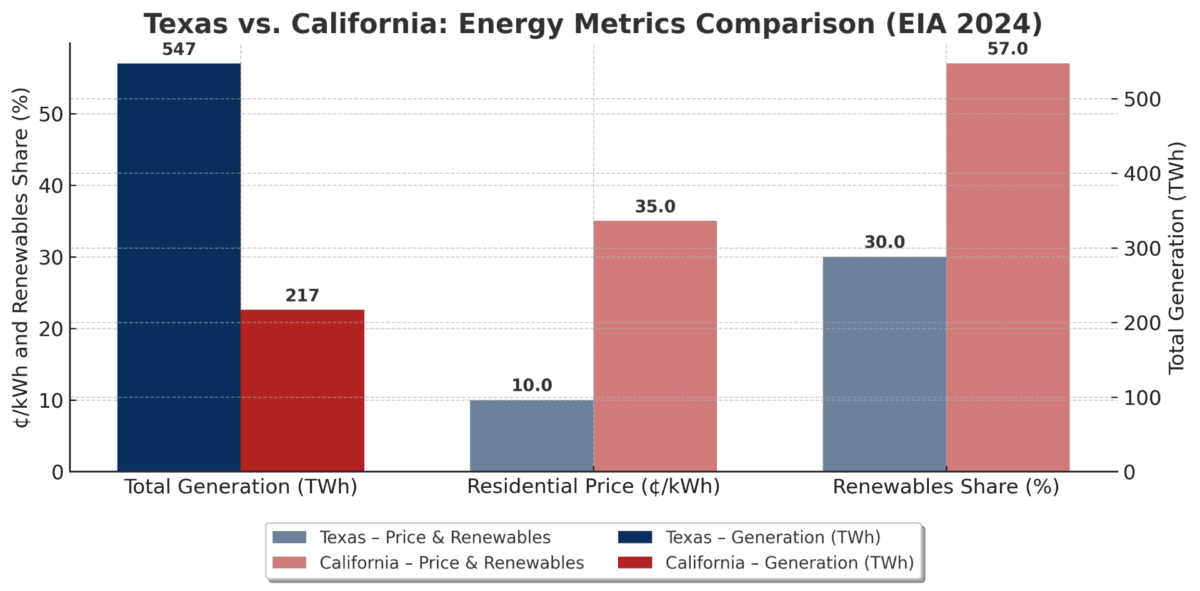
- California has some of the highest residential electricity rates in the country, averaging 35 cents per kilowatt-hour, compared to 10 cents in Texas.
- Texas produced 547 terawatt-hours of electricity— more than a quarter of U.S. generation—while California generated 217 terawatt-hours.
- California’s renewable share is 57 percent, compared to Texas’s 30 percent.
Texas Risks Becoming California
The Texas blackout during 2021’s Winter Storm Uri was a wake-up call. As energy economist Rob Bradley, policy expert Bill Peacock, and others have reported, frozen wind turbines and iced-over solar panels were unable to meet demand. Natural gas plants underperformed due to poor weatherization, and the state’s overreliance on intermittent sources magnified the crisis.

Subsidies Distort Energy Markets
Subsidies heavily distort Texas’s power generation market. Federal production tax credits and Inflation Reduction Act subsidies for wind and solar drive massive overbuilding, even when those sources couldn’t meet demand during peak stress.Now, Texas is repeating its errors with dispatchable generation—bolstering natural gas with state-backed loans rather than allowing higher market prices to attract private investment. As AIER research has shown, markets allocate resources more efficiently when prices reflect actual costs and risks. When the government guarantees a return, investors chase subsidies rather than consumer demand.
Energy Freedom Drives Prosperity
Energy is a foundational component of economic growth. It powers manufacturing, health care, technology, and every part of modern life. Energy policy must be grounded in cost-benefit analysis and market principles—not central planning and political favors.Secretary Wright is correct to warn that Europe’s “net zero” strategy has made energy more expensive and less reliable. The United States should not follow suit, and neither should Texas. Instead, lawmakers should remove barriers to pipelines, LNG terminals, and power plants, while eliminating taxes and fees on oil and natural gas production that fund unnecessary government growth.
Power for the Future
Texas’s energy sector still outproduces California’s, delivering lower prices and greater reliability. But government meddling—whether for wind, solar, gas, or nuclear—threatens to undo many of these benefits. The path forward is clear:- End all tax preferences and subsidies for every energy source.
- Let ERCOT’s price signals work without political interference.
- Approve infrastructure quickly, but without taxpayer guarantees.
- Let consumers and suppliers, not politicians or regulators, decide the energy mix.
Chart References:
- U.S. Energy Information Administration (EIA). Net Generation by State (2023).
- EIA—State Electricity Profiles: Texas (2023).
- EIA—State Electricity Profiles: California (2023).
- EIA—Electric Power Monthly, Table 5.6.A: Average Retail Price of Electricity to Ultimate Customers by End-Use Sector, by State (May 2025).
- EIA—California State Energy Profile (includes Renewables Share).
- *EIA—Texas State Energy Profile (includes Renewables Share).