“I’ll have the chicken-fried steak,” said my dinner partner to the waiter. We were sitting in what they call the treehouse section of this upscale restaurant in Buda, Texas, clearly a thriving community.
“Did you know that in New England, no one even knows what this food is?” I pointed out.
He had no idea and could not understand it. Chicken-fried steak just never made it to Connecticut. I’ve never seen it on a menu. New England prefers roasts, steaks, seafood, and so on, but frying up a steak like a chicken is not something that would occur to people at all.
You eat it with a steak knife, same as any other steak, except that it is fried in batter like a chicken. It is typically served with gravy and mashed potatoes, a down-home meal like you might get in a diner, but we were in an upscale restaurant.
This is but one signifier of that essential Texas ethos, such that class differences are blurred in dress, demeanor, diet, and demographics generally. It has something to do with its frontier history. Everyone depended on everyone else, so class affectations are far less pronounced here than in the Deep South or Northeast Corridor, where class demarcation is well practiced and baked into the culture.

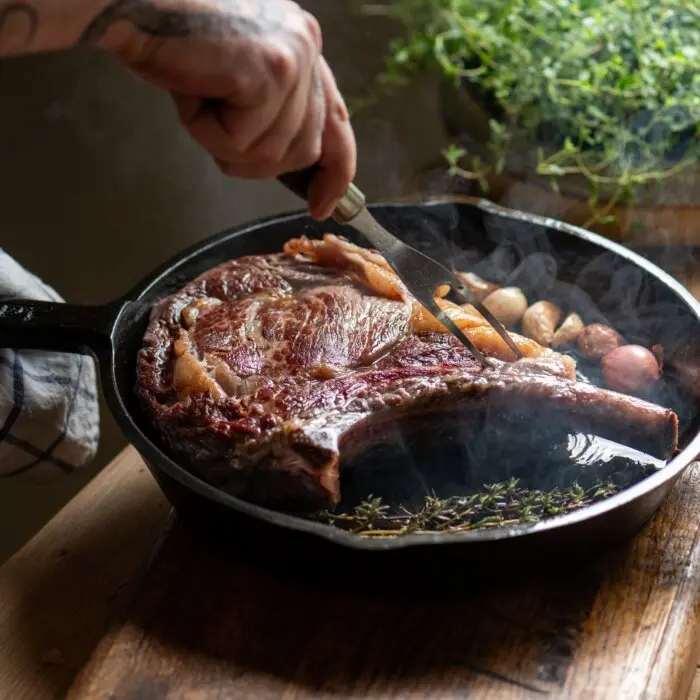
As for beef, there is a reason why Texans adore it. Look around. Land everywhere. Cows. It’s a specialty. Sure, we live in a world in which everyone can have everything, but culture and local tradition still reign supreme. This is for reasons of intergenerational habit. I cannot, for example, fathom pork ribs but love beef ribs. It’s in my DNA.
I had never been to Buda before. It’s a town outside of Austin, which has boomed into a kind of metropolis. Buda became the go-to place for those who wanted to avoid the hustle and bustle, buy a big but affordable house, and enjoy coffee with other upwardly mobile friends at hipster restaurants and shops with a country feel.
The architecture of the place is an amalgam of very old and very new. The new buildings and terrain suggest scenes from “Butch Cassidy and the Sundance Kid,” a movie I had watched only days before. There is a set of old and rusted train cars on one side of the street, likely built in the 1920s. On the other side of the street, there is a new stone wall behind which thrives a new community of large and spectacular homes.
Downtown, a packed restaurant lives inside an adobe and iron building that might have been the old jail that held cattle rustlers and bank robbers. It’s the Old West from the movies newly inhabited by 21st-century professional-class laptoppers who just want to get away from it all.
A number of features strike visitors immediately. In order, they are the following.
First, people look healthier overall, and by healthy, I mean they are normal-shaped people with a glow in their cheeks.
Second, people here are quick to smile, which can be unnerving to someone visiting for the first time, and they say things like hello and make conversation with strangers. Familiarity comes almost instantly to these nice people, and it is contagious. You pick up the habit nearly immediately. It makes life better.
Third, the driving manners are courteous and kind. If you need to merge, someone will gladly let you in the lane. That’s never happened in Connecticut for whatever reason, a place where driving is a war zone of every man for himself. As a result, the roads feel safer and more relaxing even though one frequently sees speed limits of 80.
Hanging out in Buda conveys a sense that all is right with the world. This community took on new life during the COVID-19 pandemic times, as millions fled lockdown states to Texas, with Austin as the preferred community because of its reputation for being purple rather than red, if only to lessen the culture shock to new immigrants from Washington state and New York state.
Real estate boomed in Austin. Home prices surged by 72.5 percent from March 2020 to June 2022, only to about face as the mania came to an end as interest rates rose. More supply and tighter credit prompted a 25 percent decline. Everything is still up overall, but it was a wild ride.
The community of Buda, 20 miles south of Austin, formed during these times as smart buyers decided to avoid the frenzy.
There is some deep history here. Following the Mexican–American War, the town was settled with a land grant. Following the Civil War, it became a settlement to freed slaves. As industrialism took over, it became a railroad hub to connect the larger towns in West Texas.
That’s where the name comes from, sort of. The town was called Dupre, because the postmaster said “Do, pray, give us a depot!” It worked.
Later, the name was changed to Buda at the request of the postmaster because of confusion with another town. Maybe another place prayed for a train station.
Buda is said to refer to the Spanish word for two widow cooks who obtained local fame with their cuisine.
The town boomed as a railroad hub until that came to an end with the new emphasis on cars and interstates. Now the old trains stand rotting along the roads, even to this day, even as new development is everywhere.
So yes, there is plenty of history, but it is not of the sort you find in New England with theaters, museums, farms, old factories, and large estates. Instead it is a history that seems to have skipped over half a century or more of time. It’s this smashing together of frontier town and suburban bedroom community, now with a population of only 16,000.
Despite the low population, the place is teeming with life. And it’s a good life. I get it. Friendly people. Happy people. Healthy people. Good food. Zero crime. Affordable. What’s not to like? And, after all, it is Texas, which today is surely among the happiest states.
My family was among the earliest settlers of this land, having moved from Massachusetts in 1830 seeking freedom and fortune. They found dust and desert mountains, javelinas and horned toads, a terrifying shortage of water, and an incredible mix of people from American natives to Spanish and Mexican settlers while welcoming a swath of immigrants from Germany, of all places.
They fought two wars in rapid succession and otherwise battled the elements, which were more of a challenge than Apaches or Santa Anna’s armies.
This entire section of the country cannot shake off its feeling of still being a frontier. Austin has managed to more than anywhere else, and San Antonio too to an extent, but otherwise, it still feels like the set of a Western B movie with rustlers, ranchers, saloons, and tall hats that people of all backgrounds freely wear inside bars and restaurants.
Do you see why visitors are so intrigued? I’m not exactly a new visitor, but because I have settled in New England, it is easy to forget what a special place this really is. Still, much has changed since I grew up. Toll roads are everywhere, for example, and the cost of living is far higher, even if shockingly cheaper than in Connecticut.
Back to dinner in the treehouse. I did not order the chicken-fried steak. Instead, I ordered the hamburger, which, the server pointed out, was made from brisket. Amazing. Two patties. Probably the best I’ve ever had.
My dinner partner asked what people eat in New England. In particular, he had a sense of whimsy about wanting some really great clam chowder. True, it’s good, I said, but I looked down at the chicken-fried steak that covered his entire plate, and I said not to worry. The food is just fine in these parts.