This copy is for your personal, non-commercial use only. Distribution and use of this material are governed by our Subscriber Agreement and by copyright law. For non-personal use or to order multiple copies, please contact The Epoch Times Reprints.
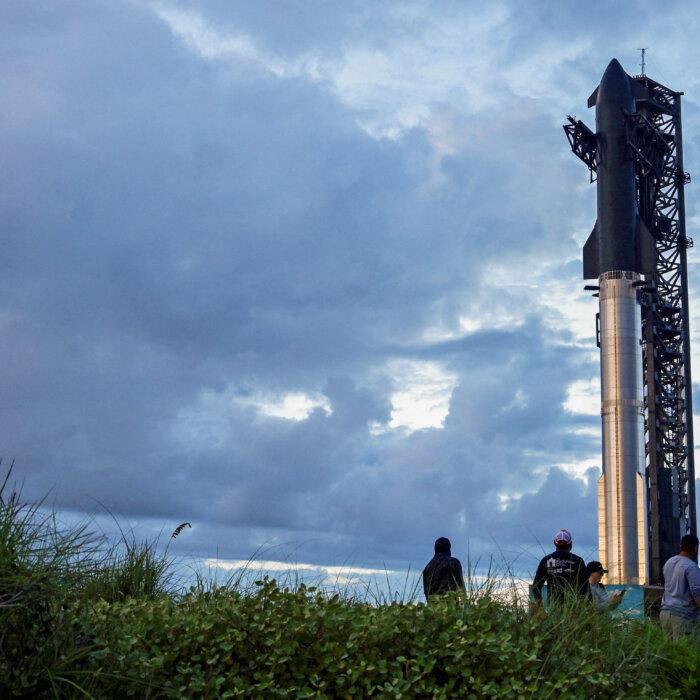
I am a longtime admirer of SpaceX and its many accomplishments. While I do not go out of my way to watch every Falcon 9 launch, I do go out of my way to watch Starship launches, and like many millions of people the world over, I was amazed and excited when the giant “Mechazilla” chopsticks at SpaceX’s Boca Chica, Texas, space center managed to grasp and secure Starship’s massive heavy booster, which had maneuvered its way to the landing/catching area with unprecedented precision. Those who follow these sorts of things have seen countless successful Falcon 9 boosters land on pillars of fire after maneuvering back to the launch site to land.
By being able to recover the boosters, SpaceX is able to reuse not only its booster fuselages but also the very expensive engines that power them.These are great leaps forward that have played a key role in reducing the cost of putting a pound of payload into space. Indeed, before SpaceX, costs of $6,400 to $12,000 per pound were typical. Space X’s Falcon Heavy has lowered that to about $1,600.
This is fantastic progress! But I must confess that I have some doubts about SpaceX plans to have manned Starships landing on pillars of fire. Certainly, it makes sense for unmanned vehicles to use this approach, as doing so has proved cost-effective. But when landing a manned spacecraft on a pillar of fire, a 99-plus percent success rate is not good enough. For example, about one in 25 million commercial airplanes making final landing approaches end in crashes with fatalities, and while surviving a crash on a commercial aircraft is unlikely, it does happen, whereas an exploding rocket is 100 percent fatal to all who are strapped in.
While improved safety measures and improvements in materials and design may be able to make pillar of fire landings safe enough, there are other space flight options that are more forgiving. First, there is the classic parachute landing. But there is also a more exciting option for returning astronauts and passengers safely to Mother Earth. That option is space planes and space shuttles.
Shuttles are designed to reenter the atmosphere with a shallow, slight angle for a long, low g-force, gentle glide,while the SpaceX Starship is designed for a steeper, more aggressive “belly flop” maneuver at about a 70-degree angle. The shallow reentry angleof a space plane puts less stress on the spacecraft. However, given the very publicized loss of 14 lives from the Challenger and the Columbia disasters, a modern space shuttle may seem risky, but major advances in thermal protection systems greatly increase the safety of space shuttle-type craft. Further, advances in composites and metal alloys mean shuttles can be made both stronger and lighter. Finally, a modern shuttle could also have reusable boosters to decrease its per pound of payload cost.
NASA’s newest thermal protection system, Advanced Lightweight TUFROC, offers substantially better protection against extreme reentry temperatures. It can withstand temperatures of up to 2,900 degrees Fahrenheit for extended period of time—up to 24 minutes—while maintaining its structural integrity. In contrast, the shuttles’ tiles would begin to soften at 2,500 degrees. It is also many times tougher than the foam tiles used on the space shuttles and much more resistant to the kind of damage that ended up destroying the Columbia. These new tougher, higher tiles, plus more than 40 years of advances in the disciplines relevant to building spacecraft, should give NASA and private sector companies the ability to build space planes many times safer than reflected by the shuttle program’s record of 133 successful missions versustwo catastrophic missions.
By not having to carry enough fuel to do a propulsive landing, a space shuttle can certainly be at least cost-competitive with Falcon 9-type systems, and its flight profile and small fuel load should allow for better overall safety when it comes to landing.
While, to date, SpaceX has decided against using a space shuttle, the U.S. military currently has a 5-ton unmanned space plane, the X-37B, that has successfully competed in at least seven missions, and its most recent mission, among other things, demonstrated its aerobraking capabilities. In the civilian sector, Sierra Space is working under a NASA contract to deliver the Dream Chaser, an unmanned spaceplane similar in appearance to the original space shuttle, but much smaller, that will deliver cargo to the International Space Station and the new space station.
To date, there are no plans to build larger space shuttles for manned flights, but their potential seems great, and it would be a shame not to pursue all viable options for manned space flight. Perhaps if Sierra Space’s Dream Chaser space plane is able to establish a solid record of profitability and safety, Sierra Space, or some other company, will decide a manned space plane makes sense.
Views expressed in this article are opinions of the author and do not necessarily reflect the views of The Epoch Times.
Mike Fredenburg writes on military technology and defense matters with an emphasis on defense reform. He holds a bachelor’s degree in mechanical engineering and master’s degree in production operations management.