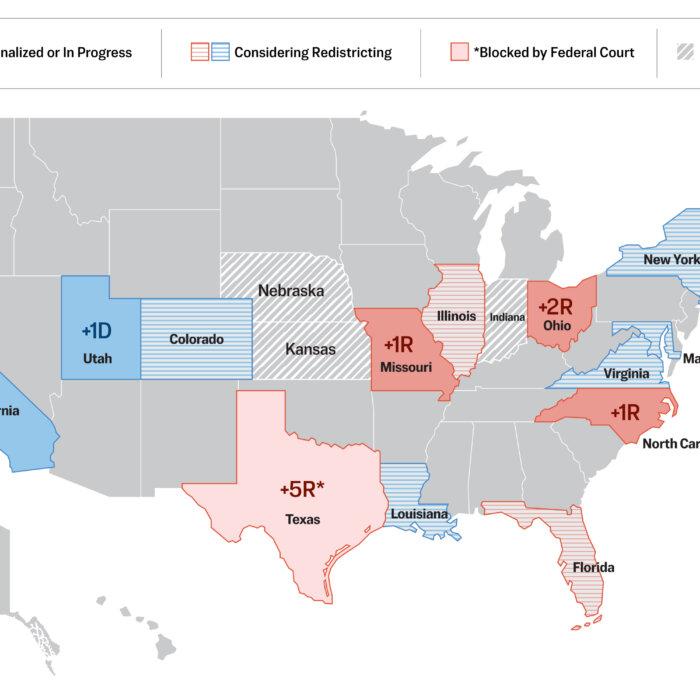
Something quietly revolutionary happened in 2025: Redistricting stopped being a decennial chore and became a permanent campaign.
The deeper reason this matters is that the United States apportions congressional seats and Electoral College votes based on total population—every resident, citizen or not, voting or not, legally present or not. A state that adds 500,000 people, by birth or border, gains political weight even if none of those newcomers ever votes.
This Didn’t Begin in 2024
The temptation is older than the republic. Before 1832, Britain kept “rotten boroughs” with a dozen voters sending members to Parliament while cities such as Manchester had none. In the United States, the word “gerrymander” dates back to 1812, when Massachusetts Gov. Elbridge Gerry approved a district so oddly shaped that a newspaper joked that it resembled a salamander.
In the 19th century, rural legislatures simply refused to redraw. Growing cities such as Chicago and New York gained hundreds of thousands of residents but didn’t gain proportional representation.
The Supreme Court ended that with three landmark rulings in the 1960s, essentially requiring that districts be drawn with roughly equal populations. But the incentive remained. By drawing district lines to concentrate one party’s voters in a few districts—or disperse them across many—partisan outcomes could still be engineered.
For much of the mid-20th century, the Democratic Party controlled a large majority of state legislatures, particularly in the South. In that era, the main redistricting strategy was delayed line-drawing.
After the Voting Rights Act of 1965, majority–minority districts were created to ensure that black voters, and later Latino voters, could elect candidates of their choice. This sometimes concentrated Democratic votes within fewer districts, which, indirectly, benefited Republicans in surrounding areas.
A decisive shift came after the 2010 census, when Republicans made state legislative control a strategic priority through REDMAP, using precision software to lock in gains. They drew maps that converted modest vote margins into stable congressional advantages in several key states. Democrats later countered with their own aggressive maps in New York, Illinois, and elsewhere once they held unified control.
Noncitizens and Birthright Citizenship
Conservative estimates suggest that 11 million to 13 million undocumented immigrants live in the United States. Less conservative estimates put the number higher. Another 12 million legal noncitizens also reside in the country, mostly concentrated in a few major metropolitan areas. Their presence already shifts House seats and electoral votes from low-immigration states to high-immigration ones. The effect compounds. Every policy that adds or subtracts long-term residents thus redraws the electoral map—even before a single district line moves.That’s why immigration and representation now appear inseparable. Looser enforcement, amnesty, Deferred Action for Childhood Arrivals protections, or an expansive reading of birthright citizenship all increase population baselines in blue-leaning metros—and thus their congressional delegations. Stricter enforcement, mass deportation, or self-deportation have the opposite effect. At present, Democrats tend to represent areas that gain from counting everyone; Republicans tend to represent areas that lose. It’s arithmetic.
2 Layers at Once
None of this is new—and none of it is necessarily conspiratorial. It’s structural. Redistricting is first a matter of housekeeping—people move, maps must follow—and is also a matter of power. The hand that draws the lines can extend its grip on office. Those truths ride together in every decision.The same double nature runs through immigration, residency, and birthright citizenship. Each carries moral weight—and each carries structural consequences. A policy that counts more people helps one side. A policy that counts fewer helps the other. The effects are almost impossible to unwind.
Seeing both layers doesn’t require cynicism—it requires clarity. We can defend birthright citizenship out of deep conviction and still acknowledge that it shifts seats. We can oppose it out of concern for long-term incentives and still recognize the political consequences. Pretending that only one layer exists is the real cynicism.
These debates persist because the stakes are real—both moral and political—and neither side can wish away the other layer. Our task is to face both levels honestly, weigh the costs, and decide where we stand, knowing what it will cost and whom it will reward. That is how citizens move from argument to discernment.