



The idea that people have an unalienable right to pursue their own happiness is a very radical idea. Before the 18th century, almost no one in the world believed it. Even today, only a small sliver of humankind agrees with it.
Equally radical is the idea that the only purpose of government is to protect that right. We can quibble about some of the details, but the central idea is unequivocal. If you and I both have the right to pursue our own happiness, it would be wrong for a government to impose burdens on you just to make me happier.
Critics of this political philosophy invariably note that some of the authors of the Declaration of Independence owned slaves. But remember, just about everyone else in the world at the time thought that there was no such thing as an individual right. In recognizing that some people had rights, the Founders opened a door that would inevitably extend to everyone else.
A Radical Declaration: All Men Are Created Equal
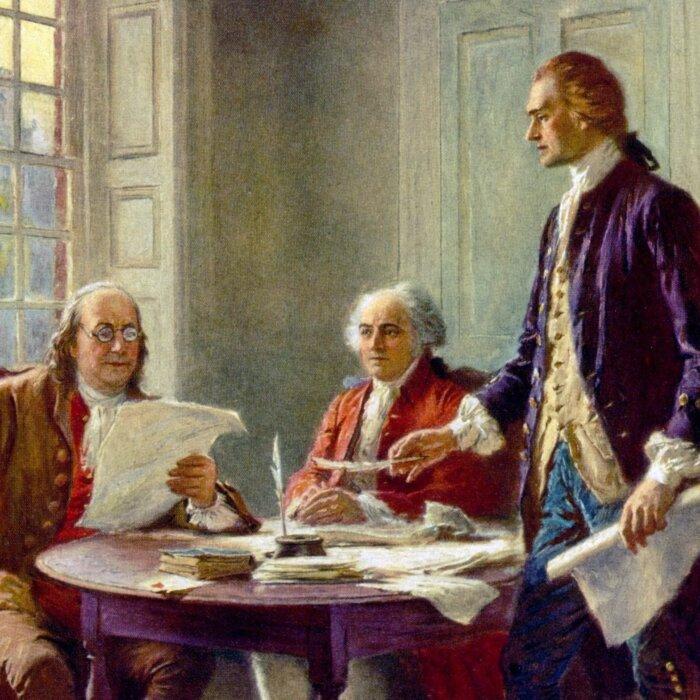
The Declaration of Independence was written at a time when the world was undergoing two major changes—both of which made the Declaration possible.One major change was intellectual: a radical shift in thinking about the relationship of human beings to one another. Today, it is called The Enlightenment or the Age of Reason. In place of domination by the Church or the state (empire or monarchy), Enlightenment thinking held that human beings were independent moral entities who should deal with one another on the basis of reason, persuasion, and voluntary exchange.

The other major change was economic.
Before the 18th century, most people in most places could probably not have survived under the political arrangement envisioned by the Declaration of Independence.
Think about a troop of soldiers on a military mission. If each one pursued his own happiness, the mission would never be achieved.
Cultural rites and rituals celebrated self-sacrifice—heroism in battle, risk-taking in the pursuit of large game, diligence in gathering food, and other cooperative duties. People were encouraged to think of the entire tribe as extended kin. Other tribal inhabitants were seen as family, not parties to exchange. Outsiders were enemies.
In time, the tribal life that dominated human existence for more than 200,000 years began to give way to the marketplace.
People began to view strangers in other communities as trading partners rather than military adversaries. Specialization and trade began to link people who lived in distant places. Tribes grew into cities, and specialization and trade replaced kinship relations in local communities as well.
In the communities populated by our distant ancestors, an individual could do the most good for others around him by sacrificing his own self-interest to the whole group. In an interconnected marketplace, an individual could do the most good for the most others by pursuing his own self-interest, providing something others wanted to buy.
The Pursuit of the Pursuit of Happiness
The Constitution that embodied the spirit of the Declaration of Independence placed restrictions on the federal government but placed no such constraints on state and local governments. Rights guaranteed under federal law were increasingly seen as appropriate under state and local governments as well, after the Civil War. The Supreme Court and evolving popular opinion rapidly expanded the ideals of the Declaration to more residents of the nation. The rights of black men to vote, and later of all women to vote, were eventually recognized.Even so, as we approach the Declaration’s 250th birthday, it is helpful to think about which subsequent policy shifts were consistent with its underlying vision, and which were not.
When Government Blocks Your Pursuit of Happiness
When it comes to the role of government in protecting our pursuit of happiness, history is a public policy roller coaster.Beginning in the Jimmy Carter era, deregulation helped undo some of the special-interest harm—much of it stemming from the administration of Franklin Roosevelt. And we are lucky that the Roosevelt era wasn’t even worse.
Reclaiming the Promise of the Declaration
Political change is hard. But acknowledging the meaning of the Declaration and honoring its creators should not be hard.In 1776, few people anywhere in the world believed anyone had an essential right to life, liberty, or the pursuit of happiness that his government was bound to honor. Fewer still were ready to die for that belief.
When the Founders first asserted the existence of individual rights—while it’s true they didn’t include everyone they should have—they were challenging what everyone else thought, and at great cost. For this, even as we acknowledge their failings, we owe them a great deal of gratitude. In opening the door for themselves, the Founding Fathers ultimately opened it for everyone else.
To honor the real spirit of the Declaration, a public policy inventory is long overdue. So much of our government actions neither protect individual rights nor promote the general welfare. We could honor the Declaration by scuttling them.