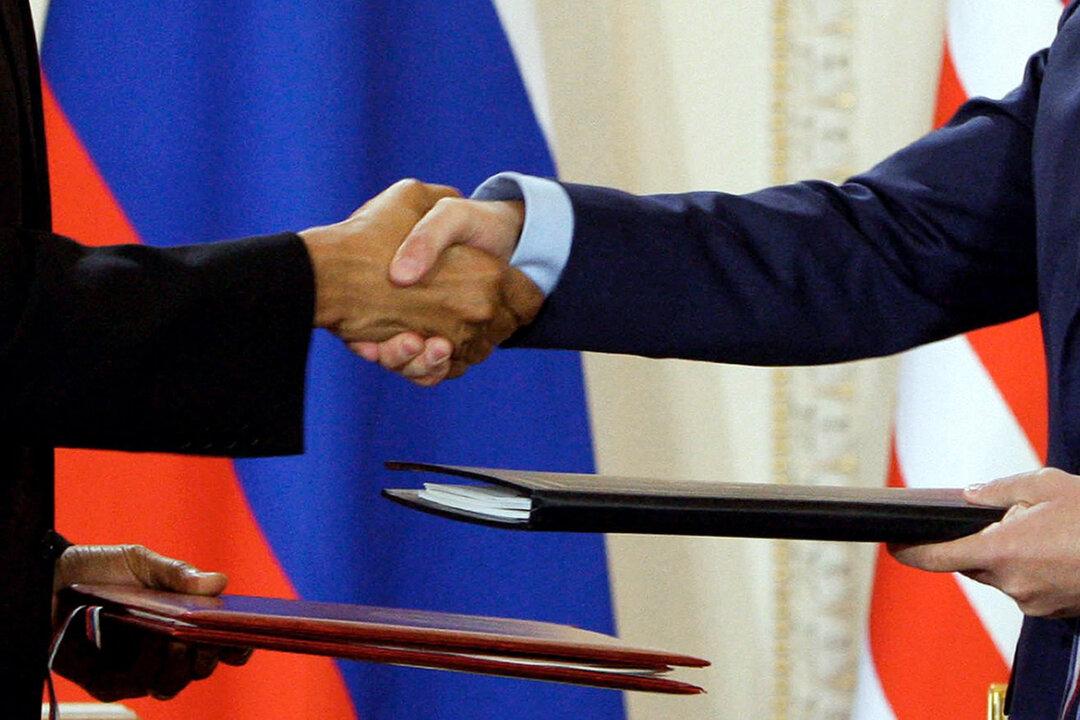
With the expiration of the Strategic Arms Reduction Treaty (START) series of arms control agreements, the United States now faces serious choices, particularly regarding how to respond to the emergence of two peer nuclear adversaries. This is especially true because the current nuclear modernization program of record was agreed to in 2010, when the nuclear balance was far more benign. Looking to the future, people across the political spectrum see a nuclear environment with storm clouds ahead. However, there is a serious divide regarding what the United States should do. As a result, the nation will soon have some difficult choices to make.
In 1981, the United States faced a similar crossroads. Would détente continue, along with a nuclear freeze of very large nuclear arsenals, modernized in the USSR but lacking in the United States? Or alternatively, would the United States and the West secure major nuclear reductions while modernizing and adopt a peace through strength strategy as a pathway to dismantle the Soviet empire?
By 1991, the latter option won out. Strategic long-range nuclear forces were projected to come down by more than 80 percent through a series of START arms agreements. Miraculously, the Soviet Union collapsed, and all of Eastern Europe was freed. But despite this extraordinary victory, the United States assumed that it was the end of history, and that all enemies were gone and would not emerge. And consequently, we took a subsequent interim 40-year holiday from nuclear sustainment.
The United States now faces the challenge of simultaneously sustaining and modernizing the entirety of the nuclear deterrent.
So, like 1981, the United States and the West face another crossroads: Either seek further nuclear reductions toward zero or abolition, while significantly curtailing nuclear modernization; or, alternatively, accelerate and enhance both nuclear modernization and sustainment, while once again adopting a strategy of peace through strength—but now to take down the hegemonic aspirations of the Chinese Communist Party.
Both options are relatively well spelled out by proponents, but they rely on very different assumptions.
Like the advocates of the nuclear freeze, abolitionists think that nuclear deterrence is bound to fail. And although nuclear deterrence has worked since the dawn of the nuclear age, it will not be useful if deterrence breaks down. A key assumption underlines this new belief: If one or even a few nuclear weapons are used in retaliation, the odds are that nearly all other nuclear weapons will subsequently be used, as escalation will take over. Thus, there is no capability to “use” nuclear weapons and survive.
Since the 2023 movie “Oppenheimer,” the abolition folks have brought forward a new twist on what is or is not possible for deterrence. As Annie Jacobsen’s book “Nuclear War: A Scenario” and the 2025 movie “A House of Dynamite” conclude, nuclear deterrence will someday not work, and war will break out. And the assumption is that the U.S. military will “jam up” the American president to retaliate “all-in.” The only alternative is nuclear abolition.
To get there, House Armed Services Committee members Reps. Ro Khanna (D-Calif.) and John Garamendi (D-Calif.) and Senate Armed Services Committee members Sens. Ed Markey (D-Mass.) and Elizabeth Warren (D-Mass.) have joined with Sen. Bernie Sanders (I-Vt.) to propose a unilateral cut of U.S. nuclear forces to 150 intercontinental ballistic missiles (ICBMs) from 400, to four strategic submarines from 12, and to zero nuclear-capable bombers from 60. The implied force is between 300 to 500 strategic warheads, compared with the New START-allowed 1,550 to 1,850 warheads, which is the current force of choice.
On the other hand, there is an option one might describe as “Record Plus.” In 2010, Congress strongly supported a modernized force of 12 submarines, 400 ICBMs, and 60 B2 and B52 strategic bombers for the U.S. strategic nuclear force. Funding for such modernization has generally been approved and is projected to cost $450 billion over the next decade. This was a force consistent with the limits of the 2010 New START nuclear treaty that expired earlier this year. What has yet to be decided is how much more nuclear capability the United States needs as generally recommended by the 2023 Commission on the U.S. Strategic Posture.
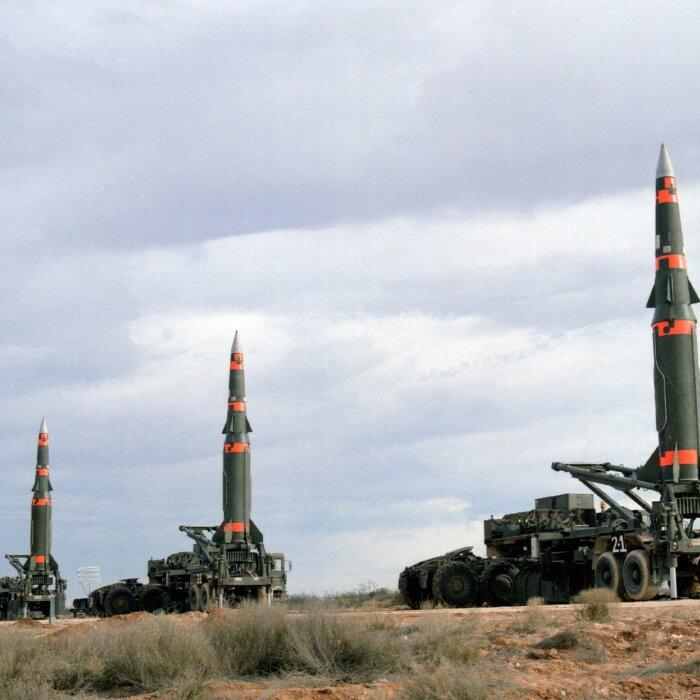
The choices are relatively straightforward. The United States needs theater or short-range nuclear forces such as sea- and land-launched cruise missiles, and such development funding has now been approved. The United States could add to the existing silo-based and submarine-based missiles we already have in the legacy nuclear forces or add to the planned new nuclear forces.
Each silo-based ICBM can add upward of two warheads. The upload process allows three missiles per ICBM wing per month or 44 months, while sub warheads can be added much faster. Other buildups could be an additional three to four submarines, but that could probably only be done at the end of the current acquisition schedule, with such submarines being acquired from 2041 to 2044. The new B21 Raider is now undergoing flight testing, and there is general consensus that the United States needs not 100 but 175 to 200 more nuclear-capable strategic bombers, with Northrop Grumman having committed to accelerate such new acquisition.
However, there is a major new concern as the United States moves forward on modernization. In April 1999, Russian President Boris Yeltsin, in a secret decree, ordered the development of thousands of short-range, low-yield, “battlefield” nuclear weapons that Russia could use to win a nuclear conflict. One recent study determined that Russian micro-testing of very low-yield, strategic long-range weapons could attack all 400 U.S. silo-based ICBMs and cause less than 10,000 casualties, making a U.S. retaliatory response less than certain.
Now the current U.S. retaliatory deterrent strategy is to destroy an enemy’s leadership and its supportive security forces along with its remaining nuclear weapons and industry support. The rationale is simple: threaten to take away those things the bad guys value. Chinese leader Mao Zedong once casually dismissed the consequences of nuclear war with the United States, declaring that Chinese women would, in a generation, make up for the loss of a few hundred million people. He hardly cared for his own people, having killed some 65 million to sustain power.
To abolitionists, such a U.S. strategy is illogical, as they assume that such a strategy is “warfighting” and not winnable. In the two movies and one book referenced earlier, some of the abolitionists are pushing to jettison current U.S. nuclear deterrent strategy altogether as unworkable. But what does the United States do for a deterrent strategy on the long road toward nuclear abolition? How does one deter bad guys brandishing nuclear weapons before their hoped-for abolition? How do you still deter on the way toward abolition?
Jacobsen was asked just this question, but she explained that she would drop her explicit support for abolition and let other “experts” figure it out. The movie “House of Dynamite” took both deterrence by retaliation off the table and missile defense to intercept an attack in the first place. The movie assumed that missile defense—even against a single warhead—would not work. And not knowing where the missile originated, the United States had to guess—retaliate against everyone, as one military officer proposed, or do nothing.
Yeltsin’s 1999 decree is being implemented. And since the invasion of Ukraine in 2014, Moscow has threatened to use nuclear weapons against Ukraine and its allies dozens of times. Many have assumed that such nuclear strikes would involve the very battlefield nuclear forces called for in Yeltsin’s 1999 decree.
Critics of such weapons say there is no consequential difference between using a regional/theater/battlefield nuclear weapon with a minimal yield and a long-range strategic nuclear warhead of many hundreds of kilotons. Any such weapon use will result in Armageddon.
That may indeed be true.
But Moscow and Beijing may not believe so and thus would be reckless enough to use such weapons. The United States and its allies must defend against this and deter such use. That may take a sea-launched nuclear-armed cruise missile and a robust missile defense, such as Golden Dome or any number of new technologies and strategies—but probably not unilateral restraint that does not take such threats seriously in the first place.