On Dec. 22, President Donald Trump announced plans to design and build a new class of large surface combatants—dubbed the “Trump-class battleships.”
Railguns Sound Impressive, but ...
Railguns promise muzzle velocities exceeding Mach 7 and ranges of more than 100 nautical miles using inexpensive kinetic projectiles. While this may sound promising, efforts to incorporate railguns into the Trump-class would likely delay construction and deployment indefinitely.The Navy Has Already Tried
Between 2005 and 2021, the Navy spent more than $500 million attempting to develop an operational railgun. The program was canceled in 2021 after failing to produce a viable system.Why the Railgun Program Failed
The railgun faced several insurmountable scientific and engineering hurdles:- Massive electromagnetic forces quickly eroded the guns’ rails, limiting their lifespan to mere dozens of full-power shots.
- Acceleration exceeding 40,000 g destroyed on-board guidance systems.
- Gigawatt-scale power requirements demanded enormous capacitor banks, which degraded quickly and consumed impractical amounts of space and cooling.
- Repetitive firing rates were never achieved.
- Integration on power-constrained ships proved impossible.
- Hypersonic drag reduced terminal effectiveness, making kinetic-only rounds less destructive than conventional explosive shells.
Have Other Nations Succeeded?
China, Japan, and India continue exploring railgun technology, but none has produced a viable naval railgun. Some engineering advances have been made, but the core scientific challenges remain.Comparative Performance: Railguns Versus Conventional Naval Guns
Even assuming the railgun’s technical hurdles were solved, its performance per ton of displacement is vastly inferior to existing alternatives.- A modern Mk 45 5-inch naval gun mount weighs only 25 to 30 tons and delivers high rates of fire with explosive payloads.
- A 1940s-era Mk 7 16-inch gun, as found on Iowa-class battleships, weighed about 575 tons (including heavy armor and below-deck systems). It delivered 410 to 470 MJ of destructive energy per shot.
- By contrast, a 32 MJ railgun delivers approximately 20 MJ of retained kinetic energy after atmospheric drag, with no explosive payload.
Size and Weight: A Design Liability
The unarmored turret and railgun barrel (including rails, containment, and controls) weigh between 60 and 80 tons. Below-deck systems—power supply, capacitors, cooling, and ammunition handling—add another 300 to 400 tons.- An Mk 45 mount totals roughly 30 tons.
- An Iowa-class triple turret averaged roughly 575 tons but delivered vastly superior firepower.
Range and Targeting Limitations
Despite claims of 100-plus-mile ranges, railgun projectiles lose energy rapidly because of drag. Worse still, they perform poorly at mid-range distances (five to 20 miles).- Flat trajectories overshoot close-in targets.
- High-arching trajectories take several minutes to arrive, allowing adversaries to maneuver.
- Current railgun designs lack guidance systems that can survive launch conditions.
Strategic Recommendation: Avoid the Railgun Trap
This is not necessarily an argument for reviving big-caliber guns. Rather, it is a call to avoid the illusion that railguns are a revolutionary leap forward.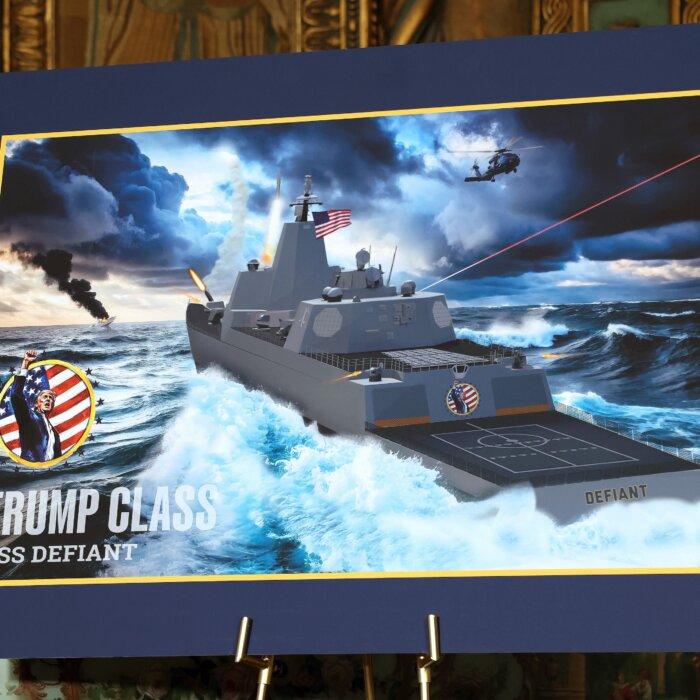

Absent a scientific breakthrough, railguns remain impractical. Even with such a breakthrough, the system’s size and weight would severely reduce the ship’s effectiveness compared with a mix of small, medium, and large conventional guns—alongside newer technologies such as advanced light-gas guns.
Rather than waste billions of dollars chasing uncertain railgun technology, the Trump-class should prioritize mature systems capable of supporting missile defense, anti-drone swarms, shore bombardment, and surface warfare.
Doing so would greatly increase the likelihood of these ships being built, deployed, and delivering tangible battlefield advantages.