The student is an unapologetic Mao-inspired revolutionary who is for more “political assassinations” and against free speech for “reactionaries” and “capitalists.” She wants “some people” to “be afraid to express their opinion in public.”
In a college course, she was taught “how violent revolution liberated millions of people and liberated women” in Mao’s China.
If the Oberlin woman, invincibly smug and ignorant, had attended a Kirk event, it’s likely she would not have been moved to reconsider her position. But consider the following facts that Kirk might have shared with her if she had asked him a question about China.
Perhaps that Oberlin student sees the destruction of the family as a worthy goal.
Because of collectivization and widespread starvation in Mao’s China, Becker wrote, “Women were forced to yoke themselves to the plough with their wombs hanging down, such was the shortage of draught animals.”
If “liberation” means granting some people arbitrary power to inflict fear and terror, then, under Mao, some women were powerful.
Becker wrote, “A 20-year-old girl, Huang Xiu Lian, who was president of the commune’s Women’s Association, cut off the ears of four people.”
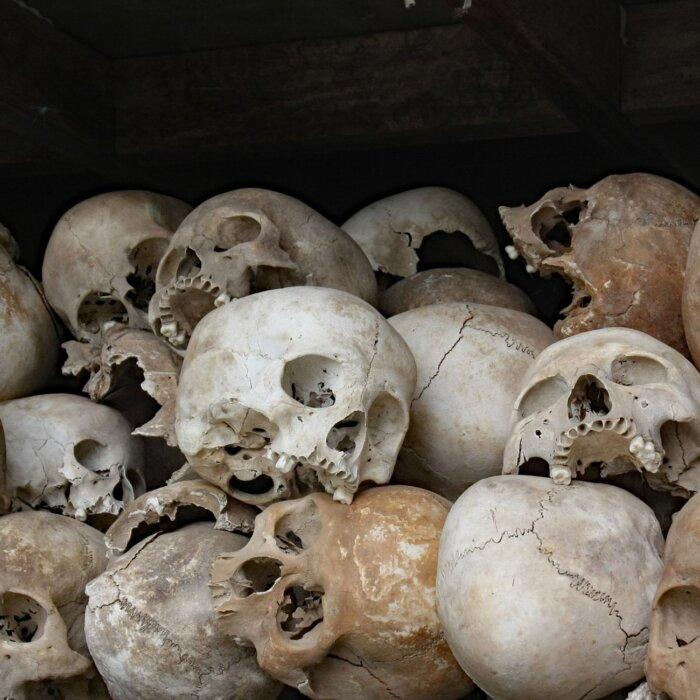
Mao starved millions of people, and survivors became slave labor in communist plantations.
Becker wrote that so many starved to death that “few of the bodies were buried.” Instead, according to him, “Many simply lay down at home and died.”
Maternal instincts were destroyed. Some mothers kept hidden stores of food from their children, fearing that their children would reveal the food to authorities.
Unlimited power leads to sexual violence, and women were defenseless. According to Becker, Mao’s liberation meant that “women were humiliated by having sticks inserted into their genitals.”
Dikötter recorded that “pregnant women who did not appear at work were made to undress in the middle of the winter and then forced to break ice.” Miscarriages while working were common.
Among Party officials, Dikötter wrote, “Rape spread like a contagion through a distressed moral landscape.” One official had “‘taken liberties’ with almost every unmarried woman in the village.”
Dikötter wrote: “[In the cities], for a ration coupon worth ten or twenty cents or for a pound of rice, they would perform a sexual favour in a quiet corner of a public park. Those who failed faced starvation.”
Dikötter wrote: “[At one factory], local bosses forced women to work naked. On a single day in November 1958, more than 300 went about their jobs in the nude. Those who refused were tied up.” The bosses claimed that they were breaking “feudal taboos.”
Becker shared eyewitness reports of dissident Wei Jingsheng. While traveling as a Red Guard, Jingsheng “was shocked to see starving and naked women and children begging for food in every railway station.” A cadre on the train dismissed the humanity of those starving, saying they were “former landlords and rich peasants, or just lazy, and that it did them good to be hungry.”
Like the cadre, the Oberlin student probably won’t see the humanity of others anytime soon.
As Dikötter observed, “Seemingly anything could be justified in the name of emancipation.”
What can we learn about why so many people today hold dearly to opinions that are contrary to facts and reason?
Yet almost three centuries later, Hume’s insights are not widely understood by the public. We can understand why. It seems to us that we come to our decisions most often through deliberate rational thinking; it’s the other person, not us, who is foolish. We prefer to think that we are the captains of our lives, exercising free will through our rationality. Challenges to our belief in our rationality make us very uncomfortable.
So, where does this leave those of us trying to defend liberty against the onslaught of people possessed by illiberal passions?
Read offered a useful analogy to high and low pressure in weather patterns, in which low pressure brings on storms and high pressure restrains lows.
He wrote, “In the heat of emotion or battle, individuals tend to create low pressure areas.
We can’t control the weather. Among people of little understanding, new low-pressure areas will form every day. Yet with the strength of our understanding, we can create high-pressure areas to block illiberal societal passions.
Read cautioned, “Bad ideas cannot be made more sensible by combating those who voice them.” Read advocated for “perfection of self-understanding as against reforming others—the former possible, the latter futile.”
Our purpose, Read explained, “is to grow in awareness, perception, consciousness.”
Liberty’s greatest threat comes from a lack of respect for the humanity of others and passions unchecked by reason. Only by cultivating self-understanding can individuals resist the allure of destructive ideologies. The real battle for liberty is taking place daily in the trenches of our own minds.