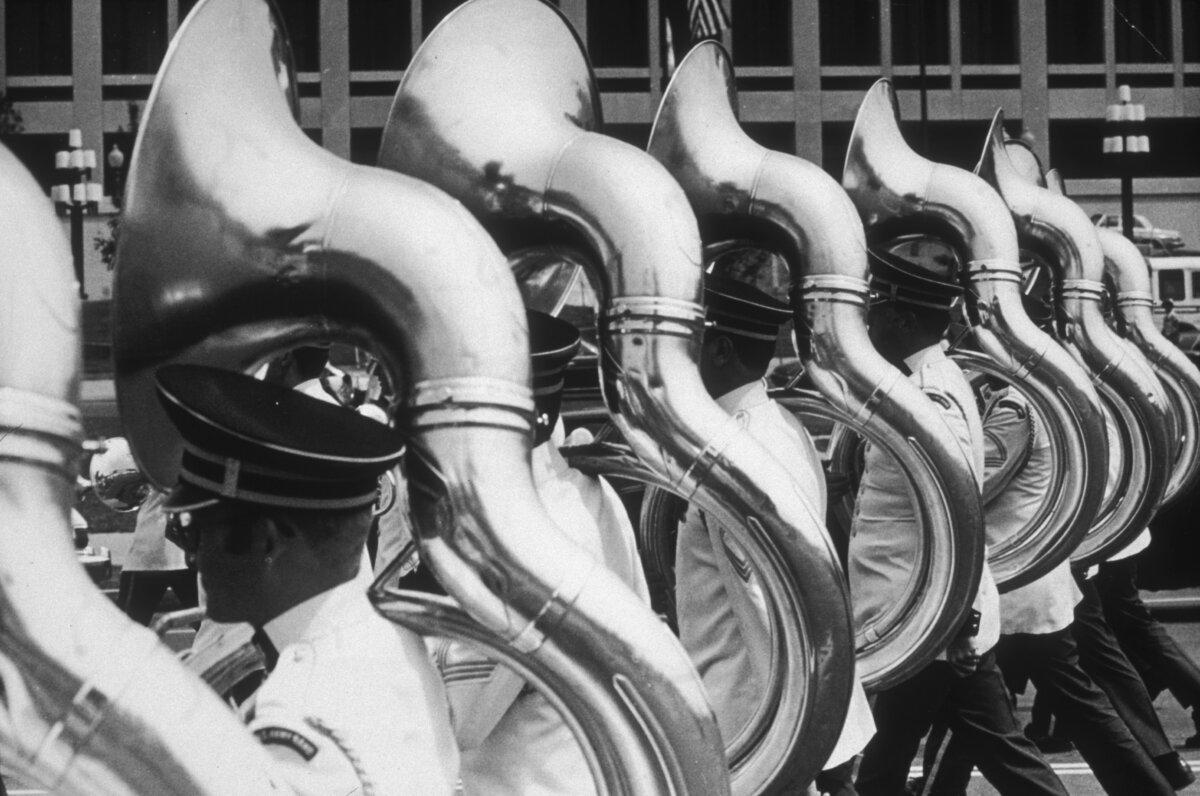
We’ve heard many renderings of “Stars and Stripes Forever” this season. But not enough is said of its brilliant composer. His name was John Philip Sousa. There is even an instrument named after him, the sousaphone—that big, bold tuba on the marching field with the giant bell and tubes that wrap around the body like a musical hug for the player.
Sousa gave America its sound. It is heard in every parade. It is commonly featured in halftime shows. It appears in commercials. He was the undisputed master of the march, a thrilling genre and a genuine American original. As a melodist, he was as endlessly creative as Haydn or Mozart. His brain seemed to manufacture one unforgettable tune after another, each one bursting with energy, precision, and pure joy.
They all belong to the American experience, played any time we want to feel that special lift in the chest that says, “This is our country.”
Born on Nov. 6, 1854, in Washington, just steps from the Marine Barracks, Sousa grew up surrounded by music and military tradition. His father, Antonio, a Portuguese immigrant, played trombone in the U.S. Marine Band. His mother was German. Young John Philip started violin lessons at age 6 and quickly mastered a whole arsenal of instruments.
By 13, he had enlisted as an apprentice in the Marine Band himself, the same group in which his father served.

He left for a time to play violin in theaters and orchestras, but in 1880 he returned as the 17th director of “The President’s Own” U.S. Marine Band. Under his leadership, it became a precision powerhouse, performing for presidents from Hayes to Harrison. But Sousa’s ambition was bigger. In 1892, he formed his own civilian band—a virtuoso ensemble that could handle both military marches and symphonic works with equal flair. They toured America relentlessly and took Europe by storm. Sousa even led a world tour in 1910–1911.
He was the man who made the wind band the sound of our civic life.
He composed more than a hundred marches, including enduring classics such as “Semper Fidelis” (the official march of the Marine Corps), “The Washington Post,” “The Liberty Bell,” and, of course, “The Stars and Stripes Forever.”
That masterpiece has a special story. Sousa composed it in late 1896 while sailing home from Europe aboard the SS Teutonic. He had received word that his band manager had died, and the homesick composer paced the decks with a “mental band” playing in his head. The melody came to him fully formed—born from a deep love of America, memories of the flag flying over the White House, and the contrast he felt between foreign lands and home. He finished the piece soon after landing, and it premiered in May 1897.
Its timing was perfect. Just months later, in April 1898, the Spanish–American War erupted. America was suddenly in a fighting mood—victorious in Cuba and the Philippines, flexing its muscles as a rising world power.
“The Stars and Stripes Forever” exploded in popularity as the perfect soundtrack for that moment. It wasn’t written about the war, but it captured the patriotic fire the nation needed right then.
Sousa used it to powerful effect in his pageants and concerts, and it helped rally the public spirit like few other pieces could. The march became forever linked with American confidence and military pride in that era. It is still so linked today.
Crucially, the music was not composed for wartime. It was composed for an audience’s delight. It just so happened to fit the sound needed to rally a war-weary people around an implausible adventure, one that was mercifully short.
What made Sousa a genius wasn’t just technical skill. It was his gift for melody that felt instantly familiar yet fresh, rhythms that made you want to step in time, and structures that built to rousing, hair-raising finales. His marches weren’t stiff or stuffy; they swung with life. They captured the optimism, discipline, and exuberance of a young, confident nation.
He even helped shape the sound of marching bands by working with instrument makers. Dissatisfied with existing bass instruments, he inspired the creation of the sousaphone in about 1893 (first built by J.W. Pepper), designed so the big bell could project sound forward and upward—perfect for the field and the stands.
Sousa lived a full life: husband, father, patriot who rejoined the military during World War I in the Naval Reserve. He kept conducting almost until the end. On March 6, 1932, at age 77, he passed away in Reading, Pennsylvania, right after rehearsing with a band. Fittingly, the last piece they ran through was “The Stars and Stripes Forever.”
His body lay in state at the Marine Barracks in Washington, honored by Marines, sailors, and musicians. But his real monument is the music itself. Every time a band strikes up one of his marches, Sousa comes alive again—lifting spirits, straightening backs, and reminding us what American energy sounds like.
We owe him a debt. In an age of noise and distraction, Sousa gave us clarity, pride, and joy in perfect 2/4 time. He didn’t just compose marches. He marched the American soul forward. And we’re still stepping to his beat.
We think of distinctly American forms of music. We hear about folk music. We talk of ragtime and jazz. We love dance bands of the ’30s and ’40s. Rock and roll changed popular music forever in the 1950s. And there is Broadway too and Hollywood musicals. All those are great.
Let’s not leave out from this litany the march and its composing master. He was an American original, and his music is also. It’s the sound of a free citizenry, whether in peace or war. Every time we hear this material, we feel it and know it.
On a personal note, I’ve played his marches many times as a trombone player. They are extremely difficult, challenging even for the best players to get right. This man knew his brass instruments well and set up a high bar for mastery. Good man, great music, wonderful tradition. Let’s keep it alive, shall we?