
Does anyone wonder why China leads the world in advanced, AI-driven, human-like robot production when it has such a huge workforce?
Vanishing Children
Across China, kindergartens are closing because there aren’t enough students. Elementary schools are merging. Universities are competing for shrinking graduating classes. Entire provinces are reporting fewer births year after year, while nursing homes expand faster than maternity wards.A Crisis Decades in the Making
The demographic crisis confronting China was not created overnight, nor can it be solved simply by encouraging couples to have more children.It’s the cumulative result of decades of government social engineering, an economy increasingly constrained by state control, soaring housing costs, declining economic confidence, and a generation that has largely stopped believing tomorrow will be better than today.
The numbers are staggering.

Now China Can’t Replace Itself
Even before the nationwide one-child policy officially began in 1980, aggressive family-planning campaigns during the 1970s had already pushed fertility sharply downward.By the early 1990s, China had fallen below the replacement rate of 2.1 children per woman. Today, most international estimates place China’s fertility rate between roughly 1.0 and 1.2 children per woman—among the world’s lowest.
The CCP Made Human Beings, Marriage and Children Liabilities
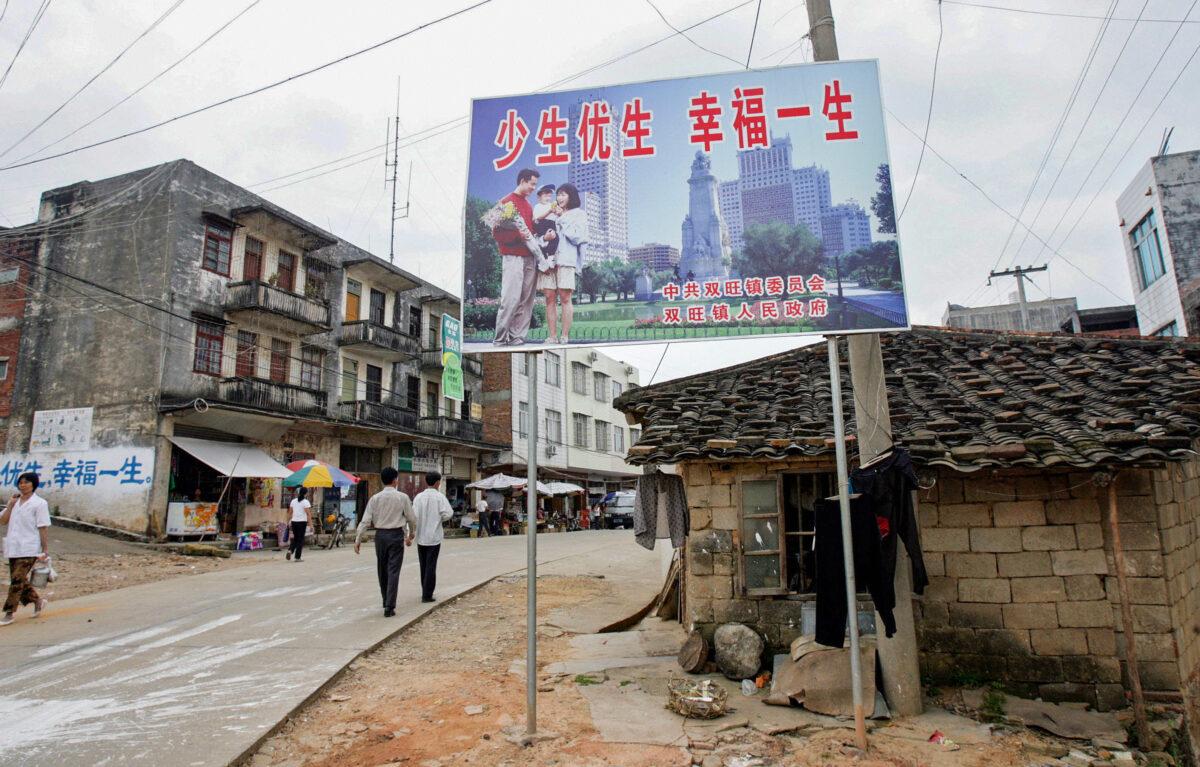
This collapse did not happen in a vacuum.For more than three decades, the CCP used extraordinary measures to reduce birth rates. The one-child policy included heavy financial penalties, employment consequences, forced abortions, forced sterilizations, and extensive government monitoring of reproductive decisions.
While China’s population growth slowed dramatically, the policy also permanently changed how multiple generations viewed marriage, family, and parenthood.
CCP Economic Policies Reinforced That View
China’s state-directed real estate market became the primary store of household wealth, with local governments relying heavily on land sales to finance spending. Housing prices climbed far faster than incomes in many cities, making home ownership an unofficial prerequisite for marriage.Meanwhile, raising children became extraordinarily expensive. Families faced escalating costs for education, tutoring, childcare, healthcare, and housing near desirable schools.
Although Beijing has attempted to restrict private tutoring and reduce educational pressure, the financial burden remains substantial.
The CCP’s Warped Economy Shaping New Cultural Pressures
Years of top-down corruption and market distortions have left the economy unbalanced and dysfunctional. Regulatory crackdowns on technology companies, mounting debt in the property sector, slowing growth, and weak consumer confidence left many young adults questioning whether they could afford either marriage or children.Independent economists continue to identify youth employment as one of China’s most persistent economic challenges.
Out of these pressures emerged two defining cultural movements among younger Chinese.
“Tang Ping,” or “lying flat,” rejects the relentless pursuit of a career, marriage, homeownership, and children. A related movement known as “Bailan,” often translated as “let it rot,” reflects an even deeper sense of resignation that hard work no longer guarantees opportunity.
The CCP Is the Problem, Not the Solution
The CCP has recognized the problem but has struggled to reverse it.After ending the one-child policy in 2015, Beijing introduced a two-child policy and later expanded it to a three-child policy in 2021.
It isn’t working.
Provincial governments now offer tax incentives, housing subsidies, childcare assistance, extended parental leave, and direct cash payments for newborns.
Yet births continue to fall.
China recorded approximately 9.56 million births in 2022 and about 9.02 million in 2023, while the country’s population declined for the first time in consecutive years in decades.
The reasons for this are clear.
Government permission to have three children does not make raising three children affordable.
Is China’s Population Crash Underreported?
Another question increasingly raised by independent demographers concerns the accuracy of China’s official population figures.Several researchers have argued that China’s true population may be tens of millions lower than official estimates suggest, citing discrepancies among census data, school enrollment figures, household registrations, and birth statistics.
Other respected demographers caution that China’s population remains extraordinarily difficult to measure precisely and that revisions are common after major censuses.
Has Beijing intentionally inflated its population figures?
It’s hard to know, but official demographic statistics serve political and economic interests.
China Is Growing Older Before Growing Richer
In any case, the broader trajectory is no longer in doubt: China is growing older before it grows richer.The workforce will continue shrinking. Pension obligations will increase. Healthcare systems will face mounting pressure. Manufacturing competitiveness will become more difficult to sustain. Economic growth will increasingly rely on productivity gains rather than labor-force expansion.
A Childless Future?
The CCP spent decades convincing its citizens that having fewer children was patriotic, responsible, and necessary. It succeeded beyond expectation.Now, it is asking those same citizens to reverse course—precisely at the moment when economic uncertainty, high living costs, and declining optimism make family formation less attractive than ever.
Of course, in the years to come, this reality will shape China’s economy, military capability, and global influence, perhaps even the survival of the CCP.
A government powerful enough to shape a nation’s reproductive choices for 40 years has discovered that it cannot easily persuade people to dream bigger than the future they believe awaits them.